

The idea in plain English
Plain idea
What changes
Intelligence is the ability to learn, predict, adapt, and solve problems; consciousness is the presence of felt experience—a point of view from inside the process.
Mechanism
How it operates
Many perceptual and motor systems classify signals and select actions before conscious awareness catches up. Conscious processing may integrate information, simulate alternatives, and report reasons, but successful behavior alone cannot reveal whether experience accompanies it.
Human stakes
Why it matters
Separating competence from experience changes how we recognize minds, assign moral status, and trust capable systems. A nonconscious intelligence might outperform us without suffering, while a conscious being might deserve care even when it performs poorly.
Used in: 4 catalog novels
Related: Artificial intelligence · Machine consciousness · Posthuman identity
A few terms make the rest of the explanation easier to follow.
- Intelligence
- The capacity to learn, predict, adapt, plan, or solve problems effectively in some environment.
- Consciousness
- Subjective experience: the presence of sensations, feelings, or a point of view for the system itself.
- Metacognition
- A system's ability to monitor uncertainty, confidence, errors, or limits in its own processing.
Use the idea while reading
Turn the definition into three observations
Do not begin by asking whether a novel is “about” consciousness and intelligence. Begin with what changes in the lives of its characters, then use the concept to explain the mechanism underneath that change.
- 01
Notice a system performs better than it can explain its own method.
- 02
Notice complex action occurs before or without conscious report.
- 03
Notice characters treat fluent behavior as proof of an inner observer.
Keep one question open: What evidence does the story offer for experience rather than competence?
Avoid the shortcut: Acting intelligently does not prove consciousness, and acting without conscious access does not mean no information was processed. Performance and experience are different questions requiring different evidence.
How it works, step by step
- 1
Separate task success from experience
Begin by measuring what the system can discriminate, remember, predict, or control. None of those achievements alone demonstrates that the processing is felt.
- 2
Look for integration and flexible access
Researchers examine whether information from different channels becomes available for planning, report, error correction, and behavior beyond one narrow reflex.
- 3
Compare multiple indicators
Behavior, memory, metacognition, neural or architectural organization, and responses to ambiguous stimuli can converge, but no single indicator is decisive.
- 4
Keep the inference graded
Because another point of view is not directly observable, confidence should rise or fall with the whole pattern of evidence rather than a binary conversational test.
A concrete example
Two equally accurate navigators
Two systems guide a rover through a changing landscape with identical success, but their internal organization and self-monitoring differ.
01
Navigator A builds a persistent world model, reports uncertainty, revises plans after surprise, and connects current choices to episodic memory.
02
Navigator B maps each sensor pattern directly to an action and has no process that preserves or integrates a continuing perspective.
03
Equal arrival rates establish competence; the architectural and behavioral differences only change the strength of an inference about experience.
The point
Consciousness and intelligence require different evidence. Stories become clearer when readers ask separately what a system can do and whether anything is present to experience the doing.
What is real, and what remains uncertain
First separate what we can observe or build today from what remains a prediction or a fictional extension.
What evidence supports it
Observed cognition and unresolved theory
Unconscious human processing, blindsight, automatic skill, and distributed animal behavior are observed. Why subjective experience exists and which systems possess it remain unsettled.
A common misunderstanding
Acting intelligently does not prove consciousness, and acting without conscious access does not mean no information was processed. Performance and experience are different questions requiring different evidence.
Try this example in your head
Two navigators avoid every hazard and explain the same route. One reports a vivid inner world; the other has no memory or experience between input and action. If their behavior stays identical, what could establish the moral difference?
No agreed consciousness meter
Science has competing theories and clinical indicators, but no universally accepted measurement that identifies subjective experience in every possible system.
Human reports are not a universal template
Language and introspection provide useful evidence in humans, yet unfamiliar animals or machines may organize experience without reporting it in human terms.
How science fiction tests the idea
Stories usually test both the promise of an idea and the trouble it creates.
Its promise
Conscious awareness enables flexible reflection, moral responsibility, and new goals.
Its problem
Awareness is a costly summary layered over intelligent work that can proceed without it.
What to notice in a story
- 01
A system performs better than it can explain its own method
- 02
Complex action occurs before or without conscious report
- 03
Characters treat fluent behavior as proof of an inner observer
Novels that use this idea
Cosmic scale
Dark · Demanding
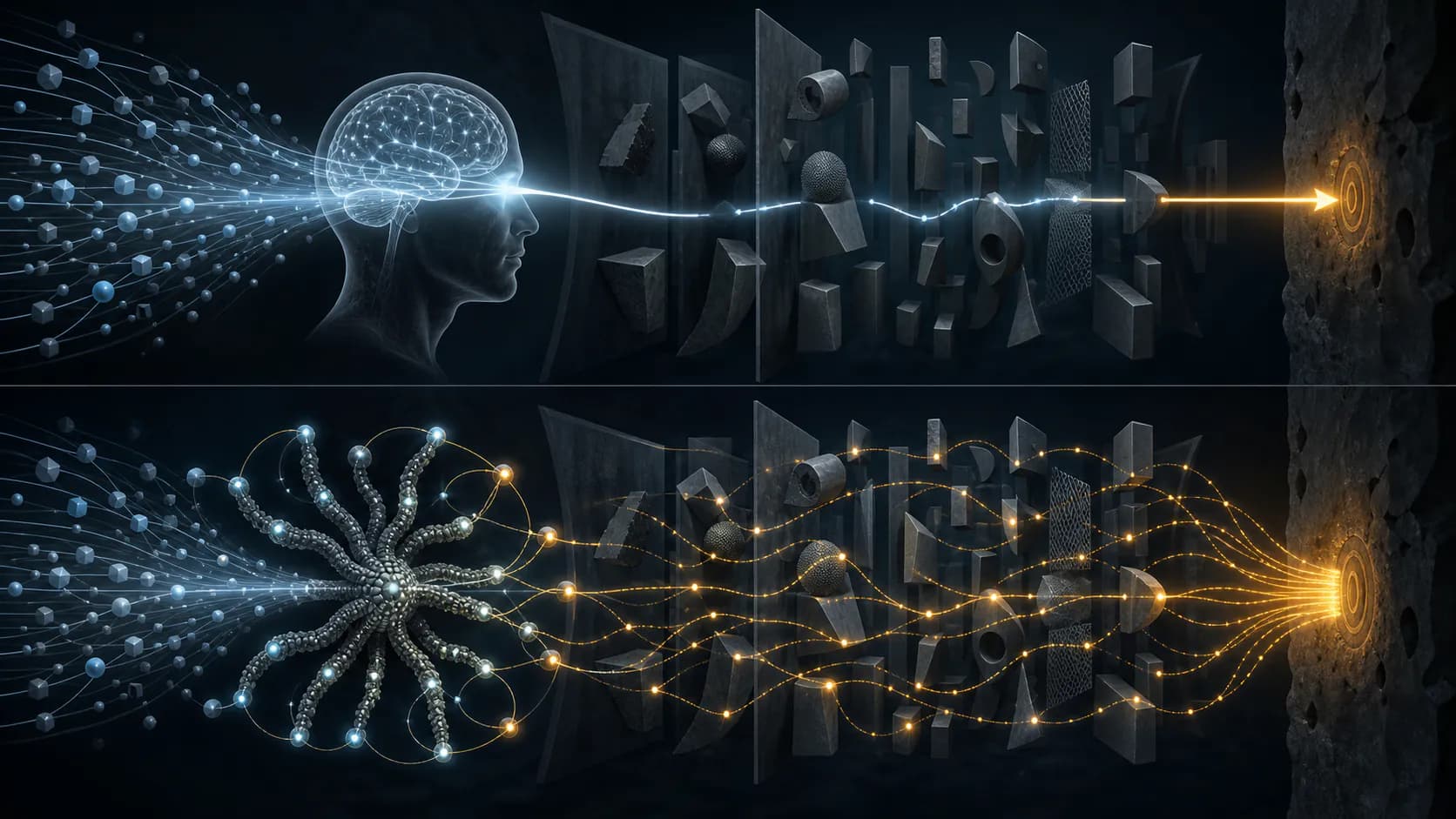
Blindsight
The novel separates adaptive competence from felt experience, then asks whether awareness improves survival or merely narrates work already done elsewhere.
Visual example · When awareness becomes the slower route
Cosmic scale
Hopeful · Demanding
Diaspora
A digital person born without a human original joins a civilization-wide flight from astrophysical disaster and follows a trail beyond familiar space, bodies, and universes.
Civilization scale
Dark · Demanding
Echopraxia
An unmodified biologist is forced aboard a mission with hive minds, soldiers who switch off awareness, and a vampire whose plans intersect an alien intelligence.
Societal scale
Cautious · Layered
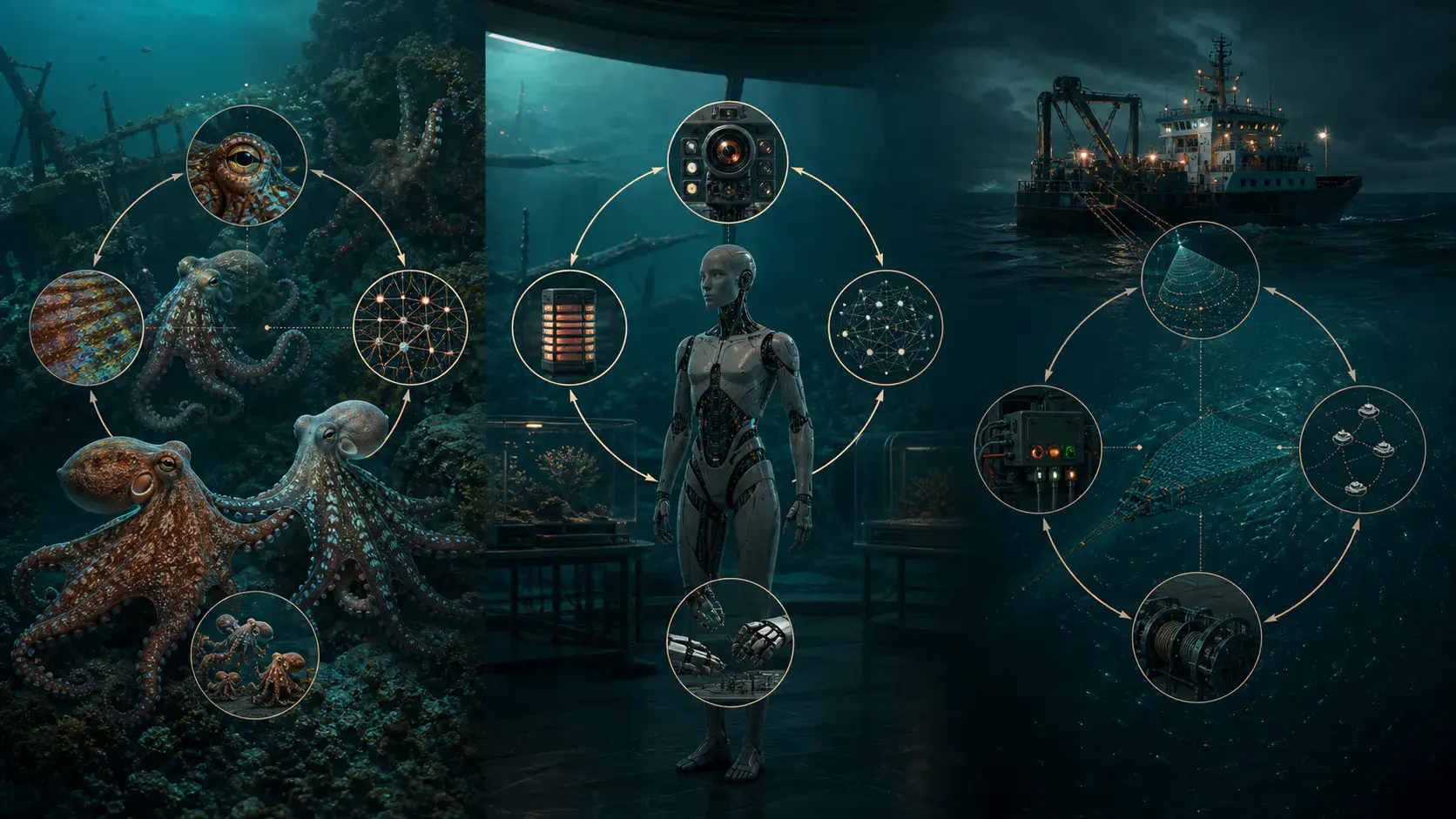
The Mountain in the Sea
Octopuses, Evrim, and autonomous ships separate fluent behavior, adaptive competence, subjective experience, and moral consideration instead of arranging them on one human-centered scale.
Visual example · Three minds cannot be ranked by one outward test
Questions to keep thinking about
What evidence does the story offer for experience rather than competence?
Does awareness change the action, explain it afterward, or create new goals?
Which moral duties depend on intelligence, consciousness, or both?
Sources and further reading
These references ground the portable lesson; story interpretations remain editorial analysis.
Frontiers in Systems Neuroscience
Indicators and Criteria of Consciousness in Animals and Intelligent Machines
MechanismReality checkLimitsNeuroscience of Consciousness
Theoretical Models of Consciousness: A Scoping Review
Reality checkLimitsStanford Encyclopedia of Philosophy
Consciousness
Human stakesLimits