
The idea in plain English
Plain idea
What changes
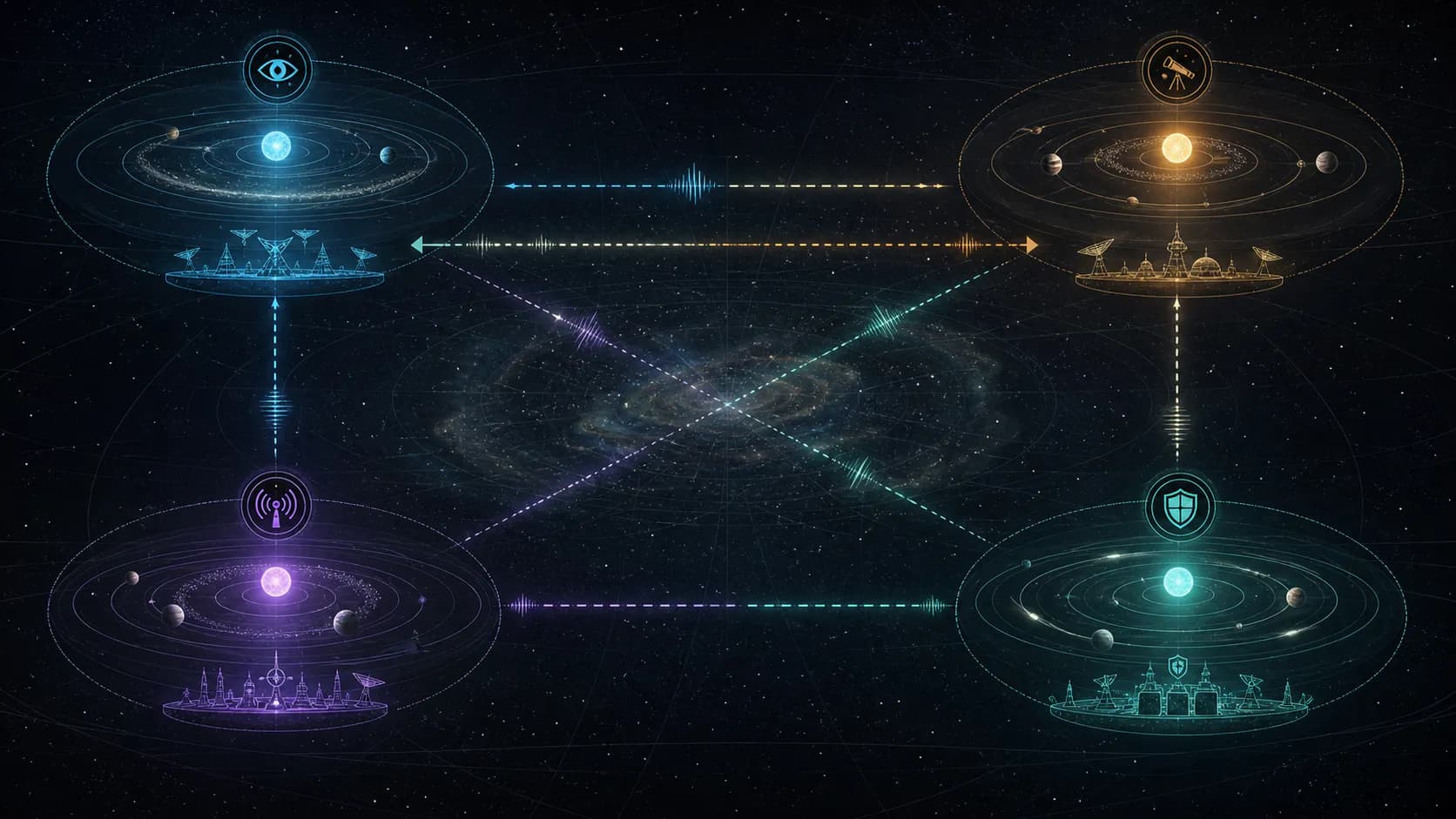
Cosmic sociology is a speculative attempt to reason about how distant civilizations might behave when survival matters and reliable communication or trust is scarce.
Mechanism
How it operates
A model begins with assumptions about resources, growth, visibility, intentions, technology, and the cost of being wrong. Those assumptions create strategic incentives such as hiding, signaling, cooperating, deterring, or attacking first.
Human stakes
Why it matters
The concept turns uncertainty into politics. A civilization may act on a model it cannot verify, and widespread fear can make secrecy or violence rational even when many societies would prefer peace.
Used in: 3 catalog novels
Related: First contact · Galactic empire · Scientific blockade
A few terms make the rest of the explanation easier to follow.
- Security dilemma
- A situation in which one actor's attempt to become safer makes another actor feel threatened, encouraging escalation neither originally wanted.
- Signaling
- An action chosen partly to communicate capability, intention, restraint, or resolve to an observer.
- Prior assumption
- A belief assigned before decisive evidence arrives, such as how common aggression, scarcity, or deception is expected to be.
Use the idea while reading
Turn the definition into three observations
Do not begin by asking whether a novel is “about” cosmic sociology. Begin with what changes in the lives of its characters, then use the concept to explain the mechanism underneath that change.
- 01
Notice which assumptions about survival and resources the strategy requires.
- 02
Notice what information each civilization lacks about the other.
- 03
Notice how signaling, silence, and preemption change the incentives of everyone watching.
Keep one question open: Which conclusion follows from evidence, and which follows from fear?
Avoid the shortcut: Cosmic sociology is not a discovered law of nature. Its conclusions depend on assumptions about civilizations that stories should expose rather than treat as automatic truth.
How it works, step by step
- 1
State assumptions about civilizations
A model chooses premises about survival, growth, resources, technological change, visibility, communication, and the cost of trusting incorrectly.
- 2
Map what each actor can observe
Distance and delay limit evidence about capability and intention, while silence itself can support several incompatible explanations.
- 3
Derive strategic incentives
Given the assumptions and uncertainty, hiding, signaling, cooperation, deterrence, or preemption may appear rational to an individual civilization.
- 4
Test the system-level result
When many actors follow the same reasoning, defensive choices can produce isolation or violence even if peaceful coexistence would benefit most of them.
A concrete example
A silent inhabited planet
A civilization detects probable industry on another world but receives no deliberate message and cannot verify the reason for silence.
01
Silence could mean fear, technical limits, extinction, indifference, preparation, or a policy of concealment.
02
Broadcasting may enable cooperation while revealing location and capability; hiding reduces exposure while preventing reassurance.
03
If both civilizations interpret concealment as evidence of hostility, caution reinforces the very universe their model predicted.
The point
Cosmic sociology is conditional reasoning, not an observed cosmic law. The conclusion changes when assumptions about scarcity, detection, communication, or acceptable risk change.
What is real, and what remains uncertain
First separate what we can observe or build today from what remains a prediction or a fictional extension.
What evidence supports it
Speculative social model
Game theory, signaling, astronomy, and security dilemmas are real fields. There is no observed population of extraterrestrial civilizations from which to validate universal social laws.
A common misunderstanding
Cosmic sociology is not a discovered law of nature. Its conclusions depend on assumptions about civilizations that stories should expose rather than treat as automatic truth.
Try this example in your head
A civilization detects a probable inhabited planet but cannot tell whether its silence means peace, fear, or preparation. Broadcasting may create friendship or reveal a target; hiding may preserve safety or guarantee mutual isolation.
The population is unobserved
No comparative dataset of extraterrestrial societies exists, so universal claims about civilization behavior cannot be empirically established.
Rationality depends on the model
A strategy can be internally rational under pessimistic assumptions while remaining disastrous if those assumptions are incomplete or self-fulfilling.
How science fiction tests the idea
Stories usually test both the promise of an idea and the trouble it creates.
Its promise
Caution is a rational response to unknowable civilizations.
Its problem
Assuming hostility can create the universe one fears.
What to notice in a story
- 01
Which assumptions about survival and resources the strategy requires
- 02
What information each civilization lacks about the other
- 03
How signaling, silence, and preemption change the incentives of everyone watching
Novels that use this idea
Cosmic scale
Dark · Demanding
Death’s End
Broadcast exposure and routine system-cleansing extend dark forest behavior beyond the Earth–Trisolaris conflict.
Cosmic scale
Dark · Demanding
The Dark Forest
Luo Ji’s field asks how distance, uncertain intentions, and rapid technological change might shape relations between civilizations.
Civilization scale
Dark · Layered
The Killing Star
A near-light-speed attack erases human civilization before anyone can respond. The scattered survivors must learn why an unknown species wants every last witness gone.
Questions to keep thinking about
Which conclusion follows from evidence, and which follows from fear?
Can actors build trust without timely verification or enforcement?
Does the strategy prevent danger—or reproduce the hostile universe it predicts?
Sources and further reading
These references ground the portable lesson; story interpretations remain editorial analysis.
SETI Institute / International Academy of Astronautics
Protocols for an ETI Signal Detection
Reality checkHuman stakesLimitsStanford Encyclopedia of Philosophy
Game Theory
MechanismReality checkLimitsNational Academies of Sciences, Engineering, and Medicine
An Astrobiology Strategy for the Search for Life in the Universe
Reality checkLimits