Novel guide
Death’s End
Cixin Liu

Story and ideas · Remembrance of Earth’s Past · Volume 3
Death’s End
by Cixin Liu
Tor trade paperback · translated by Ken Liu · 2017 · Publisher details · Cover via Open Library
Across centuries of borrowed time, one aerospace engineer inherits decisions that ask whether compassion can protect a civilization—or expose it.
Full-story article
This article discusses the complete story, including the ending.
- Reading time
- About 17 hours
- Length
- 624 pages
- Reading complexity
- Demanding
- Dense terminology, structure, or viewpoint changes reward slower, attentive reading.
- Science intensity
- 5/5
- Scientific mechanisms are central to understanding the story.
Affiliate links. As an Amazon Associate, we earn from qualifying purchases.
Watch the story
Watch on Scifi Orthogonal
Video guides from our YouTube channel. These discuss the full story and may reveal the ending.
Before you read
Is this book for you?
Start by tracking: At every time jump, identify who holds authority, which options exist in that moment, and which costs only become visible later.
Read this if you enjoy
- Civilization-scale decisions with irreversible costs
- Cosmic physics used as moral pressure
- Long historical arcs linked by a few relationships
Why readers may get lost
- The scale expands across centuries and dimensions
- Hibernation repeatedly changes social context
- This is the third volume of a connected trilogy
Keep these anchors in mind
- Cheng Xin
- carries care into decisions built around threat
- Yun Tianming
- turns distance and storytelling into information
- AA
- keeps practical action beside Cheng Xin’s ideals
- Deterrence
- makes credibility as important as capability
- The cosmic civilizations
- treat survival as a problem of hiding and scale
Demanding reading complexity. Dense terminology, structure, or viewpoint changes reward slower, attentive reading.
Science intensity 5/5. Scientific mechanisms are central to understanding the story.
01 · Overview
A human life carried through the lifespan of worlds
This guide uses six named parts because the book’s central experience is movement between eras, not a continuous run of chapters.
Where the final volume begins
The last plan of the Crisis Era begins with a brain
Aerospace engineer Cheng Xin joins the Staircase Program, an attempt to send a human intelligence toward the incoming Trisolaran fleet using nuclear pulse propulsion. The payload must be almost impossibly light. A terminally ill admirer, Yun Tianming, becomes the candidate whose brain might cross the distance.
Cheng Xin then enters hibernation and repeatedly wakes into societies transformed by decisions made while she slept. Her technical knowledge matters, but the deeper continuity is moral: people keep asking her to choose what kind of human future deserves to survive.
The central question
Can compassion remain a public virtue when survival seems to reward ruthlessness?
The novel tests that question at larger scales each time: one patient, two worlds, a solar system, dimensions, and finally the material future of the universe.
- The reading promise
- A sequence of era-spanning choices with consequences far beyond their makers
- What to track
- Who holds authority, what options were available then, and which costs arrive later
- The emotional anchor
- Cheng Xin, Yun Tianming, AA, and a relationship repeatedly interrupted by history
- The question underneath
- Is survival a value by itself, or only the condition that lets other values exist?
Series flight path
Remembrance of Earth’s Past
This final canonical volume revisits consequences from both earlier books and carries the trilogy from the Crisis Era beyond ordinary cosmic time.
Volume 1
The Three-Body ProblemDemanding
Volume 2
The Dark ForestDemanding
Volume 3 · You are here
Death’s EndDemanding
02 · Story map
Nine turns across six eras
The causal thread is simpler than the scale suggests: each period inherits a safety mechanism, decides what to trust, and passes a changed risk to the next.
The story, in human terms
The opening inheritance
- 1
Crisis Era
Cheng Xin builds a path for a human mind
The Staircase Program uses a chain of nuclear detonations to accelerate a sail carrying Yun Tianming’s brain toward the enemy fleet.
What changes: A failed trajectory still places one human intelligence beyond Earth’s control and creates a relationship that can resume centuries later.
Illustrated explanation
How the Staircase Program turns explosions into velocity
Precisely timed nuclear pulses transfer momentum to an ultralight sail, making payload mass and alignment the mission's brutal constraints.
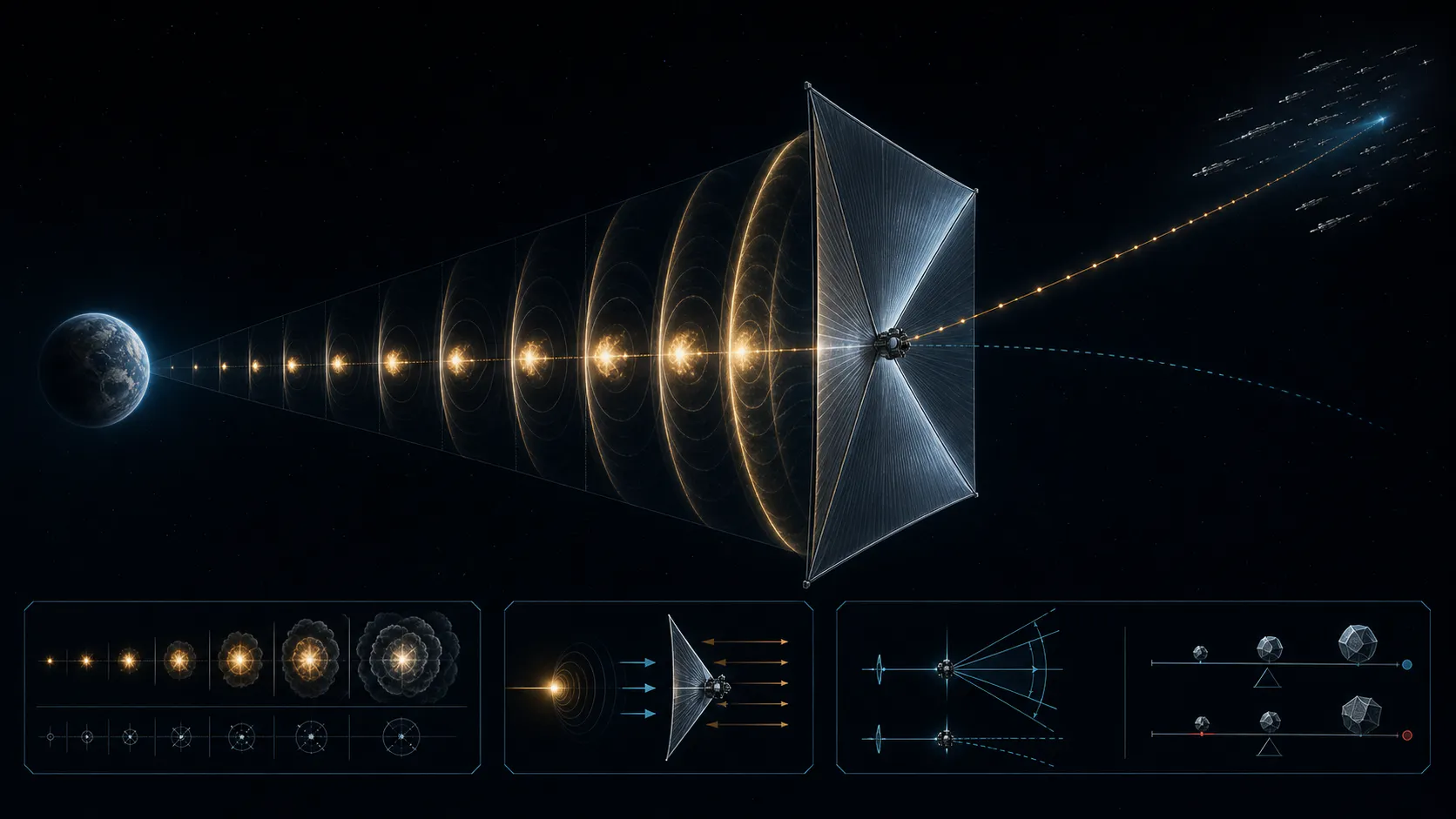
What to notice
- 01
Nuclear-pulse interstellar mission
Staircase Program
It attempts to accelerate a minimal human payload toward the enemy across a chain of precisely placed detonations.
In the image: Detonations are positioned along the departure path.
- 02
Staircase subject and encoded messenger
Yun Tianming
His brain travels toward the Trisolaran fleet, and his later stories transmit knowledge under surveillance.
In the image: Reducing the payload to a brain makes the acceleration imaginable.
- 03
Plot trajectory
A brain is accelerated toward the fleet
Nuclear pulses push the Staircase sail off course but still send Yun Tianming beyond Earth's reach.
In the image: A trajectory error changes arrival without erasing consequence.
- 04
Speculative concept
Spacecraft propulsion
The story compares propulsion by external nuclear pulses with a drive that alters spacetime, exposing how every route to speed carries different constraints.
In the image: Momentum arrives from an external sequence rather than an onboard engine.
- 05
Speculative concept
Nuclear-pulse propulsion
The Staircase Program converts a chain of nuclear detonations into momentum for an ultralight sail whose payload and alignment tolerate almost no error.
In the image: Each detonation adds another precisely timed impulse.
- 06
Primary concept
Interstellar travel
Missions, escaping ships, and a human diaspora turn travel between stars into a sequence of technical choices and broken social continuities.
In the image: The target distance makes payload, speed, and error inseparable.
Mid-book context
Deterrence asks what kind of person can hold the sword
- 1
Deterrence Era
Cheng Xin wakes into a peace she did not build
Luo Ji’s threat has produced decades of exchange and stability, and society chooses Cheng Xin as a humane successor to the Swordholder role.
What changes: The credibility of planetary retaliation moves from an aging strategist to someone the public trusts not to be monstrous.
- 2
Post-deterrence
The transfer exposes the difference between trust and deterrence
Trisolaris attacks during the brief handover because it estimates Cheng Xin is unlikely to trigger mutual destruction.
What changes: Humanity loses the shield at the exact moment it celebrates the character of the person holding it.
Complete trajectory
Every refuge solves the previous danger—and meets a larger one
- 1
Broadcast
Gravity reveals Trisolaris and exposes Earth
The distant ships use gravity-wave transmission after deterrence fails, ensuring Trisolaris is destroyed while placing the Solar System on the same cosmic map.
What changes: Humanity gains time but must learn what kind of strike can reach it and what forms of escape remain possible.
- 2
The stories
Yun Tianming hides survival knowledge inside fairy tales
In a monitored conversation, he encodes warnings about dimensional weapons, light-speed flight, and ways a civilization might signal harmlessness.
What changes: Interpretation becomes an engineering race in which metaphor determines which futures humanity can build.
- 3
The choice
Curvature propulsion is stopped
Thomas Wade prepares to defy a ban on light-speed research, but honors his promise to surrender authority when Cheng Xin refuses civil conflict.
What changes: Humanity preserves political order while losing time to develop the escape method the stories concealed.
- 4
Bunker Era
Moving cities behind planets creates confidence
Bunker worlds assume the Sun’s destruction would be the attack and that giant planets can provide shelter.
What changes: The defense is optimized for the wrong model of the weapon.
- 5
Dimensional strike
The Solar System falls into two dimensions
A dual-vector foil spreads a physical collapse that no bunker can block; Halo escapes only because it can reach light speed.
What changes: Human survival separates from the Solar System and enters a cosmos already damaged by its inhabitants.
- 6
Outside ordinary time
A reunion is displaced by relativity
Cheng Xin and Guan Yifan encounter a death line near Planet Blue and emerge after millions of external years into a changed system and a pocket universe.
What changes: The final survival decision concerns not one species but whether matter must return to the main cosmos.
03 · Ideas and visuals
Three models for a book that keeps changing scale
These visuals teach propulsion, encoded communication, and dimensional collapse as mechanisms with human consequences.
Ideas explained
Ideas to carry into the story
Treat each concept as a decision framework, not an endorsement of the character who applies it.
Idea 1
Survival ethics
When not everyone can be saved, selection rules decide whose lives and values become the future. Refusing to choose is also a choice with consequences.
In this story: Cheng Xin repeatedly represents care and legitimacy; Wade represents preparation for worst cases. The novel tests both through outcomes neither fully controls.
If survival requires becoming unrecognizable, what exactly has survived?
Read the plain-language concept articleIdea 2
Intergenerational governance
Hibernation lets individuals cross decades, while laws, infrastructure, and ordinary people live through every year between awakenings.
In this story: The same person can hold authority in societies with different norms, risks, and memories, revealing how legitimacy changes over time.
Who may bind the future to a sacrifice when the future cannot consent?
Read the plain-language concept articleIdea 3
Time travel and temporal displacement
Hibernation, relativistic motion, and altered spacetime can separate experienced time from the chronology lived by everyone elsewhere.
In this story: Time is not only a setting. It determines whether promises can be kept, whether reunions are possible, and which civilization is still there to receive a decision.
Can responsibility cross a gap of millions of years?
Read the plain-language concept articleOptional detailHow the book crosses interstellar distanceSeparate the voyage, the general propulsion problem, and the Staircase Program's particular solution.
Ideas explained
Three layers of the journey
The story moves from a reusable travel problem to one severe engineering method.
Idea 1
Interstellar travel
Crossing between stars makes delay, isolation, supplies, and the travelers' relationship to home part of the voyage.
In this story: The Staircase payload, the incoming fleet, and later human ships all reach futures their launch institutions cannot fully control.
When does a mission stop belonging to the world that launched it?
Read the plain-language concept articleIdea 2
Spacecraft propulsion
Propulsion is the exchange of energy and momentum that accelerates a payload; every method moves limits into fuel, mass, heat, or risk.
In this story: The book's survival options change when a propulsion system can move a tiny payload, a ship, or spacetime itself.
Which constraint has each apparent breakthrough merely moved elsewhere?
Read the plain-language concept articleIdea 3
Nuclear-pulse propulsion
A timed sequence of nuclear explosions can push a sail in repeated steps, but alignment and payload mass leave almost no margin for error.
In this story: The Staircase Program makes a human brain the payload because a whole body would be too heavy for the available sequence of pulses.
What remains of a human mission after engineering removes almost everything human-sized?
Read the plain-language concept articleIdeas explained
Two late-story ways that spacetime changes the journey
These concepts are separate: one changes a drive, while the other changes how much time different paths accumulate.
Idea 1
Curvature propulsion
A speculative curvature drive changes the geometry around a craft instead of relying only on ordinary exhaust.
In this story: Light-speed escape becomes possible, but the altered spacetime left behind carries strategic consequences of its own.
Can a civilization use a drive without also announcing what it can do?
Read the plain-language concept articleIdea 2
Relativistic time dilation
Different paths through high speed, gravity, or altered spacetime can accumulate radically different amounts of elapsed time.
In this story: A brief local delay erases an intended reunion because millions of years pass outside the travelers' path.
Is returning still a return when every shared reference point is gone?
Read the plain-language concept articleIllustrated explanation
How a fairy tale carries monitored physics
Repeated symbols form clusters of constrained meaning rather than a one-to-one code: danger, escape, and concealment.
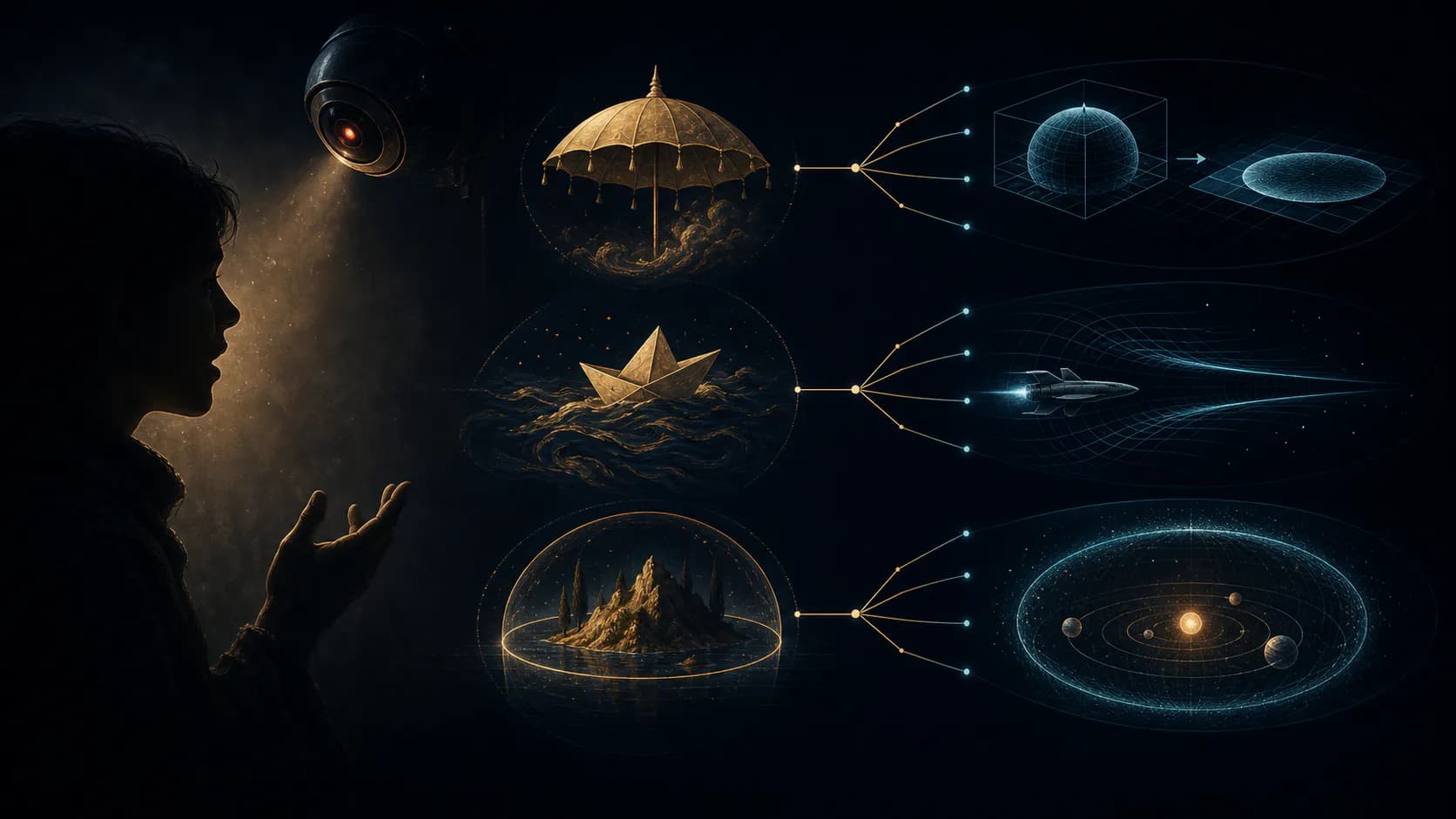
What to notice
- 01
Staircase subject and encoded messenger
Yun Tianming
His brain travels toward the Trisolaran fleet, and his later stories transmit knowledge under surveillance.
In the image: The sender must speak under observation.
- 02
Plot trajectory
Yun Tianming hides physics in stories
A monitored conversation carries indirect clues about dimensional attack, curvature propulsion, and cosmic safety.
In the image: Narrative redundancy preserves several technical clues.
- 03
Speculative concept
Curvature propulsion
Light-speed escape depends on changing spacetime itself, and the resulting trails make propulsion inseparable from cosmic safety and detection.
In the image: One clue points toward escaping by altering the geometry around a ship.
- 04
Speculative concept
Weaponized physics
Advanced civilizations attack not only matter but the dimensional conditions in which matter and defenses exist.
In the image: Another warns that geometry itself can become a weapon.
Illustrated explanation
When one short delay consumes the future
The blue path stays with the travelers' brief local interval; the gold path follows the wider universe through stellar and planetary change until the intended reunion is no longer in the same historical world.
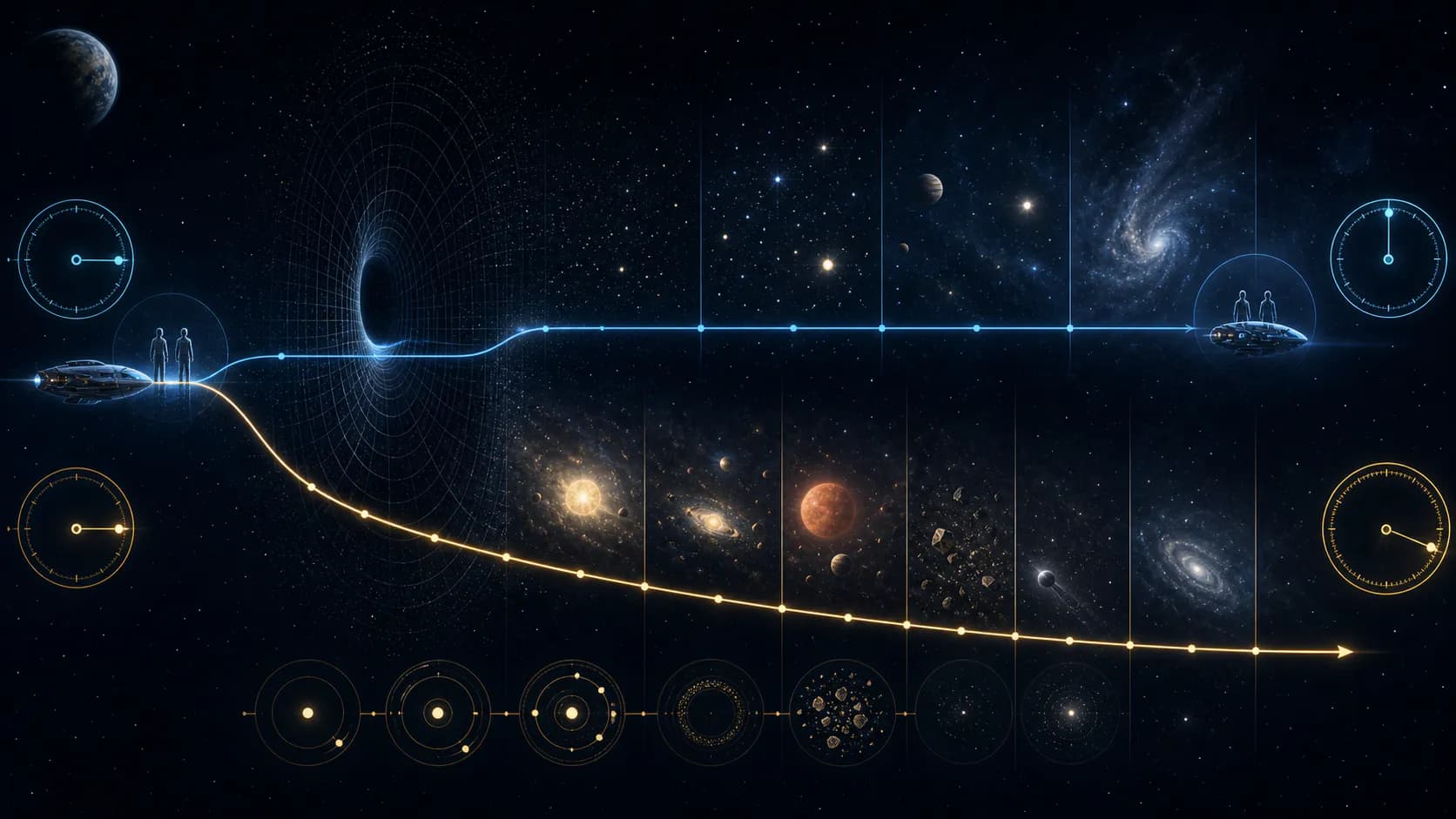
What to notice
- 01
Researcher from the galactic human diaspora
Guan Yifan
He explains curvature propulsion and dimensional damage while accompanying Cheng Xin beyond ordinary time.
In the image: The travelers emerge with little local time behind them.
- 02
Plot trajectory
A short encounter consumes cosmic time
A death-line disturbance near Planet Blue leaves Cheng Xin and Guan Yifan millions of external years late.
In the image: The disturbance separates the local path from external history.
- 03
Speculative concept
Relativistic time dilation
A short local interval near altered spacetime becomes millions of external years, making an intended reunion physically impossible.
In the image: Two valid paths accumulate radically different durations.
- 04
Primary concept
Time travel and temporal displacement
Hibernation, light-speed flight, and altered spacetime turn chronology into infrastructure that separates intention from consequence.
In the image: Temporal displacement changes what promises can still be kept.
Illustrated explanation
What the dual-vector foil changes
The expanding boundary removes depth from the region it reaches, defeating defenses that assume three-dimensional space persists.
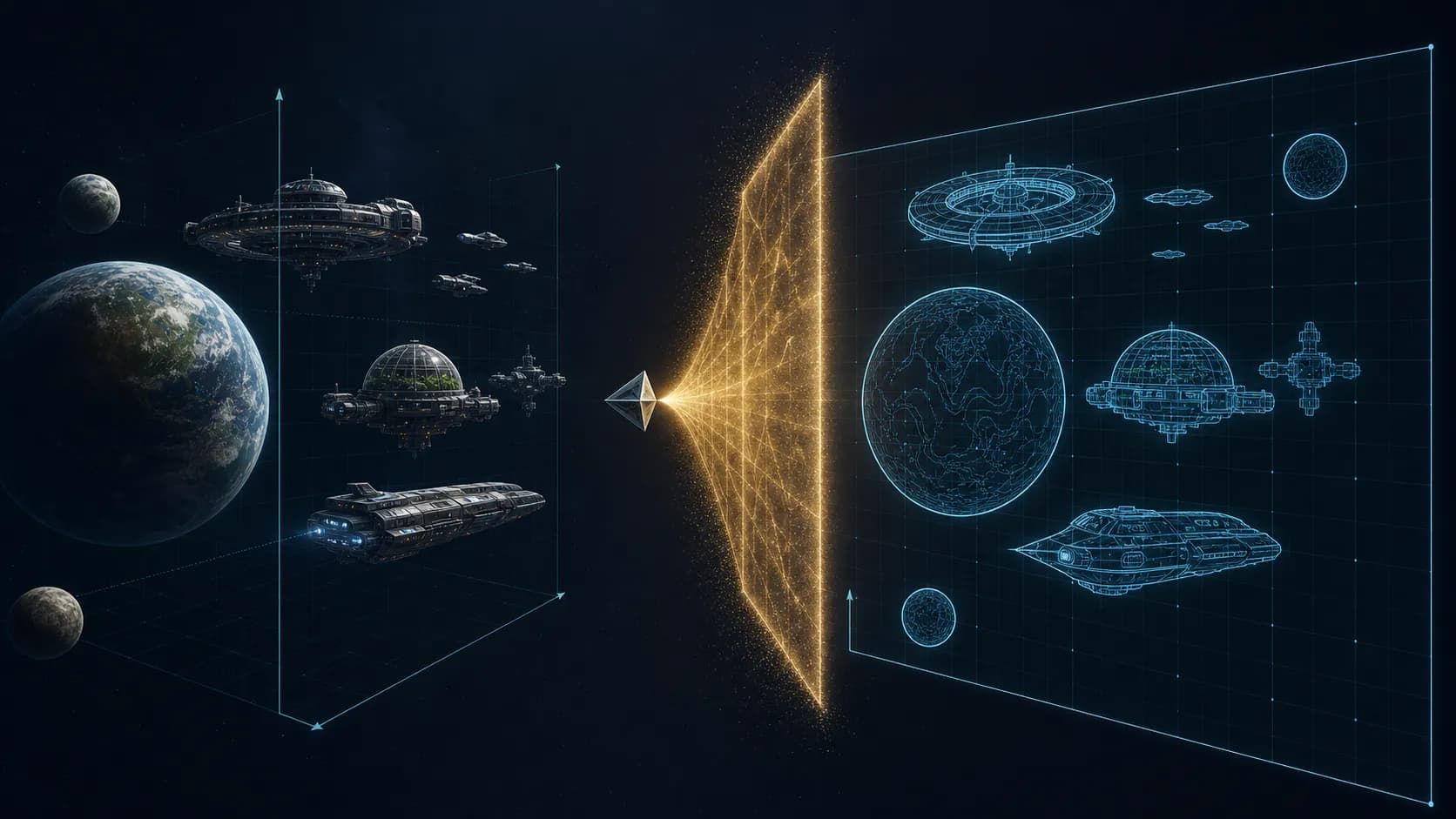
What to notice
- 01
Expanding dimensional-collapse weapon
Dual-vector foil
It turns three-dimensional space into two dimensions, bypassing defenses built for stellar destruction.
In the image: A small object initiates an expanding physical transition.
- 02
Plot trajectory
Dimensional collapse defeats the bunkers
The dual-vector foil expands through the system, flattening planets, ships, and people into two dimensions.
In the image: Matter unfolds as the boundary passes.
- 03
Speculative concept
Weaponized physics
Advanced civilizations attack not only matter but the dimensional conditions in which matter and defenses exist.
In the image: The battlefield's dimensional rules are the target.
Physics made political
A dimensional weapon attacks the space that contains every defense
A bunker, fleet, or armored habitat assumes the battlefield remains three-dimensional. The foil changes that shared condition. Its horror comes from category failure: structures do not merely break; depth itself disappears as matter is forced into a different geometry.
04 · Reading guide
Use eras as rooms, not as a date list
At each awakening, pause and identify the current safety system, the belief supporting it, and the person asked to carry its risk.
People across the eras
Cheng Xin
Aerospace engineer and recurring public decision-maker
She carries an ethic of care through eras that repeatedly ask her to authorize irreversible survival choices.
Yun Tianming
Staircase subject and encoded messenger
His brain travels toward the Trisolaran fleet, and his later stories transmit knowledge under surveillance.
Thomas Wade
Intelligence administrator and technological hard-liner
He pursues capability and worst-case preparation even when doing so requires coercion or political confrontation.
艾 AA
Astronomer, entrepreneur, and Cheng Xin's companion
AA provides practical partnership and continuity as Cheng Xin crosses societies altered by hibernation.
Guan Yifan
Researcher from the galactic human diaspora
He explains curvature propulsion and dimensional damage while accompanying Cheng Xin beyond ordinary time.
Luo Ji
Outgoing Swordholder
His long credible threat created the deterrence era that Cheng Xin is asked to inherit.
Missions, systems, and remnants
Staircase Program
Nuclear-pulse interstellar mission
It attempts to accelerate a minimal human payload toward the enemy across a chain of precisely placed detonations.
Swordholder system
Human command system for mutual deterrence
It gives one person the authority to expose both worlds if Trisolaris attacks.
Gravity
Gravity-wave broadcast ship
Its transmission reveals Trisolaris after deterrence collapses and inevitably makes Earth's neighborhood legible too.
Halo
Curvature-propelled escape ship
Its light-speed capability allows Cheng Xin and AA to leave the Solar System during dimensional collapse.
Dual-vector foil
Expanding dimensional-collapse weapon
It turns three-dimensional space into two dimensions, bypassing defenses built for stellar destruction.
Universe 647
Pocket-universe refuge
It offers safety outside the main cosmos while retaining matter that may be needed for cosmic renewal.
Reader lens · Deterrence
Separate moral approval from strategic prediction
People choose Cheng Xin because they approve of her humanity. Trisolaris evaluates whether she will press a control. Those are different questions. The tension comes from using one answer as if it guaranteed the other.
Reader lens · Broadcast
Treat the fairy tales as a constrained message
Do not hunt every image in isolation. Group clues by the practical problems they might solve: how to escape, how to slow or conceal a civilization, and what kind of attack to expect. Redundancy matters because Yun Tianming must communicate under observation.
Progress-safe room
Safe through Part 1 · Crisis Era
Progress-safe room
Safe through Part 3 · Broadcast Era
05 · Ending explained
The final gift is not escape but relinquishment
The final choice asks whether a private refuge can be justified when the larger universe needs its matter returned.
The final mechanism
A pocket universe may prevent the main universe from renewing
Universe 647 gives Cheng Xin and Guan Yifan safety outside ordinary spacetime. A multilingual message from the Returners explains that many such refuges have removed matter from the main universe. If too much remains outside, the cosmos may lack the mass needed for a successful collapse and rebirth.
Cheng Xin chooses to return almost everything, leaving a small ecological memory. The act reverses the trilogy’s repeated movement toward private escape: survival finally means contributing material back to a future she will not personally inhabit.
- Why Yun matters
- His gift and encoded stories carry both personal devotion and survival knowledge across enemy control.
- Why the reunion fails
- A relativistic disturbance turns a short local delay into millions of years outside it.
- Why the pocket universe matters
- It offers genuine refuge while removing matter the larger cosmos may need.
- Why Cheng Xin leaves
- She chooses an uncertain common future over perfect private continuation.
Keep exploring
Follow the idea beyond this ending
The Idea Atlas connects this novel’s central question to the science, philosophy, and other stories that approach it differently.
Open the connected ideaContinue through the catalog
Find another world on the same axis
Reading across the eras
The scale changes, but the moral problem keeps returning
Planets, dimensions, and millions of years can make the book feel like a sequence of new worlds. A steadier path is to watch how each era inherits a protection, mistakes its temporary safety for permanence, and passes a changed danger onward.
These lenses reconnect the enormous events to the people and institutions asked to choose inside them.
Cheng Xin's continuity
What stays the same when one person outlives whole societies?
Hibernation carries Cheng Xin through cultures that repeatedly reinterpret tenderness, courage, and responsibility. She remains recognizable, but every awakening changes the audience judging her earlier choices.
Why this matters: Her life becomes a record of how moral language shifts when consequences arrive centuries later.
Care and strategy
Is compassion a failure when it cannot deter violence?
The novel repeatedly places Cheng Xin's reluctance to sacrifice others beside systems that reward credible brutality. Some gentle choices have catastrophic strategic results, yet ruthless systems also destroy the conditions that make survival worth seeking.
Why this matters: The tension is not kindness versus intelligence; it is whether safety can be built without allowing violence to define every future value.
Stories as technology
Why are Yun Tianming's fairy tales strategically important?
The stories carry technical clues through a channel watched by an enemy. Metaphor lets meaning remain visible to the intended readers while its operational use stays uncertain to the censor.
Why this matters: Imagination becomes part of survival infrastructure, not an escape from the scientific plot.
Shrinking worlds
What is lost before matter itself is lost?
Bunkers, lightspeed regions, pocket universes, and dimensional attacks all create smaller zones of safety. Each shelter protects some lives by narrowing connection to a larger shared world.
Why this matters: The final return of matter answers a long pattern in which private refuge transfers cost elsewhere.
Coordinates on a neighboring axis
Novel guide
The Dark Forest
The Dark Forest
Cixin Liu
Humanity can prepare for an invasion everyone can see, but its only secure hiding place may be a single private mind.
Novel guide
The Three-Body Problem
The Three-Body Problem
Cixin Liu
The universe starts counting down inside a scientist’s eyes. To learn why, he must enter a world with three suns—and follow a signal humanity may regret sending.
Novel guide
House of Suns
House of Suns
Alastair Reynolds
Two travelers from a lineage of nearly a thousand cloned selves arrive late to a reunion and find their family massacred. Their search for the killer unearths a buried galactic crime.
Content notes
Assisted dying and terminal illness · Mass displacement, starvation, and death · Civilization-scale annihilation · Coercion and existential threat
Editorial record
Research and sources
The story analysis is original. Background sources support the scientific and philosophical explainers connected to this novel.
Last reviewed July 22, 2026