
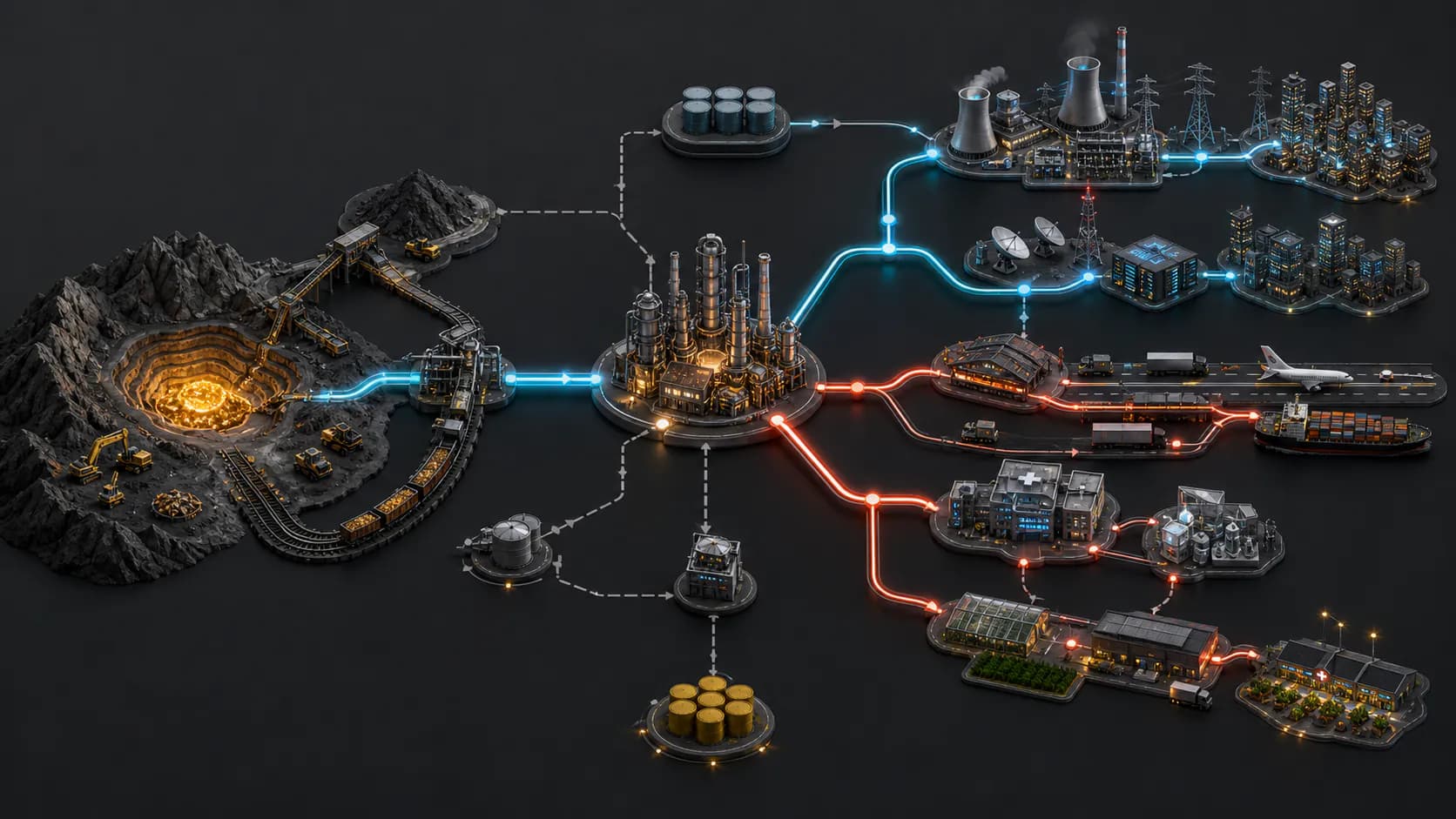
The idea in plain English
Plain idea
What changes
Critical resource dependence occurs when many important activities rely on one material or input that comes through a small number of mines, processors, routes, or political authorities.
Mechanism
How it operates
A resource becomes critical through use, not rarity alone. Demand grows because it enables essential systems; supply remains concentrated because geology, expertise, infrastructure, capital, or regulation are hard to reproduce; substitutes work poorly or require redesign; and inventories cover only short disruptions. Control of an upstream chokepoint can then influence prices, schedules, alliances, and downstream decisions far larger than the resource's physical volume.
Human stakes
Why it matters
A small interruption can stop hospitals, transport, energy, food systems, communications, or defense. Producer regions may gain revenue and bargaining power while also carrying environmental costs and becoming vulnerable to price shocks, outside intervention, corruption, or pressure to organize the whole economy around one export.
Used in: 9 catalog novels
Related: Galactic empire · Information asymmetry · Survival ethics
A few terms make the rest of the explanation easier to follow.
- Criticality
- The combination of an input's importance to essential functions and the difficulty of replacing or restoring its supply.
- Supply concentration
- A condition in which a small number of locations, firms, routes, or governments provide a large share of an input.
- Substitutability
- The practical ability to replace an input without unacceptable losses in performance, cost, safety, or time.
- Buffer
- Stockpiles, spare capacity, recycling, flexible design, or alternate suppliers that preserve function during disruption.
Use the idea while reading
Turn the definition into three observations
Do not begin by asking whether a novel is “about” critical resource dependence. Begin with what changes in the lives of its characters, then use the concept to explain the mechanism underneath that change.
- 01
Notice which essential functions fail when the resource stops moving.
- 02
Notice where extraction, processing, transport, and knowledge are concentrated.
- 03
Notice whether stockpiles, recycling, substitutes, or diversification meaningfully reduce leverage.
Keep one question open: Is dependence created by physical necessity, political design, or accumulated convenience?
Avoid the shortcut: A resource is not critical merely because it is expensive, scarce, or valuable. Criticality depends on the importance of its uses, the concentration and responsiveness of supply, available substitutes, inventories, recycling, and the time needed to redesign dependent systems.
How it works, step by step
- 1
An input becomes embedded
Industries and institutions design essential services around a material whose performance or economics make it difficult to avoid.
- 2
Supply narrows into chokepoints
Geology, processing knowledge, infrastructure, capital, regulation, or transport routes concentrate extraction and refinement in a few nodes.
- 3
Disruption propagates downstream
A closure, conflict, export restriction, accident, or demand shock reaches dependent systems faster than new supply or redesign can respond.
- 4
Actors build leverage or resilience
Suppliers can use scarcity strategically, while users diversify, stockpile, recycle, reduce demand, redesign products, or coordinate shared rules.
A concrete example
One catalyst, many stopped systems
A rare catalyst from one processing region is used in power converters for hospitals, rail networks, data centers, and water treatment.
01
Manufacturers chose the catalyst because it was reliable and cheap, so inventories and product standards now assume continuing supply.
02
An export restriction closes the dominant route. Existing stockpiles favor the highest bidders, delaying repairs in less wealthy regions.
03
Recycling and alternate materials help, but certification and new refining capacity take years, so political bargaining begins before technical substitution can mature.
The point
The resource's strategic value comes from downstream dependence and response time. Resilience requires changing the network before a disruption reveals how little choice remains.
What is real, and what remains uncertain
First separate what we can observe or build today from what remains a prediction or a fictional extension.
What evidence supports it
Observed supply-chain and commodity risk
Critical minerals, fuels, medicines, semiconductors, and food inputs already show how concentrated production, limited substitutes, and trade restrictions can transmit disruption. Fiction can intensify the concentration until one substance holds an entire civilization together.
A common misunderstanding
A resource is not critical merely because it is expensive, scarce, or valuable. Criticality depends on the importance of its uses, the concentration and responsiveness of supply, available substitutes, inventories, recycling, and the time needed to redesign dependent systems.
Try this example in your head
A catalyst weighs only a few grams inside each power converter, but one refinery supplies ninety percent of it. Closing that refinery does not remove much mass from the economy; it disables machines worth millions of times more. Where does the real power sit?
Concentration is not automatic failure
A concentrated supplier can remain reliable, efficient, and accountable; risk depends on governance, buffers, incentives, and plausible disruptions.
Self-sufficiency can create new fragility
Forcing every region to reproduce every supply chain can raise costs, reduce cooperation, and still leave hidden dependencies in equipment, skills, finance, or energy.
Diversification has social costs
New mines, processors, routes, and stockpiles shift environmental burdens and political conflict rather than making them disappear.
How science fiction tests the idea
Stories usually test both the promise of an idea and the trouble it creates.
Its promise
Concentrated supply can coordinate investment and efficiency around a resource that would otherwise be costly to develop.
Its problem
When essential systems lack substitutes, concentration turns ordinary dependence into fragility and coercive political leverage.
What to notice in a story
- 01
Which essential functions fail when the resource stops moving
- 02
Where extraction, processing, transport, and knowledge are concentrated
- 03
Whether stockpiles, recycling, substitutes, or diversification meaningfully reduce leverage
Novels that use this idea
Civilization scale
Balanced · Layered
Babylon's Ashes
After the attacks on Earth, the Free Navy controls the Belt and the routes to new worlds, forcing old enemies to build an alliance that can survive its own history.
Civilization scale
Balanced · Layered
Caliban's War
A vanished child, a Martian marine's impossible battlefield report, and a political struggle on Earth pull the Rocinante toward another protomolecule crisis.
Societal scale
Cautious · Layered
Cibola Burn
On the first contested colony beyond the Rings, refugees and a corporate expedition fight over one world while its alien systems begin waking beneath them.
Civilization scale
Dark · Demanding
Dune
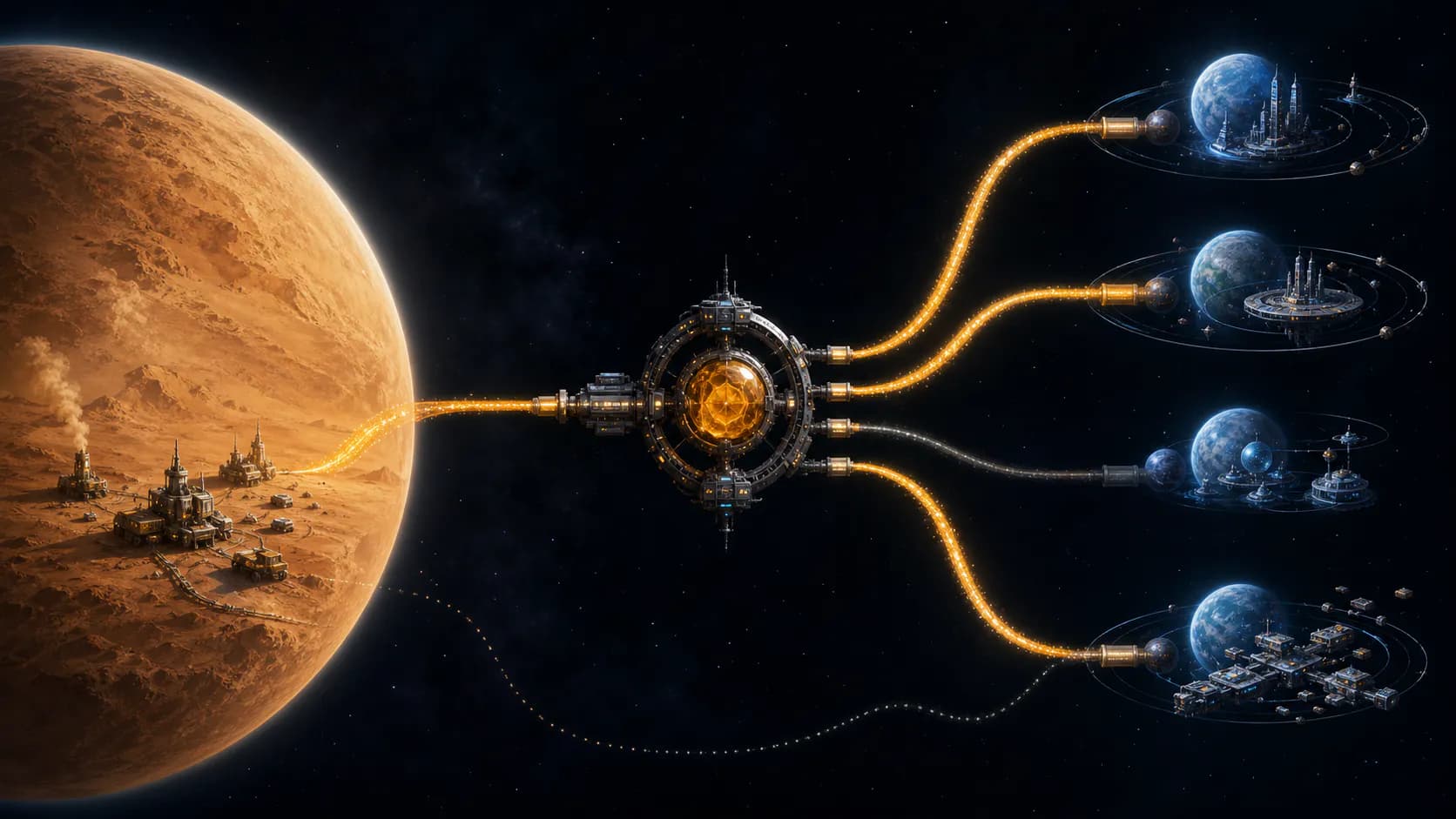
Spice is physically concentrated on one planet while transport, wealth, longevity, and imperial power are designed around its continued flow.
Visual example · One planet is the empire's supply chokepoint
Civilization scale
Cautious · Layered
Endymion
Centuries after the WorldWeb falls, Raul Endymion rescues a girl from the Time Tombs and flees a resurrection empire through the dead paths of its former portals.
Civilization scale
Cautious · Accessible
Leviathan Wakes
An ice-hauler officer and a Belt detective follow one missing woman into a conspiracy capable of turning political tension into system-wide war.
Societal scale
Cautious · Layered
Parable of the Sower
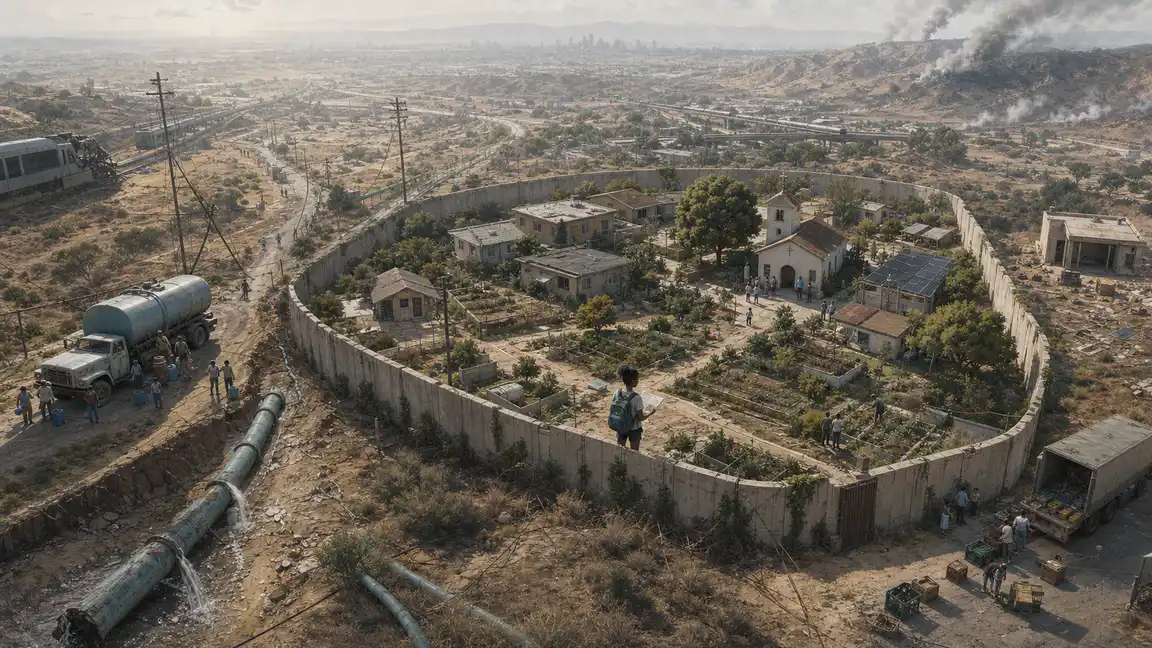
Water, employment, transport, housing, weapons, medicine, and trustworthy information become levers of control because most people cannot replace the systems that supply them.
Visual example · The wall protects a place, not the systems that keep it alive
Societal scale
Balanced · Demanding
The Dispossessed
Anarres's limited ecology makes food, labor assignments, transport, and imported goods material constraints on how freely a decentralized society can organize itself.
Civilization scale
Dark · Accessible
The War of the Worlds
An unnamed observer crosses a collapsing Victorian England after Martian machines make imperial confidence, military power, and human ownership of Earth suddenly irrelevant.
Questions to keep thinking about
Is dependence created by physical necessity, political design, or accumulated convenience?
Who bears extraction costs and who captures the strategic value?
Does the response build resilience or merely move the chokepoint?
Sources and further reading
These references ground the portable lesson; story interpretations remain editorial analysis.
International Energy Agency
Global Critical Minerals Outlook 2026 — Outlook
MechanismReality checkHuman stakesLimitsOECD
Special Focus: Critical Raw Materials Supply Chains
MechanismReality checkHuman stakesUN Trade and Development
The State of Commodity Dependence 2025
Reality checkHuman stakesLimitsOECD
OECD Supply Chain Resilience Review
MechanismHuman stakesLimits