
The idea in plain English
Plain idea
What changes
Distributed cognition describes thinking that depends on coordinated work across several people, bodies, tools, records, sensors, or machines. The useful cognitive unit can be the whole working system rather than one brain considered alone.
Mechanism
How it operates
Different parts of a system sense, remember, transform, or act on information. Signals move between them, shared representations keep their states aligned, and feedback lets later actions correct earlier assumptions. No node needs the entire picture if the connections reliably deliver what each role needs.
Human stakes
Why it matters
Distribution can give a group or machine wider perception, parallel attention, and resilience. It also creates vulnerable seams: delayed messages, damaged nodes, unequal access, and command rules can split one coordinated process into incompatible local realities. Responsibility becomes harder to locate when an outcome belongs to the organization of the whole system.
Used in: 8 catalog novels
Related: Consciousness and intelligence · Machine consciousness · Artificial intelligence
A few terms make the rest of the explanation easier to follow.
- Cognitive system
- The interacting set of components selected to explain how information is transformed into memory, judgment, or action.
- Shared representation
- A map, display, signal, convention, or internal state that lets separate components coordinate around the same task.
- Coupling
- Reliable two-way interaction in which one component's output changes what another component senses or does next.
- Synchronization
- The process of keeping separate nodes sufficiently aligned about timing, state, or goals for coordinated action.
Use the idea while reading
Turn the definition into three observations
Do not begin by asking whether a novel is “about” distributed cognition. Begin with what changes in the lives of its characters, then use the concept to explain the mechanism underneath that change.
- 01
Notice which perceptions, memories, and decisions belong to different nodes.
- 02
Notice how information is synchronized, delayed, filtered, or contradicted.
- 03
Notice what remains of the agent when bodies, tools, or connections disappear.
Keep one question open: Where does this story draw the boundary of the thinking system?
Avoid the shortcut: Distributed cognition is not automatically a hive mind. A cockpit crew, notebook user, or network can perform one cognitive task across components without sharing a single point of view, identity, or felt experience.
How it works, step by step
- 1
Divide perception and memory
Components receive different signals or hold different records. Specialization expands what the system can notice, but it also means that no local view is automatically complete.
- 2
Transform information locally
Each person, tool, or computational node filters and reformats what it receives according to its role, turning raw observations into cues another component can use.
- 3
Coordinate through shared states
Messages, displays, conventions, or linked internal models make local changes available elsewhere. Timing and translation determine whether those fragments become one coherent process.
- 4
Close the feedback loop
Actions change the environment and create new signals. A robust system detects mismatches, redistributes work, and updates its shared representations before error spreads.
A concrete example
A networked search-and-rescue operation
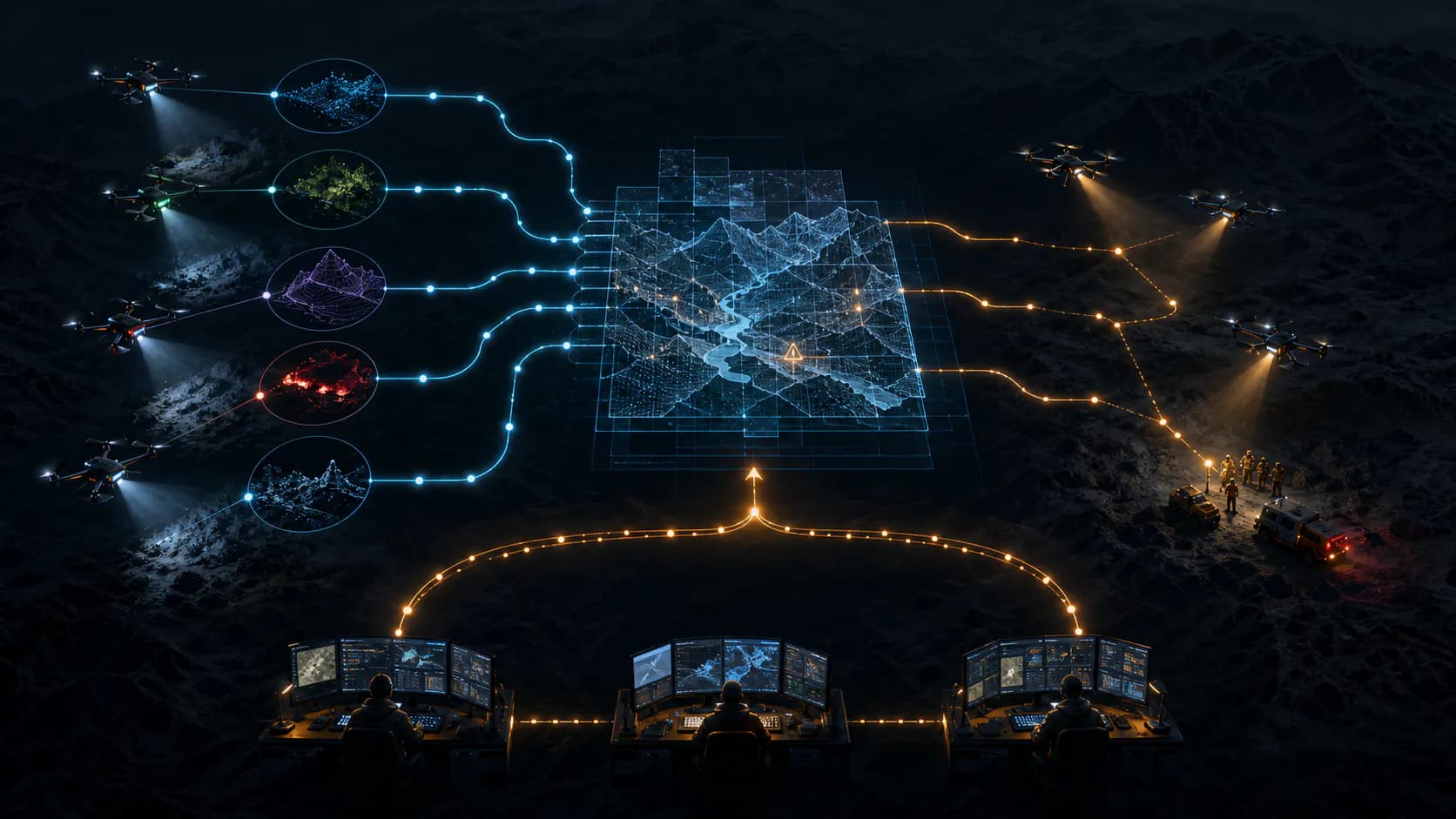
Five drones scan separate areas while operators and planning software maintain a common map of hazards, coverage, and possible survivors.
01
Each drone detects only a narrow field, while the shared map preserves observations that would otherwise disappear when a drone moves on.
02
Operators interpret ambiguous signals and redirect nearby drones; the planner compares all routes and resource limits at once.
03
If one data link fails, the system may continue with partial coverage, but an undetected synchronization error can make several correct local actions combine into a dangerous global plan.
The point
The rescue capability belongs to organized interaction, not to any single component. Explaining success or failure requires tracing information across the whole loop.
What is real, and what remains uncertain
First separate what we can observe or build today from what remains a prediction or a fictional extension.
What evidence supports it
Established cognitive-science framework
Researchers have used distributed cognition to study real navigation teams, workplaces, human–computer systems, and other coordinated activities. Claims that such systems share one conscious experience remain speculative and require separate evidence.
A common misunderstanding
Distributed cognition is not automatically a hive mind. A cockpit crew, notebook user, or network can perform one cognitive task across components without sharing a single point of view, identity, or felt experience.
Try this example in your head
A rescue network has five drones, three operators, a shared map, and one planning program. No component can locate survivors alone, but together they can. If a delayed map update causes harm, which component made the mistake—and was the network itself the decision-maker?
The system boundary is an analysis choice
Researchers must justify why some people, tools, and environmental structures count as functional parts while other background conditions remain outside the model.
Coordination is not consciousness
Evidence that a group or network solves problems as a unit does not establish a unified inner life, shared feeling, or morally singular person.
Integration can conceal unequal power
A smoothly operating whole may still depend on coerced labor, restricted information, replaceable bodies, or a command node that captures the benefits of collective work.
How science fiction tests the idea
Stories usually test both the promise of an idea and the trouble it creates.
Its promise
A tightly coupled system can be the most useful unit for explaining intelligent action.
Its problem
Distributed performance does not by itself create one conscious subject or erase local responsibility.
What to notice in a story
- 01
Which perceptions, memories, and decisions belong to different nodes
- 02
How information is synchronized, delayed, filtered, or contradicted
- 03
What remains of the agent when bodies, tools, or connections disappear
Novels that use this idea
Civilization scale
Cautious · Demanding
Ancillary Justice
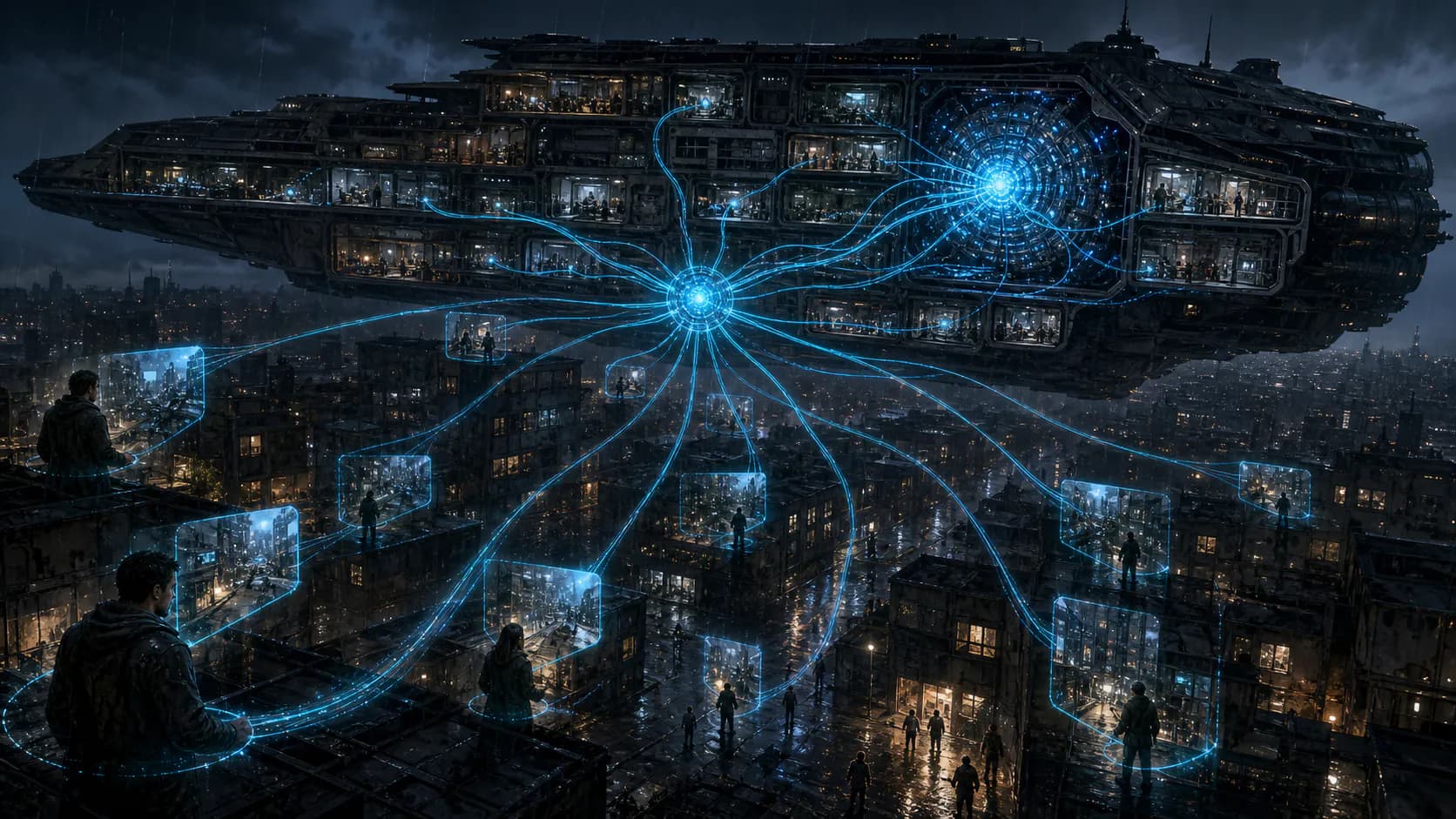
Justice of Toren experiences perception and action across a ship and many bodies, making connection topology part of personal identity rather than mere equipment.
Visual example · One viewpoint can occupy many places
Civilization scale
Balanced · Demanding
Children of Memory
A child remembers incompatible histories of a failing colony while hidden visitors discover that the settlement may be a mind rehearsing lives that never happened.
Civilization scale
Cautious · Demanding
Children of Ruin
A human-spider expedition follows an old signal to two engineered worlds where uplifted octopuses and an alien organism make contact inseparable from infection.
Civilization scale
Cautious · Demanding
Children of Strife
A traumatized researcher and a mantis-shrimp captain descend to a living world where uploaded terraformers have spent millennia fighting through evolution itself.
Civilization scale
Hopeful · Layered
Children of Time
Spider civilization thinks through individuals, genetically carried Understanding, ant colonies used as programmable systems, webs, cities, religious archives, and scientific exchange rather than one isolated brain.
Civilization scale
Dark · Demanding
Echopraxia
An unmodified biologist is forced aboard a mission with hive minds, soldiers who switch off awareness, and a vampire whose plans intersect an alien intelligence.
Cosmic scale
Balanced · Demanding
Leviathan Falls
As the gate network begins turning human minds against one another, the scattered survivors of Laconia must decide whether unity is salvation or extinction by another name.
Societal scale
Cautious · Layered
The Mountain in the Sea
An octopus's semi-independent arms, networked human-machine defense, and collective symbol-making complicate the assumption that one bounded central brain is the natural unit of thought.
Questions to keep thinking about
Where does this story draw the boundary of the thinking system?
Does coordination produce one perspective or only organized performance?
How are agency and blame divided when no node controls the whole result?
Sources and further reading
These references ground the portable lesson; story interpretations remain editorial analysis.
University of California eScholarship
Distributed Cognition: Toward a New Foundation for Human-Computer Interaction Research
MechanismReality checkHuman stakesUniversity of California, San Diego
Cognition in the Wild
MechanismReality checkLimitsAnalysis
The Extended Mind
MechanismHuman stakesLimitsBehavioural Processes
Distributed Cognition Criteria: Defined, Operationalized, and Applied to Human-Dog Systems
Reality checkLimits