
The idea in plain English
Plain idea
What changes
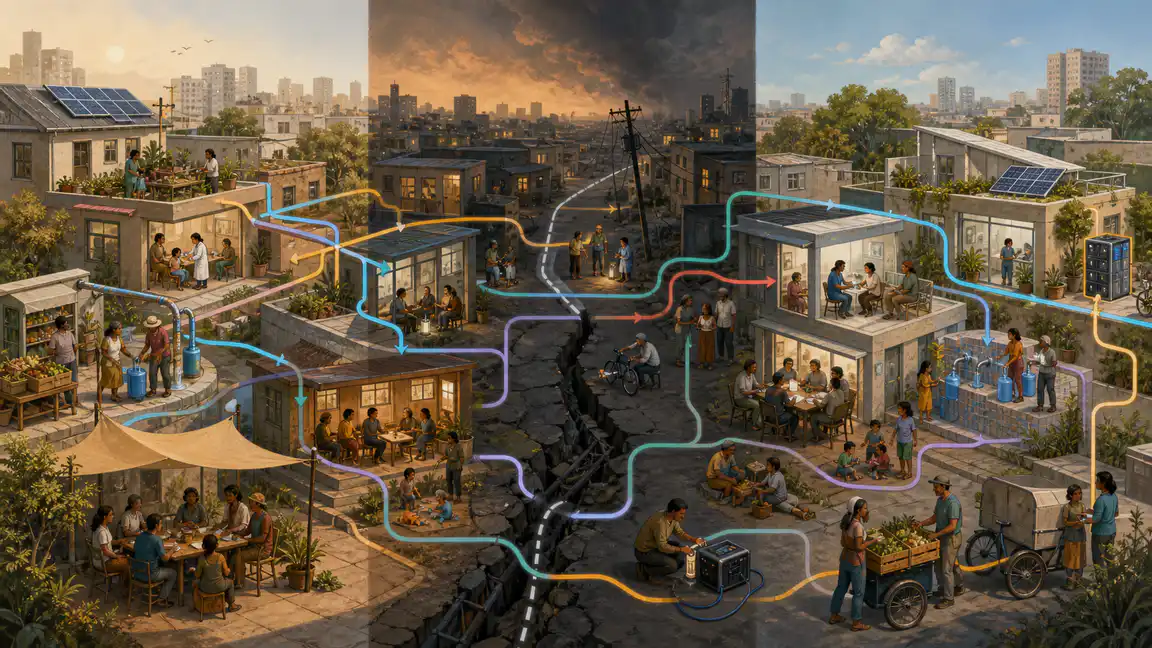
Community resilience is the ability of a group and its supporting systems to anticipate disruption, continue what matters most, recover, learn, and change.
Mechanism
How it operates
People identify essential functions, map the systems and relationships those functions depend on, reduce single points of failure, practice coordination, and learn after disruption. Material backups work best when knowledge and authority are also distributed.
Human stakes
Why it matters
A hazard becomes a catastrophe through connected failures in care, water, shelter, power, transport, information, and trust. Resilience asks whether people can keep one another alive without simply restoring the inequalities that made the damage worse.
Used in: 1 catalog novel
Related: Climate survival · Emergency governance · Critical resource dependence
A few terms make the rest of the explanation easier to follow.
- Essential function
- A service or capability whose interruption rapidly threatens health, safety, dignity, or social continuity, such as water, care, communication, shelter, or trusted coordination.
- Redundancy
- Multiple ways to perform an important function, so the failure of one person, route, institution, or technology does not collapse the whole system.
- Adaptive capacity
- The practical room to change behavior, rules, resource use, and institutions as conditions shift.
- Social infrastructure
- The relationships, gathering places, habits, and organizations through which people exchange information, coordinate care, and build trust.
Use the idea while reading
Turn the definition into three observations
Do not begin by asking whether a novel is “about” community resilience. Begin with what changes in the lives of its characters, then use the concept to explain the mechanism underneath that change.
- 01
Notice which human functions must continue when normal systems fail.
- 02
Notice where skills, authority, information, and supplies are concentrated.
- 03
Notice whether recovery reproduces an old vulnerability or changes it.
Keep one question open: What can this community reroute when one person or system fails?
Avoid the shortcut: Resilience is not a demand that individuals endure more hardship. It is a property of relationships and systems, and it cannot substitute indefinitely for public investment, rights, or accountable institutions.
How it works, step by step
- 1
Name what must continue
Begin with essential human functions rather than with a list of assets. A clinic, power line, neighborhood kitchen, and phone tree matter because of the needs they serve.
- 2
Map hazards and dependencies
Trace where water, food, energy, transport, information, authority, and care come from. This reveals single points of failure and people who bear disproportionate risk.
- 3
Build capacity before crisis
Create backups, practice skills, share knowledge, strengthen relationships, and assign authority clearly. Material reserves work best when people know how to use and replenish them.
- 4
Respond, learn, and transform
Trusted communication helps people allocate scarce resources and revise plans; recovery then corrects vulnerabilities instead of automatically restoring the same fragile arrangement.
A concrete example
A heat wave becomes a neighborhood systems test
A prolonged heat wave coincides with a power outage and intermittent water service in an apartment building whose residents have different health, mobility, work, and care needs.
01
Residents identify cooling, hydration, medical-device power, accurate information, and safe transport as essential functions, then discover that elevators, water pumps, refrigeration, and charging share one electrical dependency.
02
They form a contact tree, record voluntary support needs, train several people on backup equipment, store water safely, and arrange more than one route to a nearby cooling center.
03
During the outage, neighbors share updates, prioritize limited battery capacity, accompany residents on stairs, and revise the plan as conditions change.
04
Afterward, they document gaps and press the owner and city for building improvements rather than treating mutual aid as a permanent replacement for infrastructure.
The point
Relationships, shared knowledge, and backup routes turn supplies into usable capacity. They buy time and create collective leverage, but do not remove institutional responsibility.
What is real, and what remains uncertain
First separate what we can observe or build today from what remains a prediction or a fictional extension.
What evidence supports it
Disaster-risk and infrastructure practice
Public agencies and researchers use resilience planning to connect social needs with buildings, infrastructure, governance, and adaptation before, during, and after hazards.
A common misunderstanding
Resilience is not a demand that individuals endure more hardship. It is a property of relationships and systems, and it cannot substitute indefinitely for public investment, rights, or accountable institutions.
Try this example in your head
A neighborhood loses power and water during extreme heat. It owns one generator, but only one absent resident knows how to operate it. Is the community resilient because it possesses backup equipment?
Local capacity has material limits
A well-connected community cannot compensate indefinitely for absent public investment, unaffordable housing, unsafe work, or failing regional infrastructure.
Recovery can restore injustice
Returning to normal may reproduce the same unequal exposure, so resilience must include the capacity to transform harmful rules and resource distributions.
Cohesion can exclude
Strong internal ties may shut out newcomers or silence dissent; broad relationships and accountable decision-making matter as much as solidarity.
How science fiction tests the idea
Stories usually test both the promise of an idea and the trouble it creates.
Its promise
Shared skills and trusted relationships let a community adapt when formal systems break.
Its problem
Resilience language can disguise abandonment when institutions transfer preventable risks onto exposed people.
What to notice in a story
- 01
Which human functions must continue when normal systems fail
- 02
Where skills, authority, information, and supplies are concentrated
- 03
Whether recovery reproduces an old vulnerability or changes it
Novels that use this idea
Questions to keep thinking about
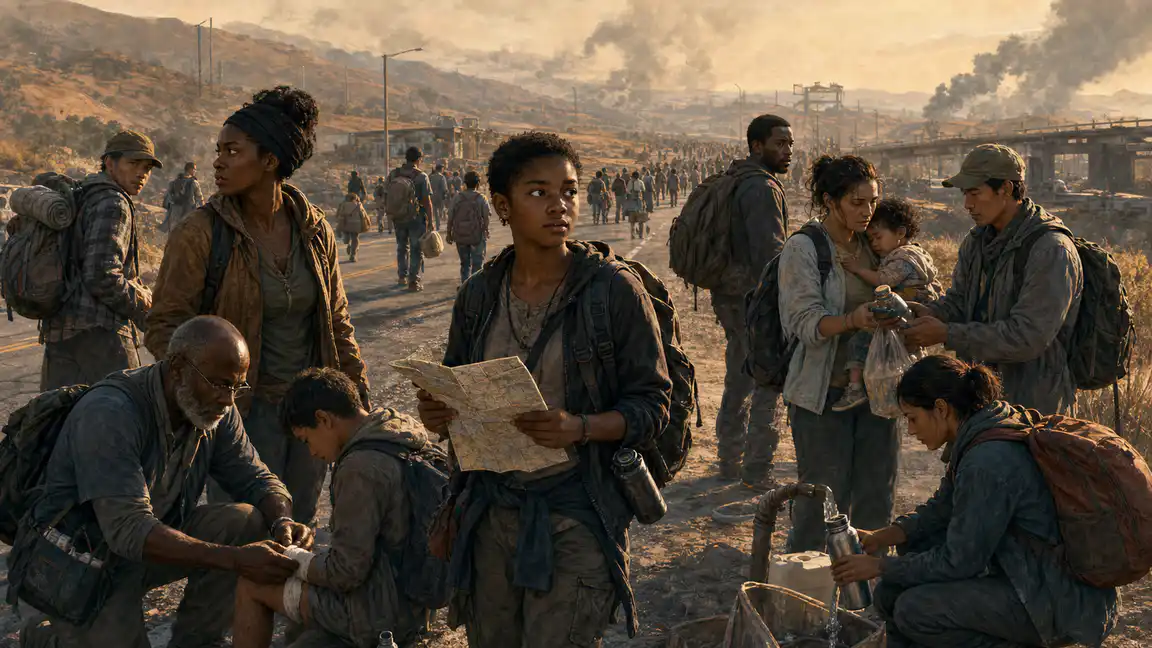
What can this community reroute when one person or system fails?
Who performs and pays for the labor of preparedness and care?
Does rebuilding return to normal or reduce the danger built into normal life?
Sources and further reading
These references ground the portable lesson; story interpretations remain editorial analysis.
United Nations Office for Disaster Risk Reduction
Resilience terminology
MechanismReality checkLimitsNational Institute of Standards and Technology
Community Resilience Planning Guide for Buildings and Infrastructure Systems: A Playbook
MechanismReality checkHuman stakesIntergovernmental Panel on Climate Change
Climate Change 2022: Impacts, Adaptation and Vulnerability — Summary for Policymakers
Reality checkHuman stakesLimits