

The idea in plain English
Plain idea
What changes
Cross-species communication is the construction of shared meaning between intelligences that may sense, inhabit, and divide the world in fundamentally different ways.
Mechanism
How it operates
Communicators must identify patterns, establish reference, test feedback, and distinguish signal from accident. Mathematics or shared objects can anchor a vocabulary, but intention, emotion, social rules, and metaphor require deeper models of embodiment and culture.
Human stakes
Why it matters
Misunderstanding can turn cooperation into danger or make one side appear irrational. Successful translation also changes both participants by creating concepts, practices, and relationships neither had alone.
Used in: 6 catalog novels
Related: First contact · Science as infrastructure · Cosmic sociology
A few terms make the rest of the explanation easier to follow.
- Referent
- The object, event, relation, or condition in the world that a signal is being used to indicate.
- Semantics
- The relationship between signs and meaning, including what words, gestures, or patterns are about.
- Pragmatics
- How context, intention, social roles, and expected consequences shape what a signal does in an interaction.
- Grounding
- The process of connecting a symbol to shared perception, action, or testable conditions rather than only to other symbols.
Use the idea while reading
Turn the definition into three observations
Do not begin by asking whether a novel is “about” cross-species communication. Begin with what changes in the lives of its characters, then use the concept to explain the mechanism underneath that change.
- 01
Notice how the participants establish shared reference and correction.
- 02
Notice which senses or environments shape each language.
- 03
Notice what remains untranslatable even after practical cooperation begins.
Keep one question open: What is the first genuinely shared meaning rather than a repeated pattern?
Avoid the shortcut: A shared equation does not produce a complete language. It may identify quantities while leaving agency, politeness, pain, promises, and cultural meaning unresolved.
How it works, step by step
- 1
Detect intentional pattern
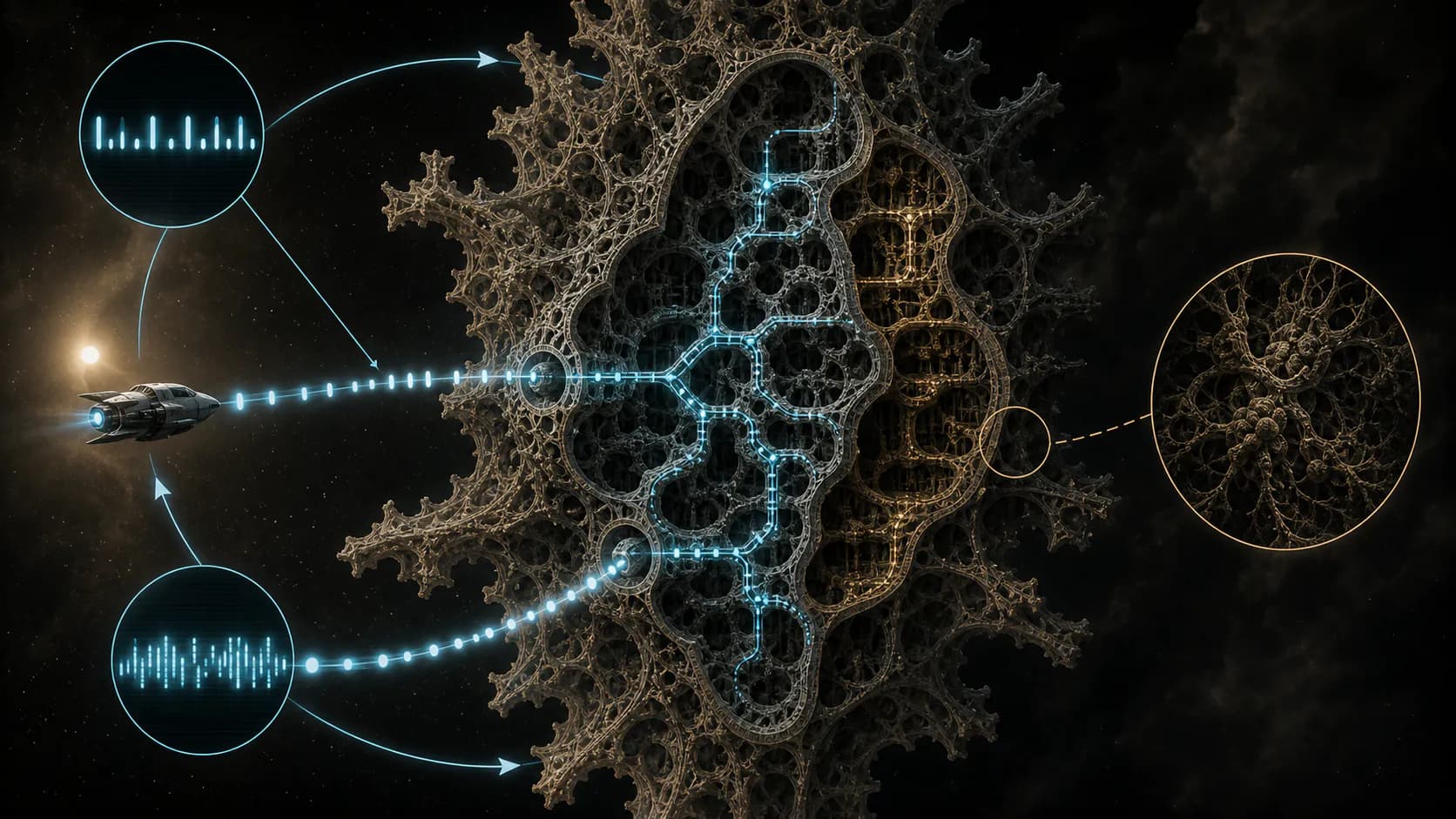
Participants first distinguish a signal from noise and learn whether variation corresponds to repeatable actions, objects, or states.
- 2
Establish a shared referent
Both sides attend to one measurable event and test how different signals predict or change responses around it.
- 3
Build correction loops
Questions, demonstrations, failed predictions, and repeated feedback reveal which mappings are stable and where apparent agreement is accidental.
- 4
Extend from measurement to social meaning
Promises, pain, status, humor, politeness, metaphor, and deception require models of bodies and relationships beyond a shared equation.
A concrete example
Learning the meaning of three
Two species can both detect three recurring pulses, but one senses through pressure and the other through sound.
01
They reproduce the pattern around three physical objects and distinguish it from two and four, creating a shared quantitative referent.
02
A repeated sound-pressure mapping establishes a symbol for the quantity without making either species experience the objects identically.
03
The success does not explain whether a later gesture means gift, warning, ownership, or threat; those meanings require social context and correction.
The point
Communication grows from shared tests, not assumed identical minds. Mathematical agreement can anchor reference while leaving intention, value, and experience unresolved.
What is real, and what remains uncertain
First separate what we can observe or build today from what remains a prediction or a fictional extension.
What evidence supports it
Observed challenge, extraterrestrial extrapolation
Human language learning and communication with other Earth species are real research areas. Communication with extraterrestrial intelligence remains hypothetical.
A common misunderstanding
A shared equation does not produce a complete language. It may identify quantities while leaving agency, politeness, pain, promises, and cultural meaning unresolved.
Try this example in your head
Two species agree on a pattern for the number three, but one experiences objects through sound and the other through pressure. Their shared count does not tell them whether a gesture is a greeting or a threat.
Human language is not the neutral standard
Comparative communication research warns that methods built around human speech can overlook meaningful signals organized through other bodies and environments.
Fluency can exceed understanding
A system may produce appropriate sequences through pattern learning while lacking shared reference, intention, or awareness of what the exchange concerns.
How science fiction tests the idea
Stories usually test both the promise of an idea and the trouble it creates.
Its promise
Shared measurement can become a bridge between radically different minds.
Its problem
Even universal facts acquire meaning through local bodies and cultures.
What to notice in a story
- 01
How the participants establish shared reference and correction
- 02
Which senses or environments shape each language
- 03
What remains untranslatable even after practical cooperation begins
Novels that use this idea
Cosmic scale
Dark · Demanding
Blindsight
Grammatical fluency becomes evidence of pattern matching without proving shared reference, intention, or experience.
Visual example · A reply can be fluent without sharing meaning
Civilization scale
Cautious · Demanding
Children of Ruin
A human-spider expedition follows an old signal to two engineered worlds where uplifted octopuses and an alien organism make contact inseparable from infection.
Civilization scale
Hopeful · Layered
Children of Time
Mathematics, vibration, images, chemical signals, inherited knowledge, and behavior gradually create reference across bodies that do not share speech or even the same sensory priorities.

Cosmic scale
Hopeful · Layered
Contact
The Message builds shared reference in layers, beginning with countable regularity and using each decoded structure to teach the vocabulary needed for the next.
Visual example · How the Message teaches humanity to read deeper

Civilization scale
Hopeful · Layered
Project Hail Mary
Shared units, patient correction, and reciprocal care build understanding before either participant can rely on fluent language.
Visual example · Build meaning from what both sides can test

Societal scale
Cautious · Layered
The Mountain in the Sea
Ha must build reference across incompatible bodies by treating color, skin texture, posture, spatial arrangement, artifacts, and the island itself as parts of a possible language.
Visual example · The language is larger than either body
Questions to keep thinking about
What is the first genuinely shared meaning rather than a repeated pattern?
Who must adapt more, and does that create power?
Does fluency produce understanding—or only more precise negotiation?
Sources and further reading
These references ground the portable lesson; story interpretations remain editorial analysis.
Biological Reviews
Animal Linguistics: A Primer
MechanismReality checkLimitsProceedings of the National Academy of Sciences
Overcoming Bias in the Comparison of Human Language and Animal Communication
MechanismReality checkLimitsSETI Institute / International Academy of Astronautics
Protocols for an ETI Signal Detection
Reality checkHuman stakesLimits