
The idea in plain English
Plain idea
What changes
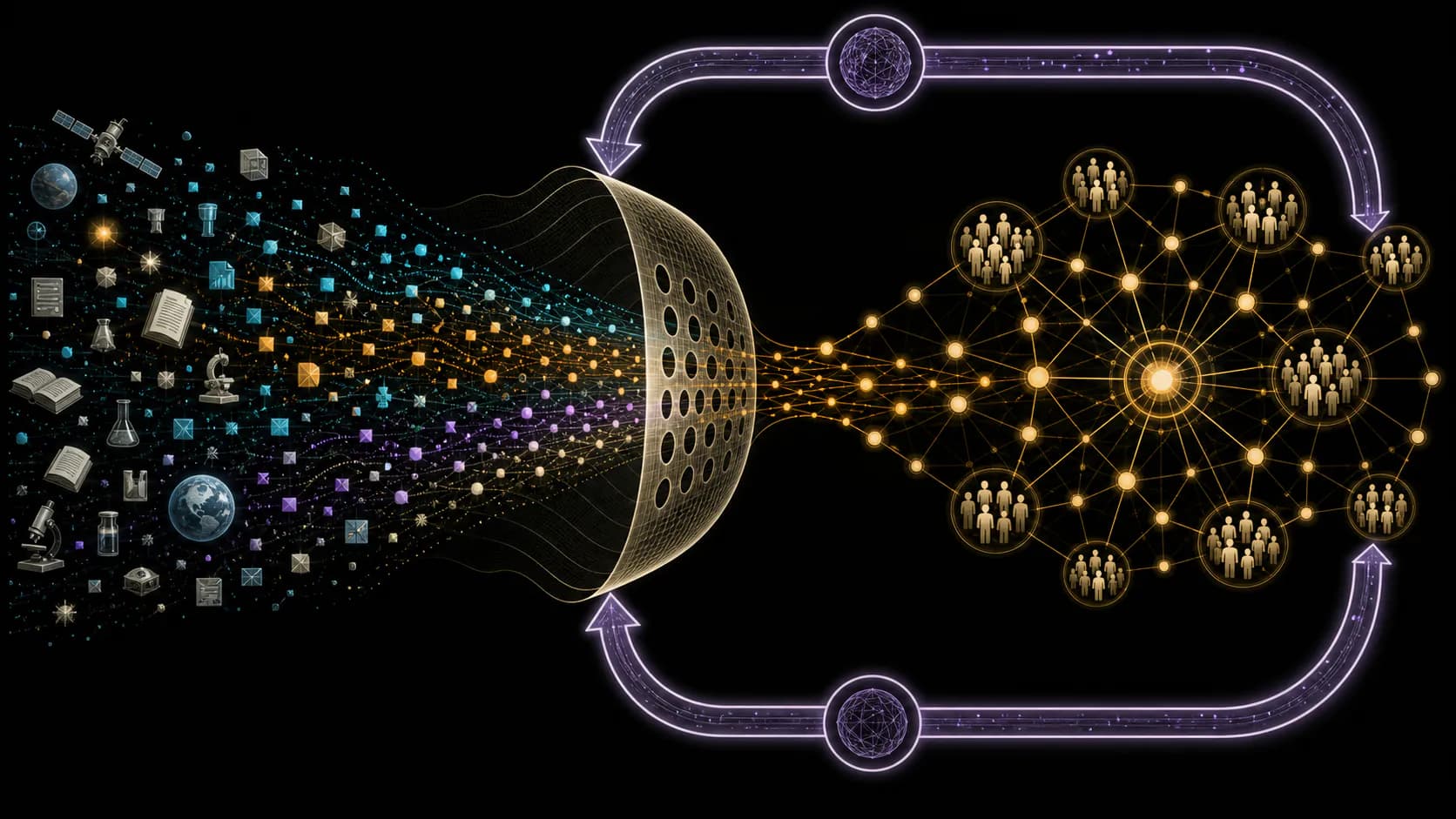
Ideological capture happens when people make a new discovery, technology, crisis, or outside power serve an existing political story and struggle.
Mechanism
How it operates
Groups select the parts of a new reality that support their goals, attach familiar moral meanings to it, and build identity around their interpretation. The object may be genuinely important while still becoming a symbol for older conflicts.
Human stakes
Why it matters
A society may stop asking what the discovery is and start fighting over what it represents. Decisions then reward loyalty, grievance, or power even when the underlying phenomenon demands a different response.
Used in: 15 catalog novels
Related: First contact · Galactic empire · Science as infrastructure
A few terms make the rest of the explanation easier to follow.
- Frame
- A pattern of interpretation that makes some features of an event salient while directing attention away from others.
- Motivated reasoning
- The tendency to evaluate evidence in ways that protect an existing identity, interest, commitment, or desired conclusion.
- Selection pressure
- Social or institutional rewards that make some claims easier to publish, repeat, fund, or publicly defend than alternatives.
Use the idea while reading
Turn the definition into three observations
Do not begin by asking whether a novel is “about” ideological capture. Begin with what changes in the lives of its characters, then use the concept to explain the mechanism underneath that change.
- 01
Notice which older grievance gives the new idea emotional force.
- 02
Notice what evidence each faction emphasizes or ignores.
- 03
Notice who gains membership, legitimacy, or coercive power from one interpretation.
Keep one question open: Is the ideology explaining the discovery or using it?
Avoid the shortcut: Strong belief or political disagreement is not automatically capture. Capture involves bending the meaning or use of something new toward a prior agenda while suppressing inconvenient evidence.
How it works, step by step
- 1
A disruptive fact enters an existing conflict
A discovery, crisis, or technology arrives in a society that already contains grievances, institutions, identities, and unequal power.
- 2
Groups attach familiar meanings
Each faction selects evidence and language that connect the new phenomenon to its earlier account of danger, virtue, betrayal, or progress.
- 3
Institutions reward alignment
Funding, membership, media attention, status, and protection favor people who reproduce the accepted frame and penalize inconvenient interpretations.
- 4
The filtered consensus reinforces itself
The resulting agreement is treated as proof of the frame, making contrary evidence look disloyal or unintelligible rather than informative.
A concrete example
One signal, four political programs
A verified alien transmission contains astronomical data but no explicit political statement.
01
One movement presents it as judgment on humanity, another as proof of technological destiny, another as a national-security threat, and another as a religious sign.
02
Each group funds experts and stories that make its interpretation socially useful while downplaying observations that do not fit.
03
Policy shifts from investigating the signal to rewarding allegiance through control of research, broadcasting, and the right to answer.
The point
Capture does not require invented evidence. It occurs when a real phenomenon is narrowed into a prior struggle until political usefulness controls what the society can learn from it.
What is real, and what remains uncertain
First separate what we can observe or build today from what remains a prediction or a fictional extension.
What evidence supports it
Observed social pattern
Political movements repeatedly absorb scientific discoveries, technologies, religions, and crises into existing identities. Science fiction changes the object and scale of that process.
A common misunderstanding
Strong belief or political disagreement is not automatically capture. Capture involves bending the meaning or use of something new toward a prior agenda while suppressing inconvenient evidence.
Try this example in your head
An alien signal contains no political message, yet rival movements call it proof of divine judgment, technological progress, national destiny, and human failure. The same data produces four programs.
Interpretation is unavoidable
All evidence requires concepts and values; capture is not merely having a perspective but suppressing correction so the object cannot challenge the prior agenda.
Consensus can still be warranted
Agreement produced by transparent methods, independent evidence, and open criticism should not be dismissed simply because it has political consequences.
How science fiction tests the idea
Stories usually test both the promise of an idea and the trouble it creates.
Its promise
New powers amplify unresolved social wounds.
Its problem
Radical alignment can be a coherent response to institutional failure.
What to notice in a story
- 01
Which older grievance gives the new idea emotional force
- 02
What evidence each faction emphasizes or ignores
- 03
Who gains membership, legitimacy, or coercive power from one interpretation
Novels that use this idea
Societal scale
Dark · Accessible
1984
A records clerk who rewrites the past begins a private rebellion and learns that the Party wants more than obedience: it wants control over what reality can mean.
Societal scale
Cautious · Layered
A Memory Called Empire
Imperial culture makes its own beauty, history, and categories feel universal, so resistance must work through a language that can absorb dissent as another proof of Teixcalaanli greatness.
Civilization scale
Hopeful · Demanding
Anathem
A young scholar raised behind monastery walls follows his exiled teacher into a planetary crisis where rival intellectual traditions must decide whether an alien ship is a visitor, a mirror, or a weapon.

Civilization scale
Dark · Demanding
Dune
Prepared prophecy and genuine Fremen need converge around Paul until a survival alliance becomes a political and religious movement larger than his private intentions.
Visual example · Seeing the future can narrow the chooser
Civilization scale
Cautious · Layered
Endymion
Centuries after the WorldWeb falls, Raul Endymion rescues a girl from the Time Tombs and flees a resurrection empire through the dead paths of its former portals.
Civilization scale
Balanced · Layered
Foundation
A mathematician predicts imperial collapse, exiles a knowledge project to the galaxy's edge, and leaves later leaders to discover how science can become political leverage.
Civilization scale
Dark · Layered
Foundation and Empire
The Seldon Plan survives the Empire's greatest general, then fails in front of a conqueror who can change the emotions that mass prediction assumes will average out.
Civilization scale
Dark · Layered
Nemesis Games
With the Rocinante crew scattered across the solar system, four private journeys expose a coordinated attack designed to break the old political order.
Civilization scale
Dark · Layered
Persepolis Rising
Decades after the Free Navy war, an empire returns from isolation with alien-enhanced warships and a plan to place every human world under one command.
Civilization scale
Cautious · Demanding
Second Foundation
Two searches hunt the hidden guardians of the Seldon Plan, only to discover that every apparent victory may be the belief those guardians needed their pursuers to hold.
Societal scale
Balanced · Demanding
The Dispossessed
Both societies turn selective accounts of the other world into proof that their own arrangements are natural, necessary, or already complete.
Cosmic scale
Hopeful · Demanding
The Rise of Endymion
Aenea begins teaching a direct, embodied alternative to Pax resurrection while Raul crosses years of time debt to rejoin her before the Core closes its trap.
Civilization scale
Dark · Demanding
The Three-Body Problem
Extraterrestrial contact becomes a vehicle for human movements seeking judgment, reform, power, or escape.
Civilization scale
Dark · Demanding
There Is No Antimemetics Division
Researchers fight ideas that erase their own traces from memory, leaving marriages, institutions, and an entire war dependent on evidence nobody can remember creating.
Societal scale
Dark · Demanding
Woken Furies
Back on Harlan's World, Kovacs protects a deCom leader who may contain a dead revolutionary while a younger copy of himself is sent to hunt them both.
Questions to keep thinking about
Is the ideology explaining the discovery or using it?
Which parts of the new reality resist every faction's story?
Can institutions respond to the phenomenon without pretending to be politically neutral?
Sources and further reading
These references ground the portable lesson; story interpretations remain editorial analysis.
National Academies of Sciences, Engineering, and Medicine
Reproducibility and Replicability in Science
MechanismReality checkLimitsUNESCO
Recommendation on Open Science
MechanismReality checkHuman stakesLimitsNational Academies of Sciences
2019 G7 Science Academies Declaration: Science and Trust
Reality checkHuman stakesLimits