Novel guide
The Three-Body Problem
Cixin Liu

Story and ideas · Remembrance of Earth’s Past · Volume 1
The Three-Body Problem
by Cixin Liu
Tor trade paperback · translated by Ken Liu · 2016 · Publisher details · Cover via Open Library
The universe starts counting down inside a scientist’s eyes. To learn why, he must enter a world with three suns—and follow a signal humanity may regret sending.
Full-story article
This article discusses the complete story, including the ending.
- Reading time
- About 11 hours
- Length
- 416 pages
- Reading complexity
- Demanding
- Dense terminology, structure, or viewpoint changes reward slower, attentive reading.
- Science intensity
- 5/5
- Scientific mechanisms are central to understanding the story.
Affiliate links. As an Amazon Associate, we earn from qualifying purchases.
Watch the story
Watch on Scifi Orthogonal
Video guides from our YouTube channel. These discuss the full story and may reveal the ending.
Before you read
Is this book for you?
Start by tracking: Track the historical wound, Wang’s countdown, the three-sun world, and which people treat contact as rescue, conquest, or evidence.
Read this if you enjoy
- First contact as a scientific and political mystery
- Ideas that grow from twentieth-century history
- Civilization-scale stakes built from investigation
Why readers may get lost
- The narrative crosses decades and viewpoints
- Scientific anomalies appear before their mechanism
- Organizations use the alien crisis for conflicting human goals
Keep these anchors in mind
- Ye Wenjie
- turns historical trauma into a decision for humanity
- Wang Miao
- follows impossible measurements toward their cause
- Da Shi
- keeps human motives visible inside cosmic mystery
- The Three Body game
- teaches a civilization through simulation
- Trisolaris
- turns distant contact into an approaching force
Demanding reading complexity. Dense terminology, structure, or viewpoint changes reward slower, attentive reading.
Science intensity 5/5. Scientific mechanisms are central to understanding the story.
01 · Overview
A scientific mystery whose first cause is a human wound
Begin with the emotional and investigative line. The alien civilization matters, but the novel first asks why someone on Earth would invite it.
Where the mystery begins
The universe starts counting down
Nanotechnology researcher Wang Miao sees a countdown that no instrument can explain. Around him, leading scientists are dying or abandoning their work because experimental results no longer seem coherent. Police investigator Shi Qiang—Da Shi—pulls Wang toward a secretive scientific circle and a virtual world repeatedly destroyed beneath three unpredictable suns.
The investigation feels fragmented because it crosses political history, laboratories, a game, and military intelligence. These are not separate plots. Each asks who has lost faith in humanity or in knowledge, and what they might accept in place of either.
The central question
If another civilization answered us, who would welcome it—and who would fear it?
First contact becomes a conflict among humans before it becomes a meeting between worlds. Grief, judgment, curiosity, and power decide what the signal means.
- The reading promise
- A detective mystery that widens from one scientist to two civilizations
- What to track
- The wound, the countdown, the three-sun world, and the people choosing sides
- The science
- Orbital chaos, experimental reliability, radio astronomy, and particle physics
- The question underneath
- Can any person answer for humanity’s right to control its own future?
Series flight path
Remembrance of Earth’s Past
This first volume establishes the contact crisis. The Dark Forest turns the discovery into strategy, and Death’s End follows the moral and physical consequences across later eras.
Volume 1 · You are here
The Three-Body ProblemDemanding
Volume 2
The Dark ForestDemanding
Volume 3
Death’s EndDemanding
02 · Story map
Eight turns from historical violence to a war against knowledge
Follow the cause-and-effect chain rather than trying to remember every proper name at once.
The story, in human terms
The opening mystery
- 1
A historical wound
Ye Wenjie loses faith in human institutions
Political violence during the Cultural Revolution destroys her family and repeatedly punishes trust, expertise, and private conscience.
What changes: Her later scientific choices will carry a moral judgment formed before any alien message arrives.
- 2
Red Coast
A classified antenna becomes a voice beyond Earth
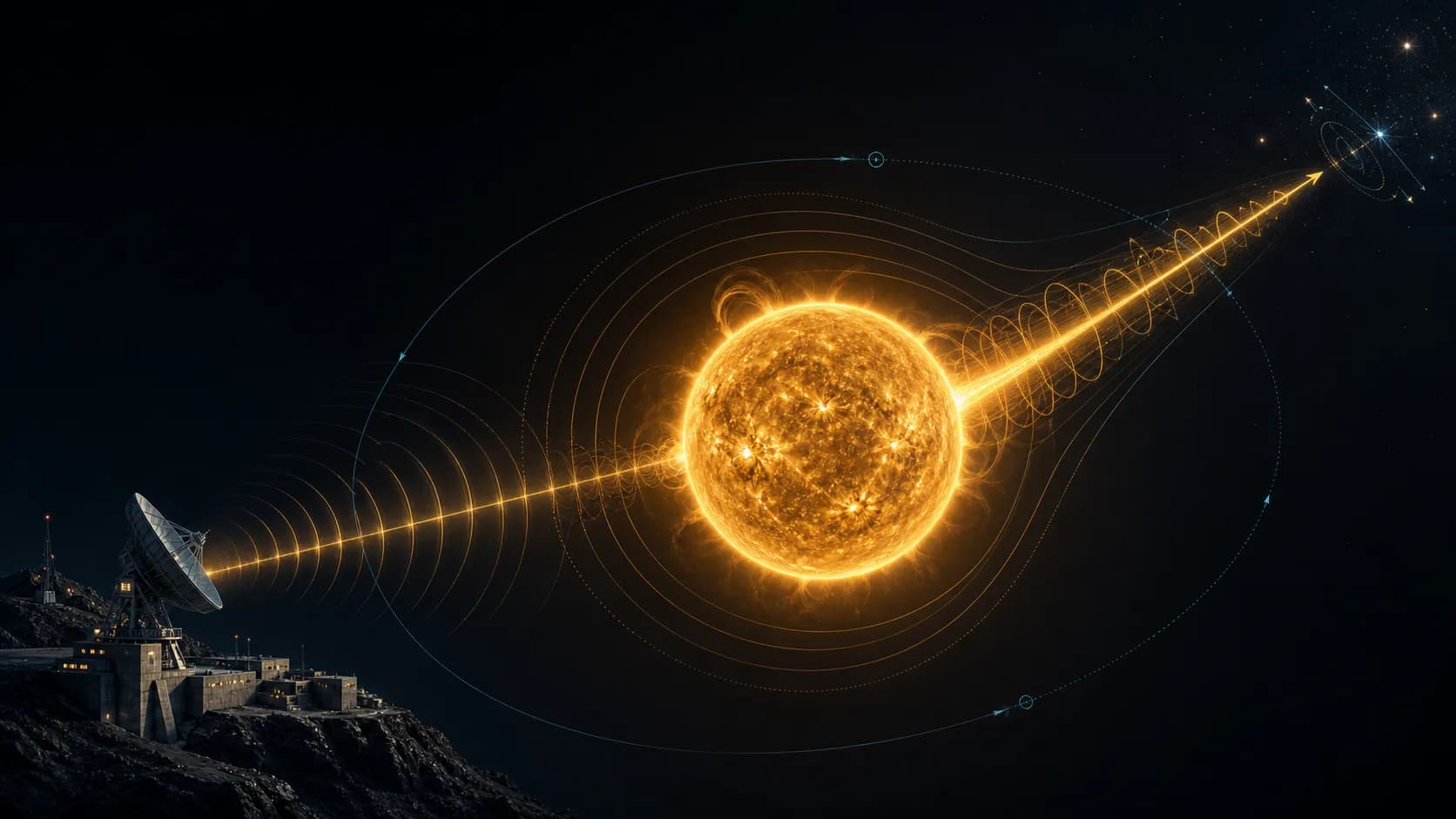
Ye discovers that the Sun can amplify a radio transmission, turning an isolated research base into an interstellar broadcaster.
What changes: A technical insight gives one injured person the power to make an irreversible species-level decision.
- 3
The countdown
Wang Miao is pressured through impossible evidence
A visual countdown, erratic experiments, and the deaths of scientists make the foundations of research feel personally targeted.
What changes: The case changes from unexplained physics into the possibility of an intelligent campaign against scientific confidence.
Illustrated explanation
How one decision becomes an interstellar signal
A focused causal diagram: antenna to Sun, amplification, then an irreversible path into interstellar space.
What to notice
- 01
Classified interstellar communication site
Red Coast Base
Its antenna and political isolation give Ye the means and opportunity to broadcast beyond Earth.
In the image: The ground installation supplies the transmitter.
- 02
Plot trajectory
The Sun becomes an interstellar amplifier
Ye recognizes a way to use the Sun to amplify a broadcast beyond the intended range of Red Coast.
In the image: The Sun is used as the amplifier.
- 03
Primary concept
First contact
Contact begins as a historically situated human decision long before two civilizations physically meet.
In the image: The signal leaves any Earth institution's control.
Mid-book context
The clues converge on another world
- 1
The investigation
Da Shi connects private despair to organized action
His attention to motives, meetings, and pressure points complements Wang’s need for repeatable evidence.
What changes: Scientists who appear isolated begin to form a social map around Frontiers of Science and a hidden movement.
- 2
Three suns
The game translates orbital chaos into lived history
Players experience civilizations that dehydrate, rebuild, calculate, and fail beneath a sky whose eras cannot be predicted.
What changes: An abstract problem becomes the environmental origin of a real civilization seeking a stable home.
- 3
Human allegiance
The Earth–Trisolaris Organization divides over what arrival should mean
Members project judgment, reform, or survival onto the distant civilization rather than sharing one coherent faith.
What changes: First contact reorganizes human loyalties centuries before a fleet could physically reach Earth.
Illustrated explanation
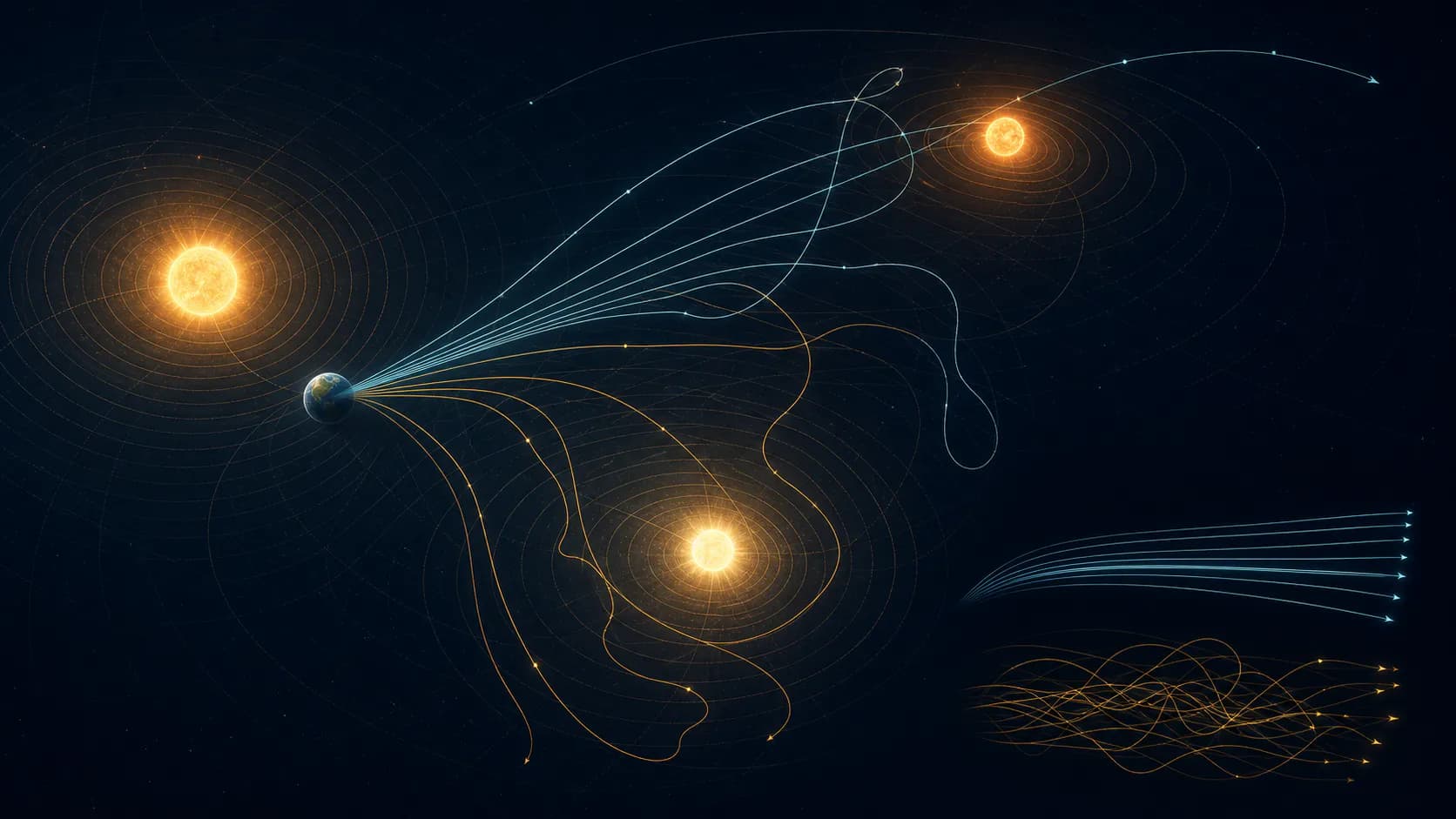
Why three suns defeat a reliable calendar
The paths remain lawful, but tiny differences grow until long-range eras cannot be securely predicted.
What to notice
- 01
Primary concept
Orbital instability
A lawful but chaotic three-star environment makes reliable eras the central material problem of Trisolaran civilization.
In the image: Competing gravitational pulls produce sensitive trajectories.
- 02
Civilization seeking a stable world
Trisolaris
Its survival beneath three suns produces both extraordinary endurance and the decision to target Earth.
In the image: Civilization must repeatedly survive the result.
- 03
Plot trajectory
Three suns make history unstable
The simulation reveals repeated civilizations trying to predict stable and chaotic eras under a three-star sky.
In the image: The game makes the instability experiential.
Complete trajectory
The recovered message reveals the real battlefield
- 1
Judgment Day
Humanity retrieves the contact record
A precisely timed nanofiber attack destroys the ETO ship while preserving enough data to reconstruct the exchange with Trisolaris.
What changes: The investigation gains direct evidence of the incoming fleet and its human collaborators.
- 2
The blockade
Sophons turn observation into strategic paralysis
Trisolaris unfolds protons into higher dimensions, builds intelligent circuitry into them, and sends them to Earth to interfere with particle experiments.
What changes: The coming war begins now as a four-century attempt to freeze the fundamental science that could let humanity catch up.
03 · Ideas and visuals
Three machines of the story, translated into human stakes
These are focused teaching illustrations: a signal chain, an unstable orbital system, and an observation blockade—not a decorative cosmic panorama.
Ideas explained
Ideas to carry into the story
No advanced physics is required. Keep the causal translation beside each idea.
Idea 1
Orbital instability
With three gravitating bodies, tiny differences in position and velocity can grow into radically different trajectories. The system follows laws without offering a dependable long-range calendar.
In this story: For Trisolaris, stability is not ordinary weather but a rare civilizational resource. The environmental problem makes another planet existentially attractive.
How would politics change if sunrise itself could not be promised?
Read the plain-language concept articleIdea 2
Science as infrastructure
Science is a continuity of instruments, methods, institutions, and trust in repeatable evidence—not merely a shelf of correct facts.
In this story: Corrupt experimental results and researchers can no longer build securely on earlier work. The attack targets a civilization’s future capacity.
What remains of rational inquiry when repetition no longer produces confidence?
Read the plain-language concept articleIdea 3
First contact
A message crosses distance and time without shared institutions, enforceable promises, or reliable knowledge of the receiver’s motives.
In this story: The first decisive interpretation belongs to one person whose life has made human cruelty feel more certain than alien danger.
Who has the authority to introduce an entire species?
Read the plain-language concept articleIllustrated explanation
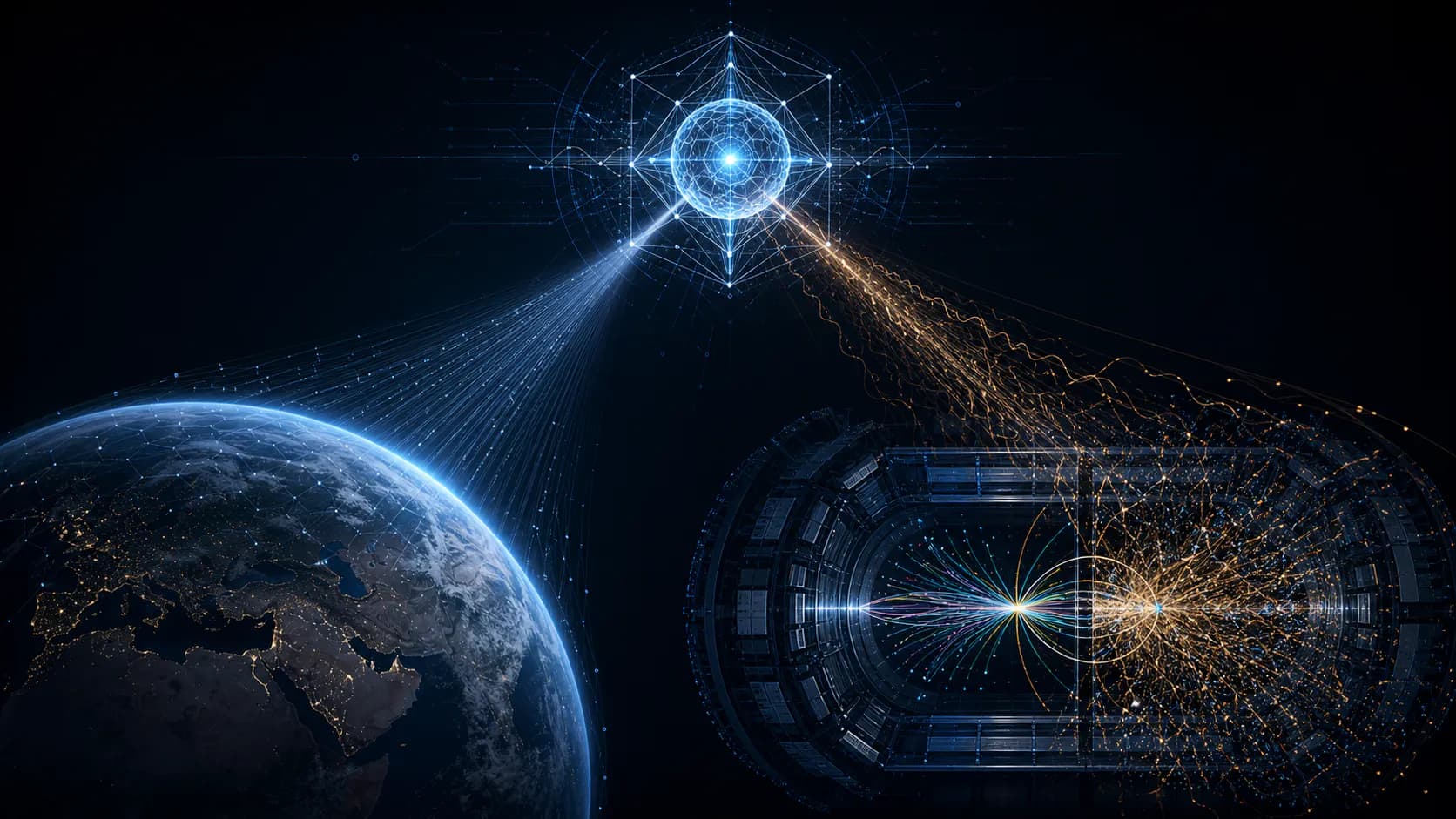
Observation becomes a blockade
The sophon links surveillance to corrupted frontier experiments, delaying the knowledge future technology would require.
What to notice
- 01
Observer and experimental disruptor
Sophon
An engineered proton arrives before the fleet to surveil Earth and obstruct fundamental physics.
In the image: An engineered observer reaches Earth before the fleet.
- 02
Speculative concept
Scientific blockade
Interference with frontier experiments is designed to freeze future capability rather than destroy present machines.
In the image: Detector results lose reliability at the frontier.
- 03
Plot trajectory
The future of physics is placed under pressure
Sophon interference makes frontier particle results unreliable while surveillance reports Earth's response.
In the image: The strategic effect begins centuries before arrival.
Scientific analysis
The observer is part of the strategy
The sophon joins two meanings of observation. In physics, measurement is part of how a phenomenon becomes knowable. In strategy, surveillance changes how the observed behave. Trisolaris uses both: experiments become unreliable while every visible response becomes intelligence.
04 · Reading guide
Four questions keep the names and machinery organized
Ask: whose wound is active, what evidence is being pressured, what the game is teaching, and who wants contact to mean what.
People in the signal
Ye Wenjie
Astrophysicist and initiator of contact
Political violence shapes the judgment behind her use of Red Coast and her answer to Trisolaris.
Wang Miao
Present-day scientific investigator
He follows the countdown, failed experiments, and Three Body experience into a civilization-scale conspiracy.
Shi Qiang
Police investigator and practical guide
Da Shi reads human pressure, organizations, and motives where scientists initially see isolated anomalies.
Yang Dong
Absent physicist at the center of the mystery
Her death connects scientific despair with the hidden history of first contact.
Shen Yufei
Physicist connected to the contact movement
Her research circle and commitment to solving the three-body problem draw Wang deeper into the investigation.
Ding Yi
Physicist confronting broken evidence
His grief and attention to experimental failure clarify how deeply the scientific crisis has entered personal life.
Worlds, groups, and technologies
Red Coast Base
Classified interstellar communication site
Its antenna and political isolation give Ye the means and opportunity to broadcast beyond Earth.
Frontiers of Science
Scientific network surrounding the mystery
It links debates about the limits of physics to people targeted, recruited, or watched during the crisis.
Three Body
Simulation, teaching device, and recruitment filter
It translates orbital chaos into recurring civilizational collapse that players can experience.
Trisolaris
Civilization seeking a stable world
Its survival beneath three suns produces both extraordinary endurance and the decision to target Earth.
Earth–Trisolaris Organization
Human movement aligned with contact
Its factions disagree over whether Trisolaris should conquer, reform, or simply replace human civilization.
Sophon
Observer and experimental disruptor
An engineered proton arrives before the fleet to surveil Earth and obstruct fundamental physics.
Reader lens · chapter 7
The game is a translation device
Three Body turns calculation into repeated civilizational trauma. Instead of merely hearing that an orbit is chaotic, players feel what it means to lose cities, records, and eras to an unreadable sky. Notice who keeps playing and what kind of commitment the experience selects.
Reader lens · chapter 15
First contact is already political
The useful question is no longer only whether humanity is alone. Ask who is trusted to interpret the answer. The other civilization becomes a screen onto which people project rescue, punishment, progress, and extinction.
Reader lens · chapter 21
Remember factions by desire
One group longs for outside judgment, another imagines reform under superior knowledge, and others focus on survival or self-interest. Their disagreement is the point: contact amplifies conflicts already present rather than producing one human response.
Progress-safe room
Safe through Chapter 10
Progress-safe room
Safe through Chapter 22
05 · Ending explained
Why the invasion begins by making truth feel impossible
The ending connects the human invitation, the alien response, and the attack on scientific confidence.
The ending mechanism
A reply shaped by history becomes a four-century blockade
Ye’s transmission reaches Trisolaris, where a pacifist warns her not to answer because any reply will reveal Earth’s position. She answers anyway, inviting intervention. Her choice grows from experiences that made humanity’s self-rule look irredeemable, but its consequences belong to people who never consented to that judgment.
The recovered ETO data shows that Trisolaris has launched a fleet and sent sophons ahead. These intelligent protons can surveil Earth and disrupt particle accelerators, preventing reliable experiments at the frontier of physics. The invasion therefore begins as an attack on what humanity may learn before the ships arrive.
- The signal
- A radio experiment becomes an irreversible political act by revealing a direction back to Earth.
- The game
- A model of environmental chaos creates empathy, recruits attention, and filters potential allies.
- The human conflict
- Contact gives existing grief and ideology a civilization-scale object.
- The blockade
- Observation and experimental interference constrain the science of future generations.
Keep exploring
Follow the idea beyond this ending
The Idea Atlas connects this novel’s central question to the science, philosophy, and other stories that approach it differently.
Open the connected ideaContinue through the catalog
Find another world on the same axis
Questions that continue after the reveal
The alien threat grows from conflicts already present on Earth
The final chapters explain the countdown and the sophons, but the book's deeper movement begins earlier: private trauma becomes political judgment, scientific doubt becomes strategic pressure, and contact becomes a screen for competing human hopes.
These perspectives help the mystery remain human even after its scale expands to another civilization.
Ye Wenjie's choice
How does suffering become authority over the future?
Ye's experiences give her powerful evidence of cruelty, betrayal, and institutional violence. They do not give her access to every possible human future, yet the reply lets one life's judgment commit people who never shared the decision.
Why this matters: The first-contact event becomes a question about when understandable despair turns into illegitimate representation.
Wang and Da Shi
Why does the investigation need two ways of knowing?
Wang looks for repeatable physical evidence and feels the deepest shock when nature seems incoherent. Da Shi reads incentives, fear, organizations, and human behavior. Each sees patterns the other initially discounts.
Why this matters: The mystery becomes solvable when scientific and social evidence are treated as parts of the same event.
Three Body as a game
Does the simulation explain Trisolaris or recruit a human response to it?
Players learn the suffering produced by the unstable suns through repeated collapse and rebuilding. The experience creates genuine understanding while selecting people willing to interpret the alien crisis in particular moral and political ways.
Why this matters: A model can educate and persuade at the same time; emotional accuracy does not make its framing neutral.
The sophon attack
Why target confidence rather than existing weapons?
Trisolaris cannot arrive for centuries, so it acts against the process that could make present superiority obsolete. Unreliable frontier experiments isolate generations from deeper physical knowledge.
Why this matters: The invasion begins as control over possible futures, showing that a civilization's ability to learn is strategic infrastructure.
Coordinates on a neighboring axis
Novel guide
The Dark Forest
The Dark Forest
Cixin Liu
Humanity can prepare for an invasion everyone can see, but its only secure hiding place may be a single private mind.
Novel guide
Death’s End
Death’s End
Cixin Liu
Across centuries of borrowed time, one aerospace engineer inherits decisions that ask whether compassion can protect a civilization—or expose it.
Novel guide
Contact
Contact
Carl Sagan
When radio astronomer Ellie Arroway finds a prime-number signal from Vega, decoding it gives humanity instructions for a Machine no one can prove is invitation rather than trap.
Content notes
Political violence during the Cultural Revolution · Suicide · Murder and death · Existential threat · Institutional persecution
Editorial record
Research and sources
The story analysis is original. Background sources support the scientific and philosophical explainers connected to this novel.
Last reviewed July 22, 2026