
The idea in plain English
Plain idea
What changes
Interstellar travel means moving people, machines, or living systems from one star system to another across distances so large that even light takes years.
Mechanism
How it operates
A mission must accelerate a payload, sustain it through the cruise, and slow it at the destination. Energy, reaction mass, heat, shielding, reliability, communication delay, and traveler's elapsed time all shape what kind of journey is possible.
Human stakes
Why it matters
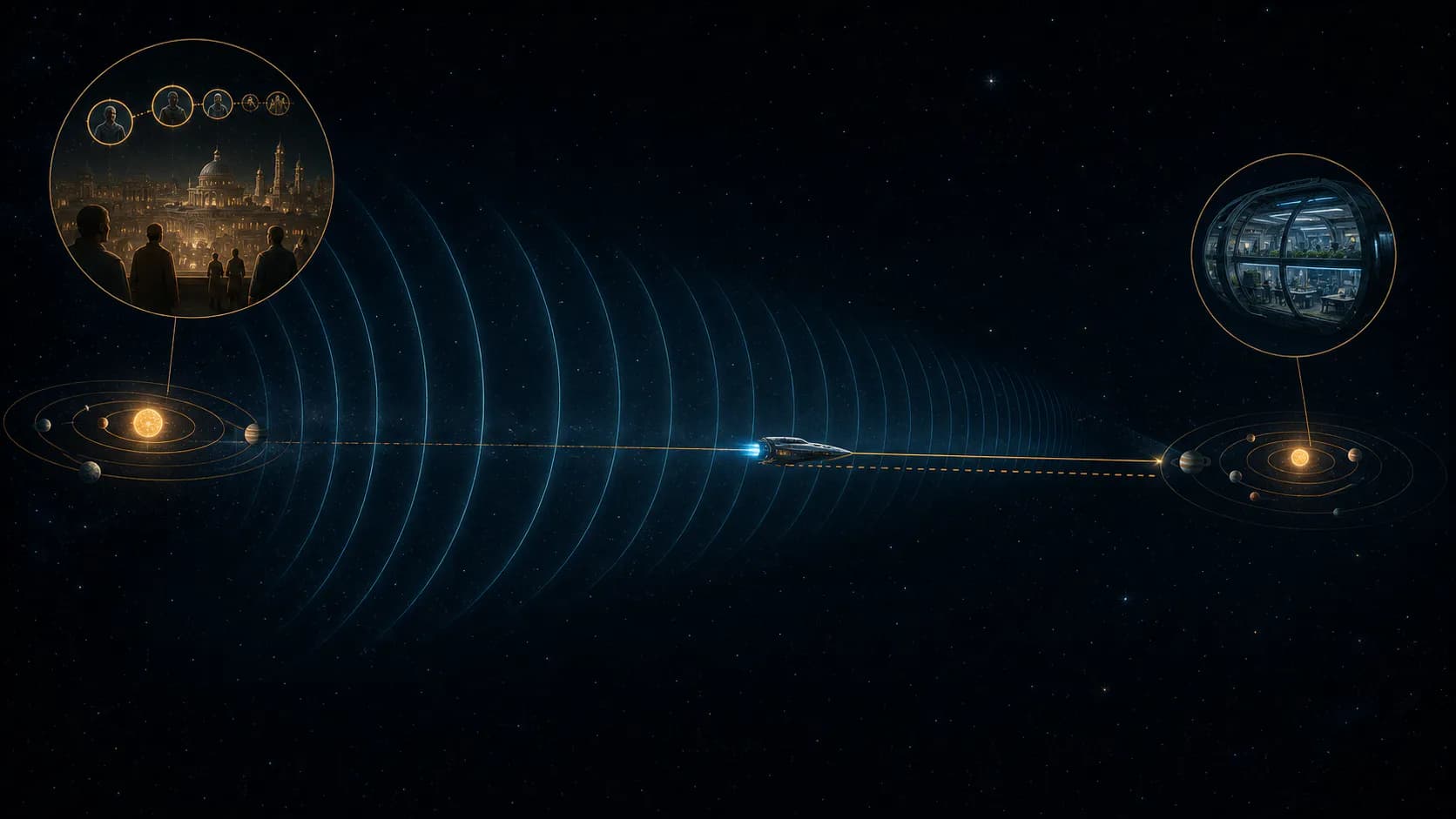
The travelers and the society that launched them stop sharing a present. Instructions arrive late, families age, political authority weakens, and the destination may be different from what decades-old observations promised.
Used in: 10 catalog novels
Related: Spacecraft propulsion · Relativistic time dilation · Suspended animation
A few terms make the rest of the explanation easier to follow.
- Light-year
- A unit of distance equal to how far light travels in one year, not a measure of travel time by itself.
- Delta-v
- The total change in velocity a spacecraft can produce for acceleration, course correction, and braking.
- Cruise phase
- The long interval between departure and arrival burns, when shielding, reliability, life support, and communication dominate the mission.
- Braking
- The energy and propulsion required to reduce arrival velocity enough to enter orbit, rendezvous, or land.
Use the idea while reading
Turn the definition into three observations
Do not begin by asking whether a novel is “about” interstellar travel. Begin with what changes in the lives of its characters, then use the concept to explain the mechanism underneath that change.
- 01
Notice the acceleration, cruise, and braking phases of the journey.
- 02
Notice how life support and repairs survive longer than institutions or crews.
- 03
Notice whether messages, travelers, and political decisions move on different timescales.
Keep one question open: What cost does the story hide inside the word distance?
Avoid the shortcut: Reaching cruising speed is only part of the problem. A useful mission must also survive, navigate, communicate, and usually decelerate without exceeding its energy and heat limits.
How it works, step by step
- 1
Observe and choose a destination
Astronomers infer conditions from light that has already spent years traveling, so a mission begins with an aging picture of the target.
- 2
Accelerate payload and survival systems
The drive must change the velocity of structure, shielding, supplies, people, and propellant rather than moving an abstract point mass.
- 3
Survive the interval
Radiation, dust impacts, heat rejection, component failure, social continuity, and communication delay accumulate throughout the cruise.
- 4
Arrive at a usable speed
Without a braking method, a fast craft only performs a brief flyby. Settlement, rescue, and rendezvous usually require another large energy and momentum exchange.
A concrete example
A mission to a star four light-years away
A crewed craft can cruise at one tenth of light speed after acceleration, while messages travel at light speed.
01
Ignoring acceleration and braking, the material journey already lasts about forty years in the departure frame.
02
A message sent after launch can overtake the craft, but a question and answer between Earth and the crew still spans years.
03
The ship must preserve people and machinery for decades, then spend substantial delta-v to avoid crossing the destination too quickly.
The point
Interstellar travel is a complete mission architecture, not a top-speed claim. Distance becomes time, energy, maintenance, delayed authority, and the problem of arriving rather than merely passing.
What is real, and what remains uncertain
First separate what we can observe or build today from what remains a prediction or a fictional extension.
What evidence supports it
Established constraints, speculative capability
The distances, speed of light, radiation, energy costs, and orbital mechanics are real. No human-built craft can yet carry people between stars.
A common misunderstanding
Reaching cruising speed is only part of the problem. A useful mission must also survive, navigate, communicate, and usually decelerate without exceeding its energy and heat limits.
Try this example in your head
A colony ship leaves with a twenty-year communication delay. Midflight, Earth cancels the mission and changes the destination. Is the crew still governed by a society whose orders describe a world that no longer exists?
No human interstellar vehicle exists
Distances and physical constraints are measured, but present spacecraft are far too slow and dependent on support to carry people between stars.
Transit estimates hide mission phases
Dividing distance by a quoted speed omits acceleration, braking, course changes, safety margins, and the mass needed to keep the payload functional.
How science fiction tests the idea
Stories usually test both the promise of an idea and the trouble it creates.
Its promise
Crossing interstellar distance can widen the range of lives and worlds a civilization may sustain.
Its problem
Distance can isolate travelers from the institutions and obligations that launched them.
What to notice in a story
- 01
The acceleration, cruise, and braking phases of the journey
- 02
How life support and repairs survive longer than institutions or crews
- 03
Whether messages, travelers, and political decisions move on different timescales
Novels that use this idea
Societal scale
Dark · Demanding
Broken Angels
Takeshi Kovacs deserts a planetary war for a corporate salvage mission whose prize is a functioning gateway to an ancient Martian starship.
Cosmic scale
Hopeful · Layered
Contact
The Machine replaces a long voyage with entry into infrastructure that humanity did not build, cannot inspect, and can use only on terms set elsewhere.
Cosmic scale
Dark · Demanding
Death’s End
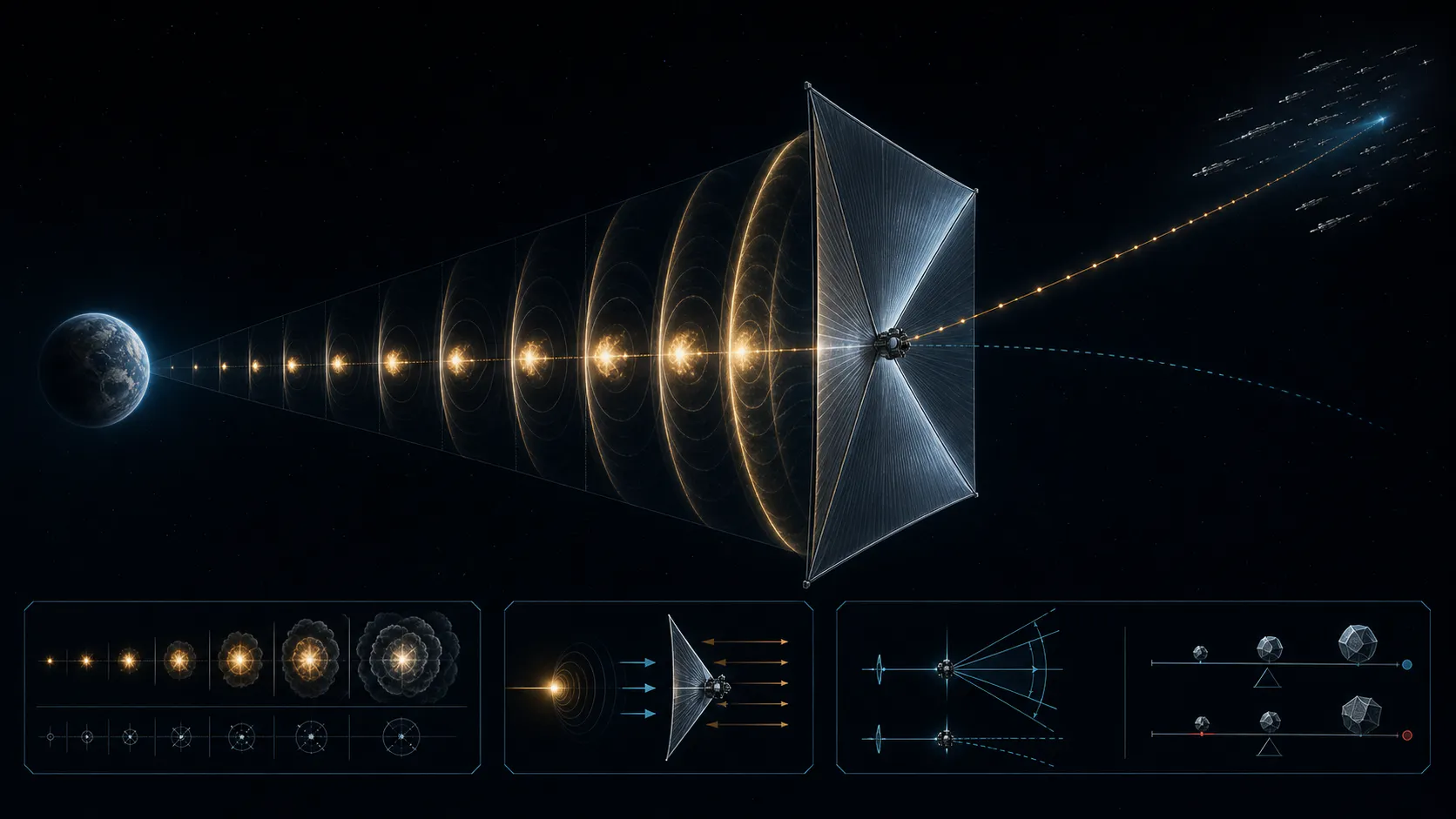
Missions, escaping ships, and a human diaspora turn travel between stars into a sequence of technical choices and broken social continuities.
Visual example · How the Staircase Program turns explosions into velocity
Cosmic scale
Hopeful · Demanding
Diaspora
A digital person born without a human original joins a civilization-wide flight from astrophysical disaster and follows a trail beyond familiar space, bodies, and universes.
Cosmic scale
Balanced · Demanding
House of Suns
Two travelers from a lineage of nearly a thousand cloned selves arrive late to a reunion and find their family massacred. Their search for the killer unearths a buried galactic crime.
Cosmic scale
Balanced · Demanding
Leviathan Falls
As the gate network begins turning human minds against one another, the scattered survivors of Laconia must decide whether unity is salvation or extinction by another name.
Civilization scale
Hopeful · Layered
Project Hail Mary
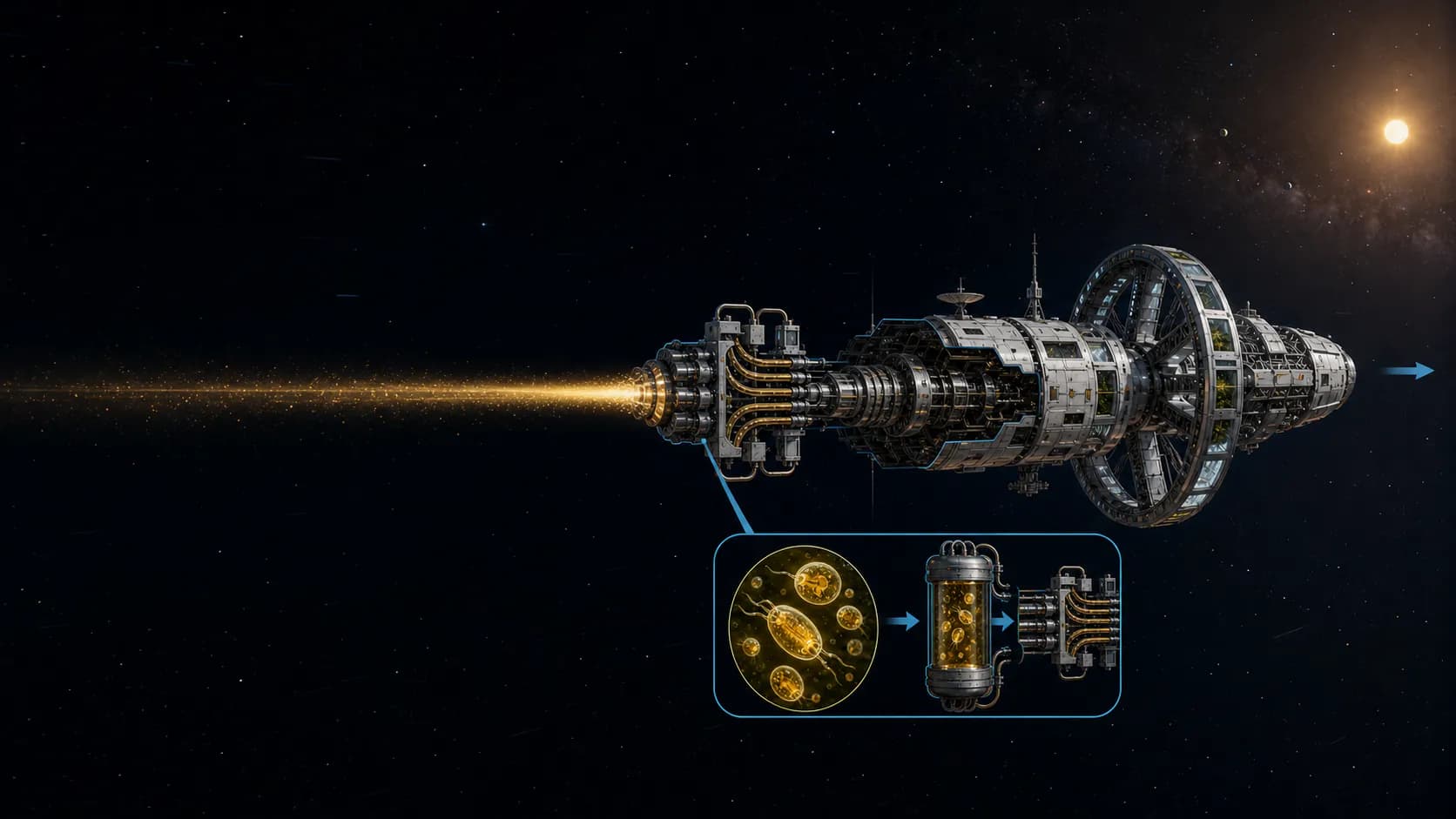
A one-way laboratory mission makes stellar distance a problem of stored knowledge, finite supplies, acceleration, and decisions whose results may arrive too late.
Visual example · The crisis organism becomes the mission's engine
Cosmic scale
Cautious · Layered
Pushing Ice
A mining crew chases Saturn's departing moon Janus for a brief look at an alien machine. The chase becomes a one-way journey that turns a shipboard disagreement into a civilization's history.
Cosmic scale
Dark · Demanding
The Dark Forest
The fleet's four-century crossing gives Earth time to transform while making every defense plan an obligation passed to later societies.
Civilization scale
Dark · Demanding
The Three-Body Problem
The fleet's centuries-long transit turns distance into preparation time for Earth and a strategic vulnerability for Trisolaris.
Questions to keep thinking about
What cost does the story hide inside the word distance?
Does the mission remain accountable to its origin after decades of separation?
Is arrival presented as exploration, migration, rescue, invasion, or exile?
Sources and further reading
These references ground the portable lesson; story interpretations remain editorial analysis.