
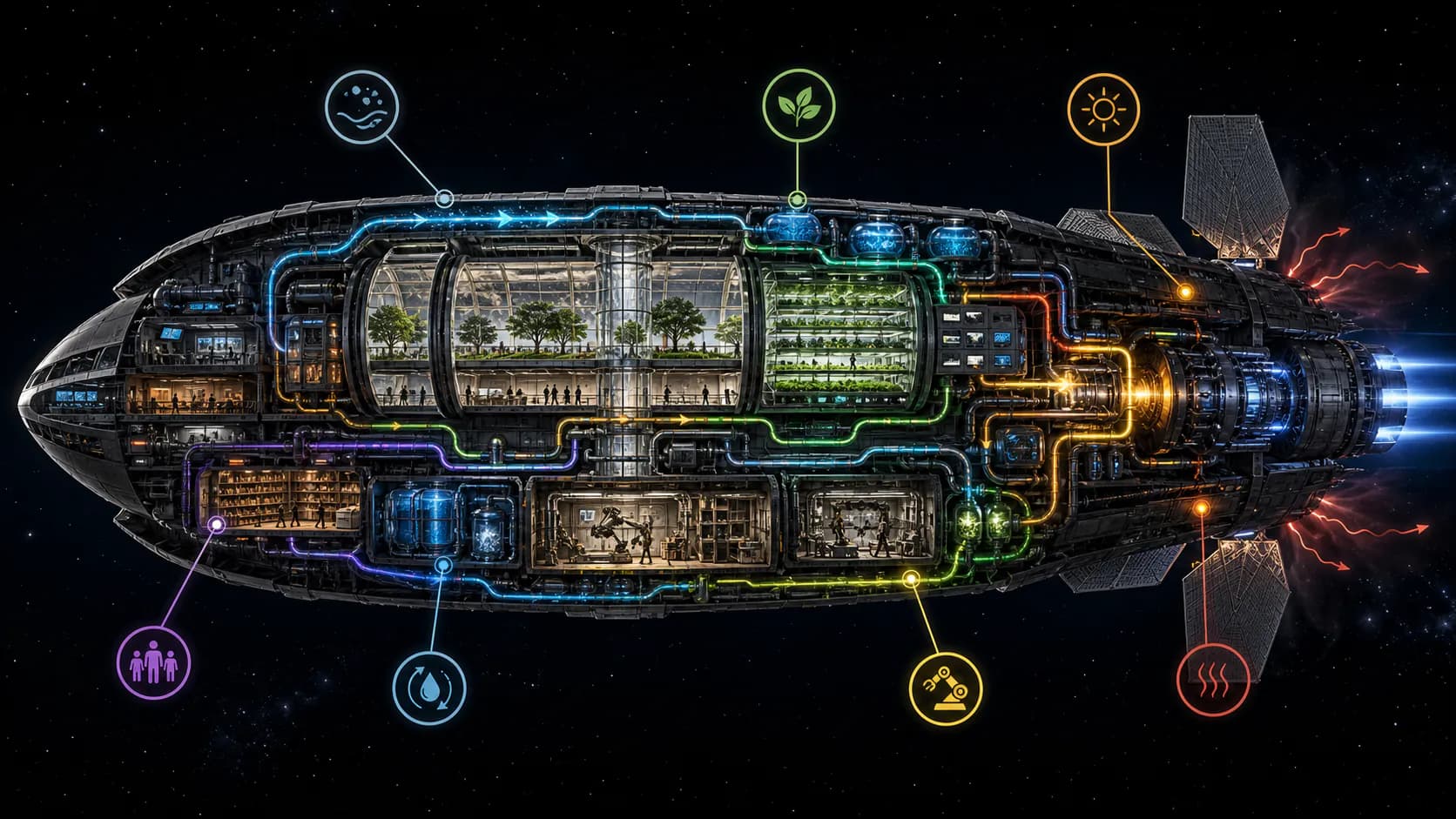
The idea in plain English
Plain idea
What changes
A generation ship is a spacecraft built to support a changing human or alien society for so long that later generations, not the original crew, complete the journey.
Mechanism
How it operates
The ship couples propulsion, shielding, agriculture, air and water recovery, population stability, education, maintenance, and government. Because no subsystem is perfectly closed, it needs reserves, repair capacity, adaptable knowledge, and institutions able to respond to failures the founders did not predict.
Human stakes
Why it matters
The passengers inherit both a home and an assignment. Questions about reproduction, labor, authority, dissent, memory, and destination become engineering constraints because a political failure can break life support as surely as a failed pump.
Used in: 4 catalog novels
Related: Interstellar travel · Closed-loop life support · Intergenerational governance
A few terms make the rest of the explanation easier to follow.
- Generation time
- The average interval between the birth of parents and the birth of their children, shaping how many generations a voyage contains.
- Carrying capacity
- The population a habitat can support under its food, air, water, energy, space, and waste constraints.
- Maintainability
- The ability to inspect, repair, replace, and redesign systems using tools, materials, and knowledge available onboard.
- Mission legitimacy
- The reasons current inhabitants have to accept, revise, or reject a purpose chosen before they were born.
Use the idea while reading
Turn the definition into three observations
Do not begin by asking whether a novel is “about” generation ships. Begin with what changes in the lives of its characters, then use the concept to explain the mechanism underneath that change.
- 01
Notice how air, water, food, energy, and spare parts cycle with unavoidable losses.
- 02
Notice who teaches skills and preserves reasons after the founders are gone.
- 03
Notice whether descendants may revise the mission, population rules, or destination.
Keep one question open: Which subsystem failure would spread fastest into social conflict?
Avoid the shortcut: A generation ship is not merely a very large rocket with farms. It is a coupled society whose biological, technical, educational, and political systems must remain repairable for longer than any founding institution survives.
How it works, step by step
- 1
Design a long-duration habitat
Shielding, rotation or gravity strategy, living space, life support, agriculture, energy, heat rejection, and reserves must support complete lives.
- 2
Close material and technical loops
Water, air, nutrients, components, tools, and knowledge cycle with losses that require manufacturing, repair, substitution, and careful inventories.
- 3
Sustain a capable population
Health, reproduction, education, specialization, care, culture, and conflict resolution keep the ship functioning after the original crew is gone.
- 4
Govern change and arrival
Later generations need legitimate authority to revise population rules, maintenance priorities, destination, and the meaning of completing the mission.
A concrete example
A safer world appears halfway
Descendants on a two-century voyage discover a newly observed habitable planet that is safer but would require abandoning the founders' scientific destination.
01
Changing course affects propulsion reserves, arrival knowledge, population planning, and the institutions built around the original purpose.
02
The founders cannot consent again, while current inhabitants bear the risks and possess evidence unavailable at launch.
03
A legitimate charter should preserve reasons and expertise without making obedience to dead planners more important than living passengers.
The point
A generation ship is a society whose politics are coupled to engineering. Technical survival requires education, consent, revision, and care across people who inherit both home and mission.
What is real, and what remains uncertain
First separate what we can observe or build today from what remains a prediction or a fictional extension.
What evidence supports it
Speculative mission architecture
Closed habitats, submarines, space stations, ecological recycling, and long-duration isolation provide partial evidence. No self-sufficient spacecraft has supported multiple human generations.
A common misunderstanding
A generation ship is not merely a very large rocket with farms. It is a coupled society whose biological, technical, educational, and political systems must remain repairable for longer than any founding institution survives.
Try this example in your head
Halfway through a two-century voyage, descendants discover a safer habitable world off the planned route. The original charter forbids deviation. Which people, systems, and promises have authority to choose?
Partial analogues are not full demonstrations
Space stations, submarines, isolated settlements, and ecological experiments illuminate components, but none has maintained a closed multigenerational space society.
Population is not a replaceable component
Treating reproduction, labor, or education as engineering variables can hide coercion and inequality that later become direct threats to system stability.
How science fiction tests the idea
Stories usually test both the promise of an idea and the trouble it creates.
Its promise
A generation ship can turn an unreachable destination into a shared civilizational project sustained by care and accumulated knowledge.
Its problem
A mission chosen by founders can become an inherited confinement whose descendants never consented to its destination or risks.
What to notice in a story
- 01
How air, water, food, energy, and spare parts cycle with unavoidable losses
- 02
Who teaches skills and preserves reasons after the founders are gone
- 03
Whether descendants may revise the mission, population rules, or destination
Novels that use this idea
Civilization scale
Hopeful · Layered
Children of Time
The Gilgamesh preserves a population across deep time, but mechanical wear, uneven awakening, command hierarchy, lost expertise, and reproduction turn the ark into a changing society rather than a sealed container.
Civilization scale
Hopeful · Demanding
The Arrows of Time
On the return leg, Peerless is less a vehicle than a mobile society deciding whether home, migration, and mission still mean what they did at launch.
Civilization scale
Hopeful · Demanding
The Clockwork Rocket
Peerless is both a machine and a society whose descendants must preserve science, crops, repairs, and a purpose chosen before they were born.
Societal scale
Balanced · Demanding
The Eternal Flame
By the third generation, the inherited rescue mission must justify scarcity and sacrifice to people who know the home world only through records.
Questions to keep thinking about
Which subsystem failure would spread fastest into social conflict?
How does the ship earn obligations from people born after launch?
Does the society preserve a mission, a destination, or the freedom to choose again?
Sources and further reading
These references ground the portable lesson; story interpretations remain editorial analysis.