
Novel guide
The Clockwork Rocket
Greg Egan

Story and ideas · Orthogonal · Volume 1
The Clockwork Rocket
by Greg Egan
Night Shade Books trade paperback · 2012 · Publisher details · Cover via Open Library
When lethal meteors cross her world's history, physicist Yalda must turn a mountain into a rocket—and entrust salvation to generations she will never meet.
Full-story article
This article discusses the complete story, including the ending.
- Reading time
- About 11 hours
- Length
- 344 pages
- Reading complexity
- Demanding
- Dense terminology, structure, or viewpoint changes reward slower, attentive reading.
- Science intensity
- 5/5
- Scientific mechanisms are central to understanding the story.
Affiliate links. As an Amazon Associate, we earn from qualifying purchases.
Watch the story
Watch on Scifi Orthogonal
Video guides from our YouTube channel. These discuss the full story and may reveal the ending.
Before you read
Is this book for you?
Start by tracking: Follow Yalda’s questions in order: each new observation solves one problem while exposing a larger physical or social constraint.
Read this if you enjoy
- Physics discovered step by step inside an alien world
- Science joined to reproductive and political freedom
- A generational mission built from collective work
Why readers may get lost
- The fictional geometry differs from our universe
- Technical discovery and social reform develop together
- The characters’ biology changes familiar assumptions
Keep these anchors in mind
- Yalda
- moves from observation to science and organizing
- The Hurtlers
- make a distant physical anomaly an extinction threat
- Peerless
- turns time dilation into a civilizational plan
- Nereo
- helps translate geometry into shared knowledge
- The women of Yalda’s world
- bear the bodily cost of inherited institutions
Demanding reading complexity. Dense terminology, structure, or viewpoint changes reward slower, attentive reading.
Science intensity 5/5. Scientific mechanisms are central to understanding the story.
01 · Overview
A child follows a streak of light into a rescue measured in generations
This is an original companion to the novel, not the novel itself. Begin with Yalda’s struggle for a life of her own; the unfamiliar physics matters because it gives that life a civilization-scale purpose.
Where the journey begins
Curiosity is Yalda’s first act of independence
Yalda grows up in a rural community where her body is expected to determine her future. She wants education, scientific work, and the right to decide what her life is for. A strange object crossing the sky becomes more than a childhood fascination: understanding its motion requires a new account of light, matter, and time.
The same phenomenon threatens every nearby world. Yalda and the people who believe her need an answer faster than their civilization can discover one. Their solution is not a single invention but a society built to keep learning after its founders are gone.
The central question
What if a rescue could borrow centuries for its researchers while home waited only years?
The impossible geometry creates the opportunity. Education, consent, food, maintenance, and trust determine whether anyone can use it.
- The reading promise
- A scientific life story that widens into the founding of a generation world
- What to track
- Yalda’s choices, the Hurtlers, the new geometry, and what Peerless must preserve
- What can pass
- You do not need to reproduce the derivations; keep the observation, changed model, and practical consequence
- The question underneath
- Can a mission for the future respect the lives and choices of the people who must carry it?
The story, in human terms
The opening human path
These three turns give the physics a reason to matter.
- 1
A constrained childhood
Yalda wants a future beyond the role assigned to her
Learning offers a way to name both the sky and the forces controlling her own life.
What changes: Education turns private refusal into the possibility of useful work and durable independence.
- 2
A streak in the sky
An impossible motion becomes a lifelong question
Yalda cannot accept a description that leaves the observation unexplained.
What changes: The Hurtler connects personal curiosity to a physical danger no city can ignore forever.
- 3
A scientific community
Questions become instruments, arguments, and students
Teachers and colleagues give Yalda room to test ideas while exposing the institutions that decide whose knowledge counts.
What changes: The mystery can now become shared theory—and eventually shared action.
Series flight path
Orthogonal
The Clockwork Rocket founds the mission. The Eternal Flame follows the third generation as finite resources and reproductive politics collide. The Arrows of Time follows the return and asks whether descendants must complete the purpose they inherited.
Volume 1 · You are here
The Clockwork RocketDemanding
Volume 2
The Eternal FlameDemanding
Volume 3
The Arrows of TimeDemanding
02 · Story map
From one anomalous light to a mountain in flight
Follow the decisions that turn one strange observation into a journey requiring an entirely new society.
The story, in human terms
The mission takes shape
- 1
The evidence
Hurtlers reveal a different orientation of history
Yalda’s insistence on a coherent explanation risks her standing but gives the threat a form people can investigate.
What changes: Time can no longer be treated as categorically unlike every spatial direction.
- 2
The geometry
A strange spacetime becomes usable
The new model matters because it predicts how light and matter can move, not because its equations are elegant in isolation.
What changes: A trajectory becomes conceivable on which travelers experience far more time than the people at home.
- 3
The proposal
Eusebio asks a mountain to carry a scientific civilization
The plan asks living people to leave home and unborn descendants to continue work they did not choose.
What changes: A planetary emergency becomes a problem of engines, farms, schools, legitimacy, and generations.
Illustrated explanation
How Peerless borrows generations from geometry
The fictional Riemannian geometry lets the mountain ship turn onto a history that contains many traveler lifetimes while only a short interval passes at home; Hurtlers reveal the dangerous intersecting orientation.
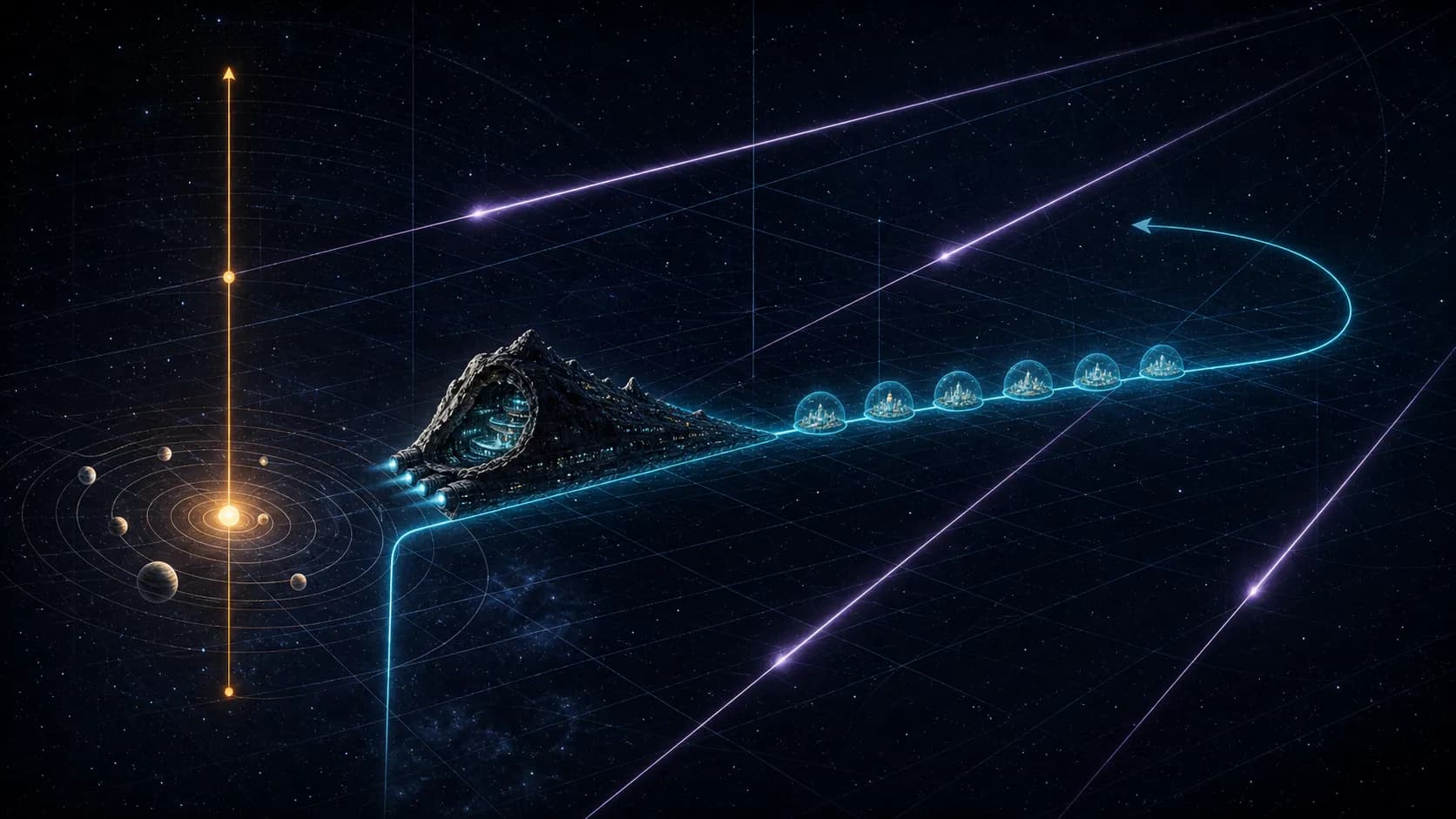
What to notice
- 01
Mountain-sized generation ship
Peerless
A carved and engineered mountain becomes habitat, laboratory, school, farm, and vehicle for a society in flight.
In the image: The carved mountain begins the long orthogonal cruise.
- 02
Primary concept
Riemannian spacetime
Yalda learns that treating time with the same geometric sign as space overturns familiar light cones and makes an orthogonal multigenerational journey possible.
In the image: Successive habitat glows represent generations along the ship's extended history.
- 03
Planetary threat and clue to alternate spacetime
The Hurtlers
Their extreme intersecting histories make both the catastrophe and the orthogonal rescue trajectory visible.
In the image: Symmetric streaks cross the home system on differently oriented histories.
- 04
Plot trajectory
A mountain becomes the rescue plan
Eusebio proposes a generation ship whose travelers can spend centuries researching while home experiences only years.
In the image: Home experiences only a short span while the travelers gain research time.
Expanded context
The idea becomes an irreversible commitment
- 1
Visible catastrophe
Gemma’s destruction ends the luxury of disbelief
A distant loss makes the Hurtler threat immediate to people who never followed the theory.
What changes: Emergency authority and labor can now be organized around Peerless.
- 2
Mountain works
Rock becomes engine, habitat, and archive
Workers and prospective travelers must build a home whose failures will be inseparable from their own survival.
What changes: Propulsion is no longer one machine; it is an infrastructure project coupled to a whole society.
- 3
Launch
Peerless leaves both supervision and rescue behind
Travelers accept that no authority at home can solve their future disputes or repair their future mistakes.
What changes: The founders’ plan becomes the descendants’ world.
- 4
Weightlessness
The crops expose a missing assumption
The first crisis after launch threatens food rather than theory, forcing the travelers to redesign the mountain while living inside it.
What changes: Rotation and artificial gravity reveal the habitat as one connected biological and mechanical loop.
Illustrated explanation
A mountain becomes a coupled living system
Rotation gives crops an outward floor, while water, cooling, workshops, and sunstone engines connect every inhabited layer; damage in one farm zone threatens the whole habitat.
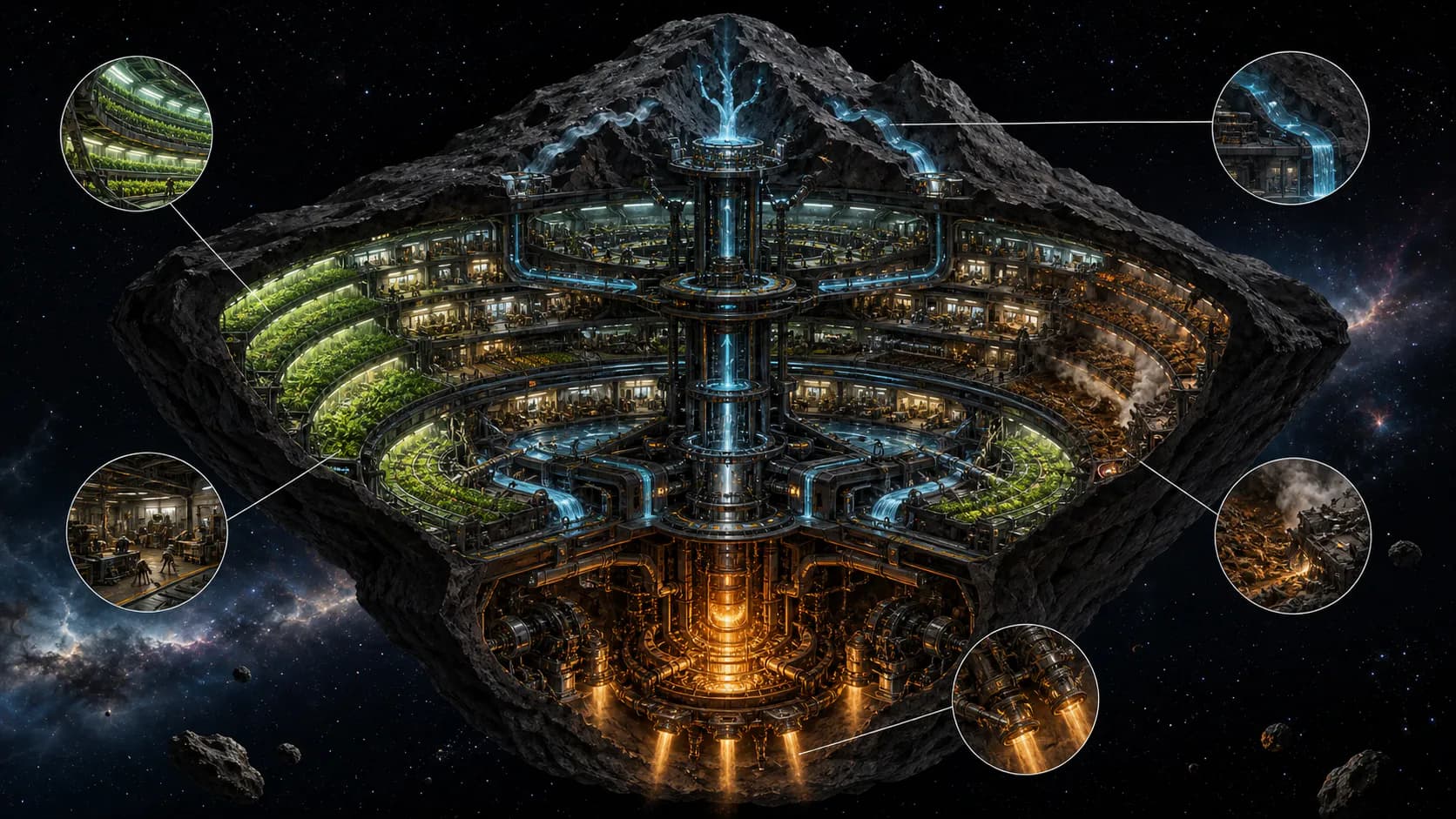
What to notice
- 01
Mountain-sized generation ship
Peerless
A carved and engineered mountain becomes habitat, laboratory, school, farm, and vehicle for a society in flight.
In the image: Carved rock encloses the ship's habitat and structural mass.
- 02
Speculative concept
Closed-loop life support
When weightlessness stunts crops, Peerless reveals that food, gravity, heat, and maintenance form one coupled survival system.
In the image: Terraced farms depend on rotation, water, nutrients, and light.
- 03
Plot trajectory
Weightlessness threatens the food system
Stunted crops force the travelers to redesign the mountain around rotation and artificial gravity.
In the image: A failing crop sector exposes the danger of one broken assumption.
- 04
Speculative concept
Spacecraft propulsion
Turning sunstone and an entire mountain into a launch system makes propulsion an infrastructure project whose failures can strand a civilization.
In the image: Engine and heat flows sit beneath the inhabited mountain.
03 · Ideas and visuals
Three ideas turn geometry into an inheritance
Each concept translates one system into a question the travelers must answer together.
Ideas explained
Ideas to carry into the story
Treat the model as fictional physics with rigorous consequences inside the story.
Idea 1
Riemannian spacetime
The novel gives time the same geometric sign as space. Light and matter therefore follow relations unlike the Lorentzian spacetime of our universe.
In this story: This geometry explains Hurtlers and permits Peerless to follow a long traveler history while little time passes at home.
Which familiar intuition fails first when time is another direction rather than a privileged axis?
Read the plain-language concept articleIdea 2
Generation ships
A voyage lasting multiple lifetimes must transport a renewable habitat, repair capacity, education, governance, and cultural continuity—not only passengers and fuel.
In this story: Peerless has to remain a world capable of producing new knowledge, because its founders cannot live to complete the mission.
What must the ship teach rather than merely store?
Read the plain-language concept articleIdea 3
Intergenerational governance
Long projects distribute decisions across people who cannot all deliberate together: founders choose conditions, while descendants inherit costs and authority.
In this story: The rescue depends on later generations, but treating them as instruments would undermine the society expected to save everyone.
When does an inherited purpose remain a promise, and when does it become coercion?
Read the plain-language concept articleOptional detailWhy this is not ordinary time dilationOpen for a compact comparison between the novel’s geometry and familiar relativistic diagrams.
Model boundary
Orthogonal changes the rules rather than extending our own
In our universe, time enters the spacetime interval with a different sign from spatial directions, producing light cones and familiar relativistic limits. The novel deliberately uses an all-positive geometry. Its diagrams can therefore be reasoned through consistently, but they describe a constructed universe rather than a proposed drive for ours.
04 · Reading guide
Keep the people, systems, and equations in one causal chain
These landmarks connect each equation to the person, system, or decision it changes.
People carrying the idea
Yalda
Physicist, organizer, and first-generation traveler
Her curiosity about light grows into responsibility for a rescue mission designed to outlive her.
Eusebio
Engineer and advocate of the Peerless plan
He converts Yalda's physics into the proposal to gain centuries of research by launching a mountain.
Valeria
Student and witness on the home world
She represents the people whose short wait depends on generations of work beyond their view.
Threat and vessel
The Hurtlers
Planetary threat and clue to alternate spacetime
Their extreme intersecting histories make both the catastrophe and the orthogonal rescue trajectory visible.
Peerless
Mountain-sized generation ship
A carved and engineered mountain becomes habitat, laboratory, school, farm, and vehicle for a society in flight.
People in the story
- Yalda
- Physicist, organizer, teacher, and first-generation traveler · from Chapter 1
- Eusebio
- Engineer who sees a rescue mission inside Yalda’s geometry · from Chapter 10
- Valeria
- Student and witness among the people waiting at home · from Chapter 12
Terms explained
- Hurtler
- A fast luminous body whose differently oriented history threatens inhabited worlds and supplies evidence for the new spacetime model. · from Chapter 2
- Peerless
- The mountain converted into a generation ship, research institution, farm system, and independent polity. · from Chapter 10
- Sunstone
- An energetic material used in the novel’s launch and propulsion engineering. · from Chapter 11
- Orthogonal journey
- Peerless’s fictional trajectory along a differently oriented history, allowing generations aboard while home experiences a short interval. · from Chapter 10
Reader lens · chapter 5
Bodily freedom is part of the scientific infrastructure
Yalda’s ability to study is not separate from reproductive custom, economic independence, or safety. Notice who provides material room for choice and who treats her future as already owned.
Reader lens · chapter 10
Translate every equation into a changed possibility
Ask what was observed, which old assumption failed, what the new model predicts, and what Eusebio can build because of it. The last step is where geometry becomes story.
Reader lens · chapter 16
A generation ship is a coupled system
Crop failure is not a side problem. It links gravity, food reserves, engineering labor, public trust, and the mission schedule. The crisis shows why the vessel must preserve problem-solving institutions rather than a fixed operating manual.
Progress-safe room
Safe through Chapter 10
Progress-safe room
Safe through Chapter 16
05 · Ending explained
Why Yalda’s final achievement is to become unnecessary
The full debrief connects her last choices to the curiosity that opened the novel.
Complete story
The founder yields the future
Yalda helps Peerless survive launch, political conflict, and the loss of gravity. She cannot live through the generations required to solve the Hurtler problem. After yielding command, she chooses reproduction with Nino and undergoes the fatal division their biology imposes. Her children and students continue aboard the world she helped make.
This does not make her death a simple endorsement of the social role she resisted. The difference is agency and context: education and community let her choose the timing, relationship, and meaning of an act that others once claimed the right to demand. The mission’s future belongs to people equipped to question her, not merely memorialize her.
- The opening streak
- A child’s refusal to ignore an anomaly becomes a civilization’s chance to survive.
- The mountain
- A physical vehicle works only by carrying a renewable society inside it.
- The crop crisis
- The first major failure teaches the travelers that inherited designs must remain revisable.
- Yalda’s legacy
- She passes on methods, institutions, and permission to exceed her knowledge.
Keep exploring
Follow the idea beyond this ending
The Idea Atlas connects this novel’s central question to the science, philosophy, and other stories that approach it differently.
Open the connected ideaContinue through the catalog
Find another world on the same axis
What the launch is really carrying
Peerless is a social invention before it is a successful machine
Yalda can discover unusual physics and help move a mountain, but no equation can keep the mission alive for generations without education, consent, maintenance, and the right to correct founders.
These perspectives keep the strange geometry connected to the ordinary lives that make long-term survival possible.
Yalda's curiosity
Why begin with a child noticing light?
The first anomaly matters because Yalda refuses to accept that a difficult observation belongs outside her permitted life. Learning becomes a route away from roles assigned by family and biology, then a resource she can share with an entire society.
Why this matters: Scientific attention is shown as a form of personal and political freedom.
Reproduction and consent
How can a species survive without treating bodies as public equipment?
The travelers need future generations, but their biology places fatal reproductive costs on individuals. Mission necessity intensifies pressure that already existed at home rather than automatically justifying it.
Why this matters: A sustainable society must preserve meaningful choice even when every birth affects collective survival.
Education
What makes Yalda's knowledge durable?
The equations become useful across time only because students learn how to test, criticize, and extend them. Teaching transfers method and permission, not merely correct answers.
Why this matters: The generation ship's most important redundancy is a community able to recreate understanding after any expert is gone.
Founding and yielding
Why must a successful founder give up control?
Yalda's authority is necessary during discovery and launch, but a centuries-long society cannot remain legitimate if every later choice is judged only by her vision. Stepping back allows the mission to become a shared institution.
Why this matters: Her final achievement is not permanent command; it is creating people capable of disagreeing with her and continuing the work.
Coordinates on a neighboring axis
Novel guide
The Arrows of Time
The Arrows of Time
Greg Egan
As the Peerless finally turns for home, Agata and Ramiro must decide whether news from their own future can protect free choice—or quietly abolish it.
Novel guide
The Eternal Flame
The Eternal Flame
Greg Egan
Three generations into the Peerless voyage, Tamara, Carlo, Carla, and Patrizia must solve fuel and population crises without letting survival make anyone's body expendable.
Novel guide
Blindsight
Blindsight
Peter Watts
After alien probes map Earth and vanish, a man who reads people without feeling close to them joins a radically altered crew sent to meet an intelligence that may not need awareness at all.
Content notes
Death associated with reproduction · Coercive gender roles and threatened sexual violence · Workplace death and planetary catastrophe · Confinement and sabotage
Editorial record
Research and sources
The story analysis is original. Background sources support the scientific and philosophical explainers connected to this novel.
Last reviewed July 22, 2026