
Novel guide
The Eternal Flame
Greg Egan

Story and ideas · Orthogonal · Volume 2
The Eternal Flame
by Greg Egan
Night Shade Books hardcover · 2012 · Publisher details · Cover via Open Library
Three generations into the Peerless voyage, Tamara, Carlo, Carla, and Patrizia must solve fuel and population crises without letting survival make anyone's body expendable.
Full-story article
This article discusses the complete story, including the ending.
- Reading time
- About 10 hours
- Length
- 328 pages
- Reading complexity
- Demanding
- Dense terminology, structure, or viewpoint changes reward slower, attentive reading.
- Science intensity
- 5/5
- Scientific mechanisms are central to understanding the story.
Affiliate links. As an Amazon Associate, we earn from qualifying purchases.
Before you read
Is this book for you?
Start by tracking: Keep astronomy, biology, and quantum experiments separate at first, then watch how scarcity and authority force them into one political conflict.
Read this if you enjoy
- Scientific discovery inside a closed generation ship
- Biology and quantum physics with political consequences
- Collective reform rather than one heroic solution
Why readers may get lost
- It is the middle volume of the Orthogonal trilogy
- Several research threads advance at once
- Alien reproduction requires abandoning human assumptions
Keep these anchors in mind
- Tamara
- connects bodily knowledge to public resistance
- Carlo
- tests reproductive biology against inherited rules
- Carla
- makes discrete light experimentally visible
- Peerless
- turns limited resources into social pressure
- The Object
- keeps the external mission urgent
Demanding reading complexity. Dense terminology, structure, or viewpoint changes reward slower, attentive reading.
Science intensity 5/5. Scientific mechanisms are central to understanding the story.
01 · Overview
A finite world asks who must pay for its survival
This original companion follows the third generation aboard Peerless. The scientific mysteries begin inside a social emergency: the ship needs both fewer deaths and a new source of power.
Where this generation begins
Tamara inherits a rescue mission and an impossible body politics
Peerless has supplied generations with air, food, work, and purpose, but its reserves are not infinite. Population pressure has hardened into coercive policy, and the travelers’ reproductive biology makes every proposed solution a question of bodily control and death.
Astronomer Tamara discovers a moving object that might replenish the ship’s dwindling fuel. Biologist Carlo studies whether reproduction must always follow its fatal inherited pattern. Physicist Carla and her students probe the behavior of light. Their investigations appear separate, but all ask the same question: can knowledge create choices where scarcity has made cruelty look inevitable?
The central question
Can a closed society invent its way out of a conflict between survival and autonomy?
The novel treats science as a network of observations, teaching, dangerous tests, and political permission—not a miracle delivered from outside the habitat.
- The reading promise
- Three linked investigations inside a generation ship under ecological and political strain
- What to track
- The Object, reproductive signaling, discrete light, and who controls each decision
- The system
- Population, forest, food, fuel, heat, laboratories, and legitimacy share one finite world
- The human question
- Does an emergency narrow moral choice, or increase the duty to create new options?
The story, in human terms
Three people meet the same limit
- 1
Tamara
An astronomer sees material hope in the dark
She wants her work and her future to belong to her, even as the population crisis makes both politically contested.
What changes: The Object offers possible fuel but demands a route that could endanger the ship.
- 2
Carlo
A biologist asks whether fatal reproduction is immutable
His research matters to people whose survival policies have erased meaningful bodily choice.
What changes: Comparative life may reveal a mechanism rather than an unavoidable destiny.
- 3
Carla
A teacher makes precision cumulative
She builds instruments and students capable of pursuing results no single researcher could finish.
What changes: The nature of light becomes a possible route beyond stored fuel.
Series flight path
Orthogonal
This is the second Orthogonal volume. The Clockwork Rocket explains why Peerless launched; The Eternal Flame asks how its descendants keep the mission and one another alive; The Arrows of Time follows the return and its temporal consequences.
Volume 1
The Clockwork RocketDemanding
Volume 2 · You are here
The Eternal FlameDemanding
Volume 3
The Arrows of TimeDemanding
02 · Story map
Three investigations converge on a larger set of choices
Read the three investigations as parts of one problem: each result changes what the travelers can safely choose next.
The story, in human terms
The inherited emergency
- 1
Capacity
The habitat approaches a population limit
Policies meant to protect the whole ship fall most violently on people with the least control over reproduction.
What changes: A technical ledger becomes a crisis of authority and bodily autonomy.
- 2
The Object
Tamara finds a reachable reserve
Her observation offers hope, but changing course or mounting an interception exposes everyone to new risk.
What changes: Astronomy becomes navigation, and navigation becomes public argument.
- 3
The laboratories
Biology and physics search for options scarcity cannot see
Carlo, Carla, Patrizia, and their communities have to make uncertain research legible to people living with immediate fear.
What changes: The ship’s future depends on preserving inquiry while emergency politics demands certainty.
Expanded context
Clues challenge two apparent inevitabilities
- 1
Alien biology
An arborine signal suggests reproduction can change
Carlo sees a developmental mechanism that might separate the birth of a child from the destruction of a parent.
What changes: The population debate gains a possible third path beyond compulsory death or mass killing.
- 2
Discrete light
Patrizia measures energy in packets
A student’s careful result matters because Carla has built a community where an unexpected measurement can survive criticism.
What changes: Light begins to look like a controllable energy exchange rather than only illumination.
- 3
Political backlash
New options threaten inherited power
People who benefit from old reproductive rules can resist reform even when it would ease the ship’s material crisis.
What changes: Scientific possibility does not automatically become social permission.
Complete trajectory
Experiments become irreversible choices
- 1
Controlled birth
A modified signal lets one child separate
The intervention is dangerous and costly, but it demonstrates that a parent need not be consumed entirely by reproduction.
What changes: Autonomy becomes materially possible rather than a demand with no biological alternative.
- 2
The forest attack
Opponents burn part of the habitat’s living reserve
Political violence converts resistance to reform into immediate danger for every person who depends on the forest.
What changes: Ecology and justice are revealed as the same survival problem.
- 3
The engine cycle
Quantum light becomes the Eternal Flame
Carla’s synthesis joins years of instruments, teaching, and student work into a renewable source of propulsion.
What changes: The mission no longer has to consume a fixed chemical reserve to continue.
Illustrated explanation
A changed signal turns fate into a choice
The upper pathway shows the inherited fatal four-way division. Below, an arborine clue helps target one body region so one child separates and the parent remains alive, though injured.
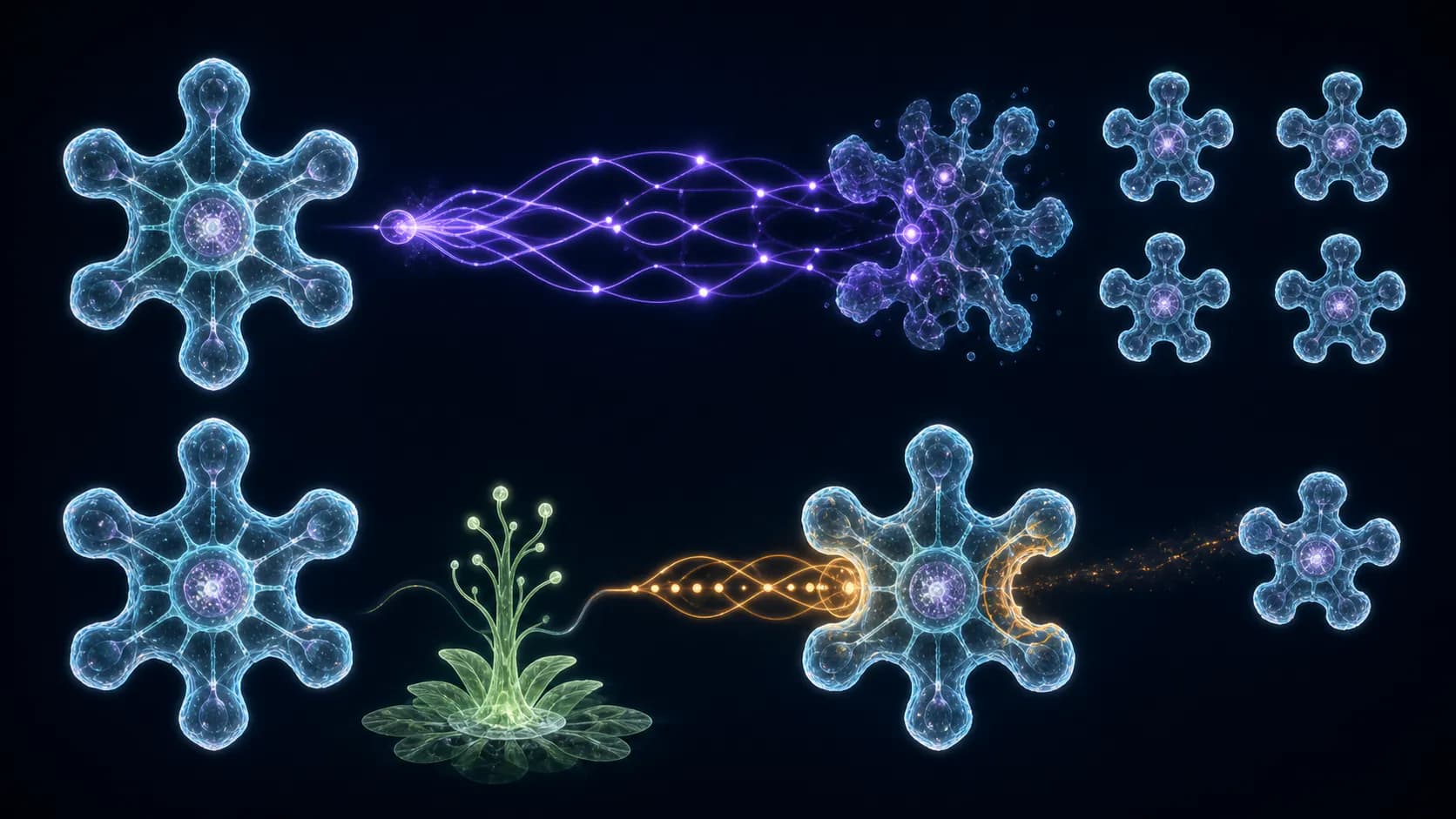
What to notice
- 01
Biologist studying reproductive signals
Carlo
He searches alien life for a developmental signal that could separate birth from the parent's death.
In the image: Comparative biology supplies the clue for a modified signal.
- 02
Primary concept
Reproductive autonomy
A biology in which reproduction kills the mother turns population policy into a direct test of whether survival can coexist with bodily self-determination.
In the image: A controllable mechanism makes meaningful bodily choice possible.
- 03
Plot trajectory
A modified signal preserves the parent
A dangerous biological intervention demonstrates that reproduction can produce one child without requiring the parent body's complete division.
In the image: One offspring separates while the parent structure remains.
- 04
Speculative concept
Survival ethics
The novel rejects a choice between extinction and cruelty by asking scientific work to expand the set of morally available futures.
In the image: The natural pathway had made population and parental death appear inseparable.
Illustrated explanation
How quantized light closes the fictional engine cycle
Discrete light enters an optical interaction, changes frequency and energy, produces directed output, and returns part of that process to a repeatable loop rather than exhausting a chemical tank.
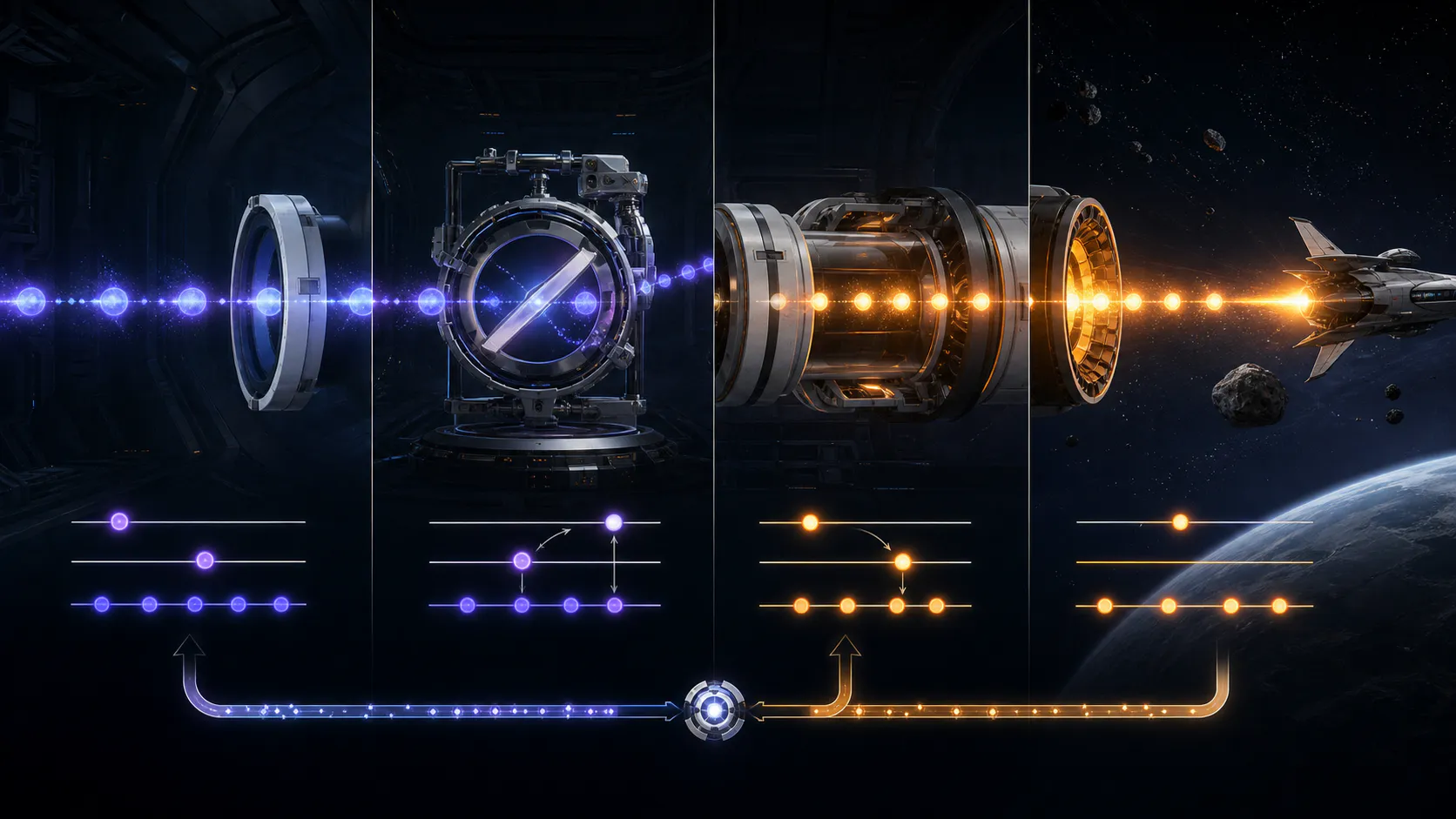
What to notice
- 01
Student physicist
Patrizia
Her work on the discrete relationship between light and energy gives the later engine insight its missing scale.
In the image: Discrete packet spacing represents the quantized relation Patrizia establishes.
- 02
Physicist and teacher
Carla
She builds a culture of measurement whose quantum results eventually point toward renewable propulsion.
In the image: Carla combines the measurements into a complete energy cycle.
- 03
Self-sustaining fictional light engine
The Eternal Flame
A cycle of quantized light and energy conversion removes the mission's dependence on a dwindling finite fuel reserve.
In the image: The apparatus converts the fictional light behavior into sustained output.
- 04
Speculative concept
Spacecraft propulsion
The fuel crisis turns quantum insight into a practical question: whether light can sustain a drive without consuming the ship's future.
In the image: A test craft demonstrates thrust without a diminishing chemical fuel store.
- 05
Plot trajectory
Carla closes the Eternal Flame cycle
Quantum light, frequency change, and controlled energy exchange become a propulsion loop capable of sustaining the mission.
In the image: The feedback path is the synthesis that saves the long mission.
03 · Ideas and visuals
A closed system can survive by increasing choice
The central systems are ecological, institutional, and bodily at once.
Ideas explained
Ideas to carry into the story
Use each idea to connect a scientific result to the person whose options it changes.
Idea 1
Reproductive autonomy
Bodily autonomy requires more than formal permission: a person needs knowledge, safety, resources, and real alternatives to coercion.
In this story: Because reproduction naturally destroys the parent in this world, changing its mechanism changes who can participate in society and on what terms.
When biology constrains a choice, what must a community provide before consent is meaningful?
Read the plain-language concept articleIdea 2
Closed-loop life support
A closed habitat continually cycles air, water, nutrients, heat, and materials while finite losses and accumulating waste remain dangerous.
In this story: Population, farms, forest, fuel, and experiments cannot be optimized independently aboard Peerless.
Which proposed solution moves its cost into another part of the loop?
Read the plain-language concept articleIdea 3
Science as infrastructure
Reliable discovery depends on trained people, instruments, records, criticism, institutions, and enough freedom to pursue uncertain results.
In this story: The engine and biological reform emerge from linked careers and students rather than a solitary flash of genius.
Which relationship lets a fragile observation become durable knowledge?
Read the plain-language concept articleOptional detailWhy the engine is called eternalOpen for the fictional energy logic without treating it as real-world propulsion advice.
Model boundary
A repeatable cycle, not energy from nothing
Within Orthogonal’s invented physics, light exchanges energy in discrete quantities and can change frequency through controlled interactions. The engine closes a cycle that replaces a dwindling consumable propellant with repeatable conversion and durable machinery. “Eternal” names relief from the mission’s fuel bottleneck, not a violation of bookkeeping inside the story.
04 · Reading guide
Keep the three investigations connected
These landmarks bring the people, terms, and discoveries back into the same causal chain.
Researchers and advocates
Tamara
Astronomer and advocate for bodily reform
Her study of the Object and her personal choices join the ship's material and reproductive crises.
Carlo
Biologist studying reproductive signals
He searches alien life for a developmental signal that could separate birth from the parent's death.
Carla
Physicist and teacher
She builds a culture of measurement whose quantum results eventually point toward renewable propulsion.
Patrizia
Student physicist
Her work on the discrete relationship between light and energy gives the later engine insight its missing scale.
World and result
Peerless
Inherited world and research vessel
Three generations after launch, its finite forests, fuel, farms, and institutions must support both survival and discovery.
The Eternal Flame
Self-sustaining fictional light engine
A cycle of quantized light and energy conversion removes the mission's dependence on a dwindling finite fuel reserve.
People in the story
- Tamara
- Astronomer whose work and personal future meet the population crisis · from Chapter 1
- Carlo
- Biologist investigating reproductive development · from Chapter 3
- Carla
- Physicist and teacher building a program of precision experiments · from Chapter 2
- Patrizia
- Student physicist whose light measurements become essential · from Chapter 12
Terms explained
- The Object
- A moving astronomical body that may offer material resources if Peerless can safely reach it. · from Chapter 6
- Arborine
- An alien form of life whose development offers a comparative clue to reproductive signaling. · from Chapter 10
- Quantized light
- Light whose energy exchanges occur in discrete amounts within the novel’s fictional physics. · from Chapter 20
- Eternal Flame
- The propulsion cycle that uses controlled light-energy exchanges instead of a diminishing stored fuel supply. · from Chapter 44
Reader lens · chapter 10
A mechanism can expose a false moral binary
Carlo’s clue does not settle the politics, but it changes what can honestly be called inevitable. Track how people respond when science threatens an argument built on the absence of alternatives.
Reader lens · chapter 20
The student’s measurement belongs to an institution
Patrizia’s result is hers, yet it also depends on Carla’s teaching, shared instruments, repeatable procedures, and a community willing to inspect a surprise. This is what science as infrastructure looks like at the scale of a ship.
Reader lens · chapter 38
Technical success is not the same as justice
A biological alternative expands what people can choose. It does not erase risk, heal political violence, or guarantee equal access. Ask which institutions must change so that the option remains genuinely voluntary.
Progress-safe room
Safe through Chapter 20
Progress-safe room
Safe through Chapter 38
05 · Ending explained
Why two new cycles change what survival can mean
The ending joins reproductive reform and propulsion as parallel escapes from inherited scarcity.
Complete story
The mission survives by refusing its false binaries
Carlo’s research helps produce a modified reproductive signal: one child can separate while the parent survives, injured but intact. The result does not undo the danger or the conflict around it, and opponents attack the forest that supports the entire habitat. Yet the experiment proves that population survival need not require the old total division of every parent.
In physics, Patrizia’s quantized measurements and Carla’s synthesis produce the Eternal Flame, a repeatable propulsion cycle no longer dependent on Peerless’s shrinking fuel reserve. Both advances emerge from communities that preserved experimentation long enough for earlier clues to combine.
- The population crisis
- A real material limit does not grant institutions unlimited moral authority.
- The biological clue
- Comparative life turns a presumed destiny into a mechanism that can be changed.
- The forest
- Political violence against reform also attacks the ecology on which every faction depends.
- The flame
- Cumulative teaching and measurement remove the mission’s finite-fuel bottleneck.
Keep exploring
Follow the idea beyond this ending
The Idea Atlas connects this novel’s central question to the science, philosophy, and other stories that approach it differently.
Open the connected ideaContinue through the catalog
Find another world on the same axis
Life inside the closed world
The two breakthroughs are also arguments about who gets a future
Reproduction and propulsion appear to be separate research programs. Both challenge a scarcity regime that asks the present generation to accept inherited limits as permanent destiny.
These lenses connect the scientific investigations to the political pressure running through Peerless.
Carlo's research
Why does biological comparison become political?
Studying another reproductive pattern reveals that the travelers' fatal division is a mechanism with alternatives, not an unquestionable law of social duty. That possibility threatens institutions built around managing the old constraint.
Why this matters: Scientific evidence widens bodily choice and redistributes authority over survival.
The forest
Why is the habitat more than background?
The forest stores food, air, ecological relationships, and experimental possibility. Attacking it to stop reform damages the common system every faction needs.
Why this matters: Political violence is exposed as self-destructive when it treats shared life support as a weapon.
Cumulative knowledge
Who discovers the Eternal Flame?
Patrizia's measurements, Carla's synthesis, teachers, instruments, earlier failures, and maintained records all contribute. The result belongs to a chain of inquiry rather than one isolated genius.
Why this matters: The engine demonstrates science as an institution capable of carrying unfinished work across generations.
Freedom under constraint
Can choice be meaningful inside a finite habitat?
Peerless cannot remove every material limit, but it can decide whether scarcity is answered by coercion or by creating new options. The breakthroughs do not abolish dependence; they change what people can consent to.
Why this matters: The novel defines progress as enlarging accountable choice inside reality, not pretending limits have disappeared.
Coordinates on a neighboring axis
Novel guide
Project Hail Mary
Project Hail Mary
Andy Weir
A scientist wakes alone on a starship with two dead crewmates, no memory, and one impossible assignment: learn why a distant star is surviving the same disaster killing the Sun.
Novel guide
The Arrows of Time
The Arrows of Time
Greg Egan
As the Peerless finally turns for home, Agata and Ramiro must decide whether news from their own future can protect free choice—or quietly abolish it.
Novel guide
The Clockwork Rocket
The Clockwork Rocket
Greg Egan
When lethal meteors cross her world's history, physicist Yalda must turn a mountain into a rocket—and entrust salvation to generations she will never meet.
Content notes
Infant euthanasia under population pressure · Reproductive coercion and bodily injury · Kidnapping and political violence · Fire and fatal scientific experimentation
Editorial record
Research and sources
The story analysis is original. Background sources support the scientific and philosophical explainers connected to this novel.
Last reviewed July 22, 2026