
Novel guide
The Dispossessed
Ursula K. Le Guin

Story and ideas · Standalone
The Dispossessed
by Ursula K. Le Guin
Harper Perennial 50th Anniversary paperback · 2024 · foreword by Karen Joy Fowler · Publisher details · Cover via Open Library
A physicist leaves an austere anarchist moon for its wealthy rival world, hoping to free a theory that both societies have learned to contain.
Full-story article
This article discusses the complete story, including the ending.
- Reading time
- About 10 hours
- Length
- 384 pages
- Reading complexity
- Demanding
- Dense terminology, structure, or viewpoint changes reward slower, attentive reading.
- Science intensity
- 3/5
- Scientific ideas recur and influence major choices.
Affiliate links. As an Amazon Associate, we earn from qualifying purchases.
Before you read
Is this book for you?
Start by tracking: Track who controls rooms, labor, publication, travel, and the practical ability to say no, even when nobody formally owns them.
Read this if you enjoy
- Political philosophy tested through ordinary life
- A nonlinear character study about work and belonging
- Science treated as a social institution
Why readers may get lost
- Alternating chapters move between two worlds and periods
- Formal ideals and informal power rarely align cleanly
- The novel withholds simple political winners
Keep these anchors in mind
- Shevek
- seeks a physics and politics that can remain open
- Takver
- grounds theory in care, work, and shared life
- Anarres
- rejects property while developing informal barriers
- Urras
- offers abundance through hierarchy and exclusion
- The ansible theory
- tests whether knowledge can escape ownership
Demanding reading complexity. Dense terminology, structure, or viewpoint changes reward slower, attentive reading.
Science intensity 3/5. Scientific ideas recur and influence major choices.
01 · Overview
A wall can surround an idea without enclosing it
This is a reading companion, not the novel. It starts with Shevek's practical problem: the science he needs cannot move freely through the society that taught him freedom, so he must decide what crossing to the other world will cost.
Where the journey begins
Shevek leaves home because his work has nowhere left to go
Shevek is a physicist from Anarres, an arid moon settled by revolutionaries who rejected government, money, private property, and permanent authority. Its people coordinate survival through syndicates, shared storehouses, rotating labor, and mutual obligation. The arrangement is not scenery. It shapes the language Shevek speaks, the rooms he inhabits, the work he owes others, and his suspicion that claiming anything—including another person—as property diminishes both parties.
Yet his developing theory needs conversations and scientific traditions that Anarres has allowed to narrow. The richer world Urras has universities, equipment, colleagues, and generations of work he cannot reach at home. It also has owners, servants, prisons, armies, borders, and governments eager to possess the result. Shevek crosses the wall around Anarres's port hoping that exchange between the worlds can be mutual. He arrives celebrated, protected, and unable to tell whether he is a guest or an investment.
The central question
Can knowledge be given freely when every institution carrying it assigns ownership, credit, access, or debt?
The novel does not offer one society as a finished answer. It watches ideals become habits, habits become power, and renewal begin when people risk reopening a boundary.
The story, in human terms
The opening movement—and the history folded inside it
Odd-numbered chapters mostly follow the visit to Urras. Even-numbered chapters return to Shevek's earlier life on Anarres. Chapters 1 and 13 bridge both worlds, making the structure itself a journey out and back.
- 1
The wall
Shevek leaves amid fear and anger
He is separating from Takver, their children, his work community, and the only social language that has ever felt like home.
What changes: Boarding the freighter makes a disputed idea—communication with Urras—into an irreversible public act.
- 2
The welcome
Urras treats a dissident as an honored scientist
Shevek wants colleagues, unbroken time, and evidence that people divided by institutions can still work together.
What changes: Material abundance makes his isolation comfortable while university hosts decide which people and parts of the country enter his view.
- 3
The return chapters
Anarres explains why he had to go
Childhood, friendship, partnership, blocked work, scarcity, and collective labor reveal that departure was made from attachments rather than contempt.
What changes: Each remembered constraint changes how the apparent freedom of Urras should be judged—and how much of Anarres remains worth defending.
Illustrated explanation
Two worlds share one narrow door
Anarres and Urras are physically close and economically connected, yet the wall and freighter route make movement exceptional. Different systems govern the goods, labor, people, and ideas crossing between them.
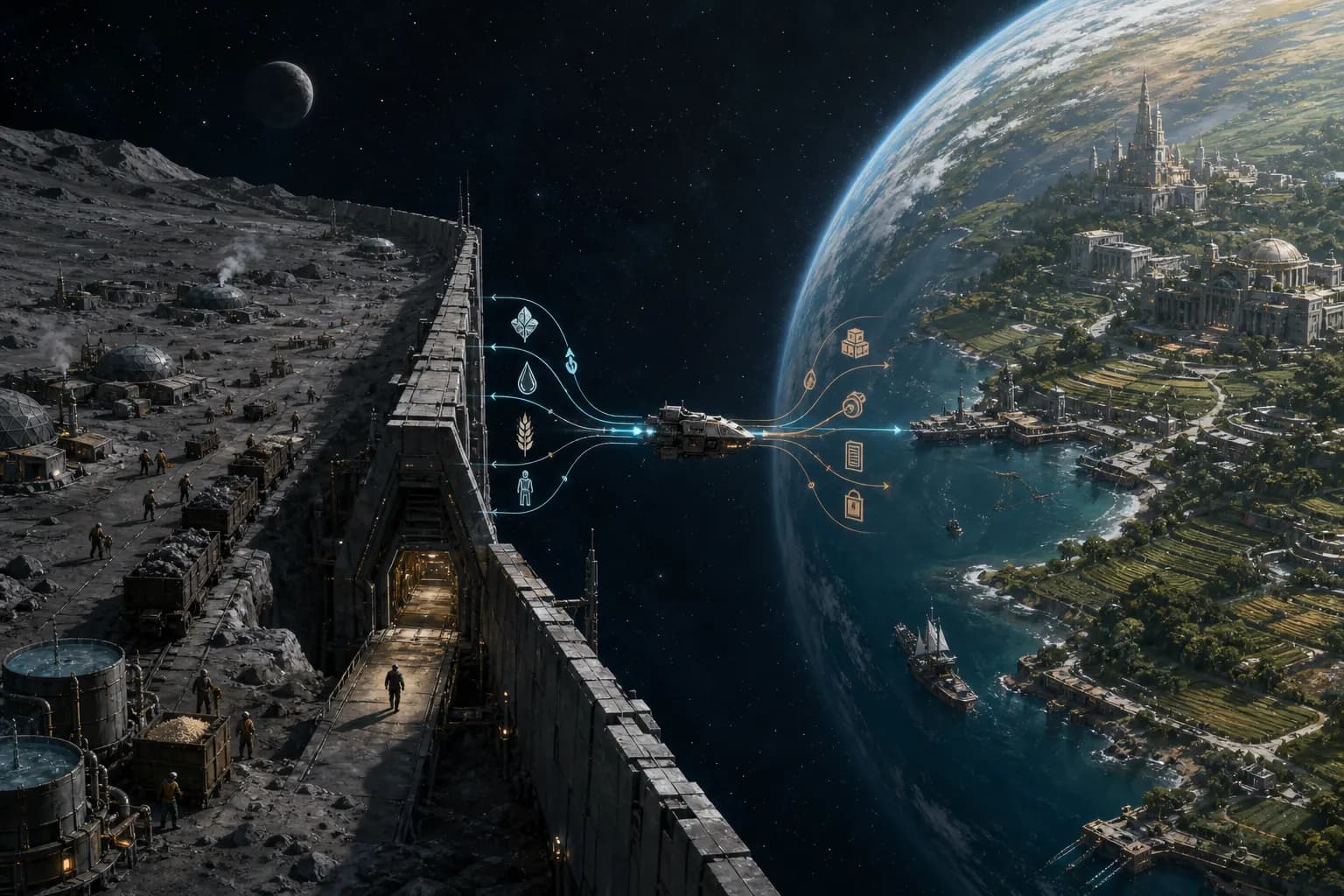
What to notice
- 01
The austere anarchist moon
Anarres
Anarres organizes survival through syndicates, voluntary labor, shared goods, and mutual obligation under severe ecological limits.
In the image: The arid moon relies on coordinated work, shared distribution, and limited exchange with Urras.
- 02
Plot trajectory
Shevek leaves Anarres for Urras
A hostile crowd gathers at the port as Shevek crosses the wall around the spacefield and boards an Urrasti freighter alone.
In the image: Shevek's departure turns a supply route into a political crossing.
- 03
The abundant propertarian world
Urras
Urras offers Shevek beauty, resources, and scientific prestige while keeping class, gender, national rivalry, and political violence outside his protected university view.
In the image: The abundant world offers resources and scientific institutions shaped by property and national power.
- 04
Primary concept
Commons and property regimes
The paired worlds show that abolishing legal ownership changes everyday life without automatically abolishing exclusion, status, gatekeeping, or the labor required to maintain shared systems.
In the image: The route reveals that access, exclusion, exchange, and maintenance are separate choices in both systems.
- The reading promise
- A political thought experiment carried by one scientist's work, partnership, loneliness, and return
- What to track
- Who controls rooms, labor, publication, travel, information, and the right to say no
- The paired structure
- Present-tense Urras chapters alternate with the Anarresti past that made the journey necessary
- The productive tension
- An institution may oppose ownership in principle while reproducing exclusion through custom and reputation
02 · Story map
Two timelines test each other's definitions of freedom
The novel is easier to follow when each return to Anarres is treated as an answer to a question raised on Urras, not as a detour from the main plot.
- Chapter 1 · Both worlds
Shevek crosses the port wall, boards the Mindful, and reaches an Urras he knows largely through censored books and inherited argument.
- Chapters 2, 4, 6 · Formation
Childhood, physics, Bedap's criticism, Sabul's gatekeeping, and partnership with Takver reveal how an anarchist society becomes daily practice.
- Chapters 3, 5, 7 · The curated visit
University prestige and abundance widen Shevek's work while class, gender, labor, and political opposition remain beyond his managed itinerary.
- Chapters 8 and 10 · Crisis and initiative
Drought tests solidarity, and later an independent syndicate tries to make communication across the wall a collective project.
- Chapters 9 and 11 · Urras exposed
Shevek leaves elite protection, encounters resistance and state violence, and must decide who should receive the work Urras expected to keep.
- Chapters 12 and 13 · Departure reconsidered
The final Anarresti past clarifies the choice to go; the return asks whether home can admit an outsider and remain open to change.
Mid-book context
The same four needs take different institutional forms
- 1
Work
Sabul can restrict science without owning it
Shevek needs Urrasti papers and readers but has no independent channel through which to obtain either.
What changes: Informal professional authority begins to look like a property right over access, credit, and publication.
- 2
A room
Takver and Shevek make privacy through commitment
They want a durable shared life without treating intimacy as possession or withdrawing from communal obligations.
What changes: The partnership shows that boundaries can protect relationship and concentration without turning people into property.
- 3
Food
Drought makes every abstraction material
The family endures separation because labor and supplies must be redirected toward survival across the moon.
What changes: Mutual aid proves real and costly, while the institutions coordinating sacrifice become harder to question from inside the emergency.
Illustrated explanation
A free idea still needs institutional passage
Sabul controls the sanctioned route to Urrasti physics; Urrasti patrons later control Shevek's facilities and audience. The gates differ, but both convert scientific infrastructure into leverage over circulation.
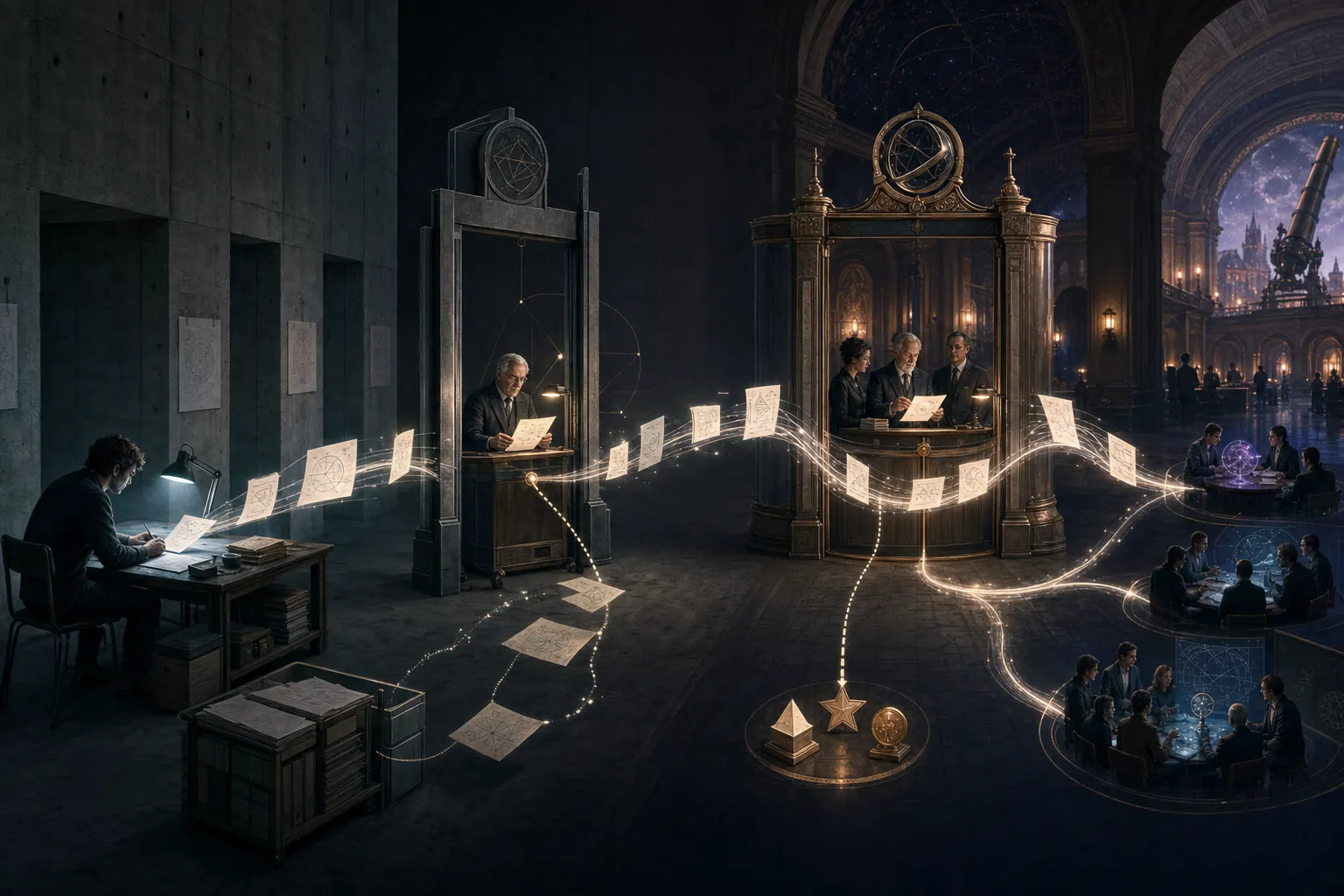
What to notice
- 01
Physicist, partner, and border-crosser
Shevek
Shevek wants to finish and share his General Temporal Theory, but discovers that crossing a wall does not mean leaving institutions of possession behind.
In the image: The theory begins as one person's difficult work but cannot mature in isolation.
- 02
Senior physicist and gatekeeper
Sabul
Sabul mediates access to Urrasti physics and uses control of publication to keep Shevek's growing work inside an unequal professional bargain.
In the image: Control of translation and publication lets Sabul shape credit and access.
- 03
Primary concept
Science as infrastructure
Shevek's theory depends on teachers, correspondence, publishing, time, equipment, and trust, making intellectual freedom a property of institutions rather than solitary genius alone.
In the image: Correspondence, journals, institutions, equipment, and trust are part of the scientific mechanism.
- 04
Speculative concept
Information asymmetry
Physicists, coordinators, governments, and diplomats gain leverage by deciding which papers, institutions, motives, and audiences Shevek is allowed to see.
In the image: Hosts can widen Shevek's resources while narrowing what he knows about their interests and society.
Complete trajectory
Shevek stops asking which world deserves the theory
- 1
The street
He leaves the university's protected version of Urras
Workers and dissidents show Shevek a political struggle his hosts treated as either invisible or primitive.
What changes: The state's violent attack destroys the idea that elite hospitality can stand in for freedom across the society.
- 2
The broadcast
He gives the work beyond one government's reach
Shevek needs refuge and a way to keep the theory from becoming the exclusive advantage of the power that funded him.
What changes: Simultaneous distribution refuses a single owner without pretending that future uses will automatically be just.
- 3
The return
He approaches the same wall with Ketho
Home is still dangerous, but returning alone would repeat the one-way isolation the journey was meant to break.
What changes: An outsider's arrival turns communication from Shevek's personal exception into a test Anarres must collectively face.
03 · Ideas and visuals
Ownership is not one switch
The book becomes sharper when property is unpacked into access, use, exclusion, transfer, maintenance, credit, and voice. Both worlds distribute those powers; neither makes them disappear.
Ideas explained
Ideas to carry into the story
Use these three lenses to connect the political systems to ordinary choices.
Idea 1
Commons and property regimes
A property regime is the rule system deciding who may use, change, share, exclude, transfer, and maintain a resource—not merely the name on a title.
In this story: Urras formalizes ownership through law and class; Anarres rejects it while still allocating rooms, labor, goods, publication, and social permission.
Where does a practical power to exclude survive after the legal right is abolished?
Read the plain-language concept articleIdea 2
Science as infrastructure
A theory needs time, teachers, records, criticism, equipment, publication, translation, and communities capable of carrying it forward.
In this story: Shevek's intellectual isolation is produced by damaged channels between scientific communities, not by a shortage of solitary talent.
Which parts of scientific freedom belong to the thinker, and which must be maintained by institutions?
Read the plain-language concept articleIdea 3
Intergenerational governance
Founding principles remain alive only when later generations can reinterpret institutions without being treated as traitors to the founders.
In this story: Odo's revolution gives Anarres its freedom, but inherited Odonian language can also make criticism sound morally illegitimate.
How can a society preserve a revolution's purpose without preserving every habit formed in its name?
Read the plain-language concept articleThe transferable mechanism
Trace the bundle of rights, then trace the labor
Ask separate questions about each important resource. Who can enter the room? Who can use the printing channel? Who may change a labor assignment? Who receives credit? Who repairs the pipes? Who can appeal when an allocation fails? Answers that differ reveal a regime more clearly than the words owned, public, or common.
This also prevents an easy mistake about abundance. Information can be copied without leaving less for the next reader, but a living knowledge commons still consumes attention, translation, archiving, equipment, care, and trust. Making Shevek's equations widely available changes exclusion; it does not finish the work of stewardship or just application.
Illustrated explanation
The theory leaves the state that expected to own it
Shevek cannot guarantee how the work will be used. He can prevent one government from making exclusive control the starting condition by sending the same knowledge outward at once.
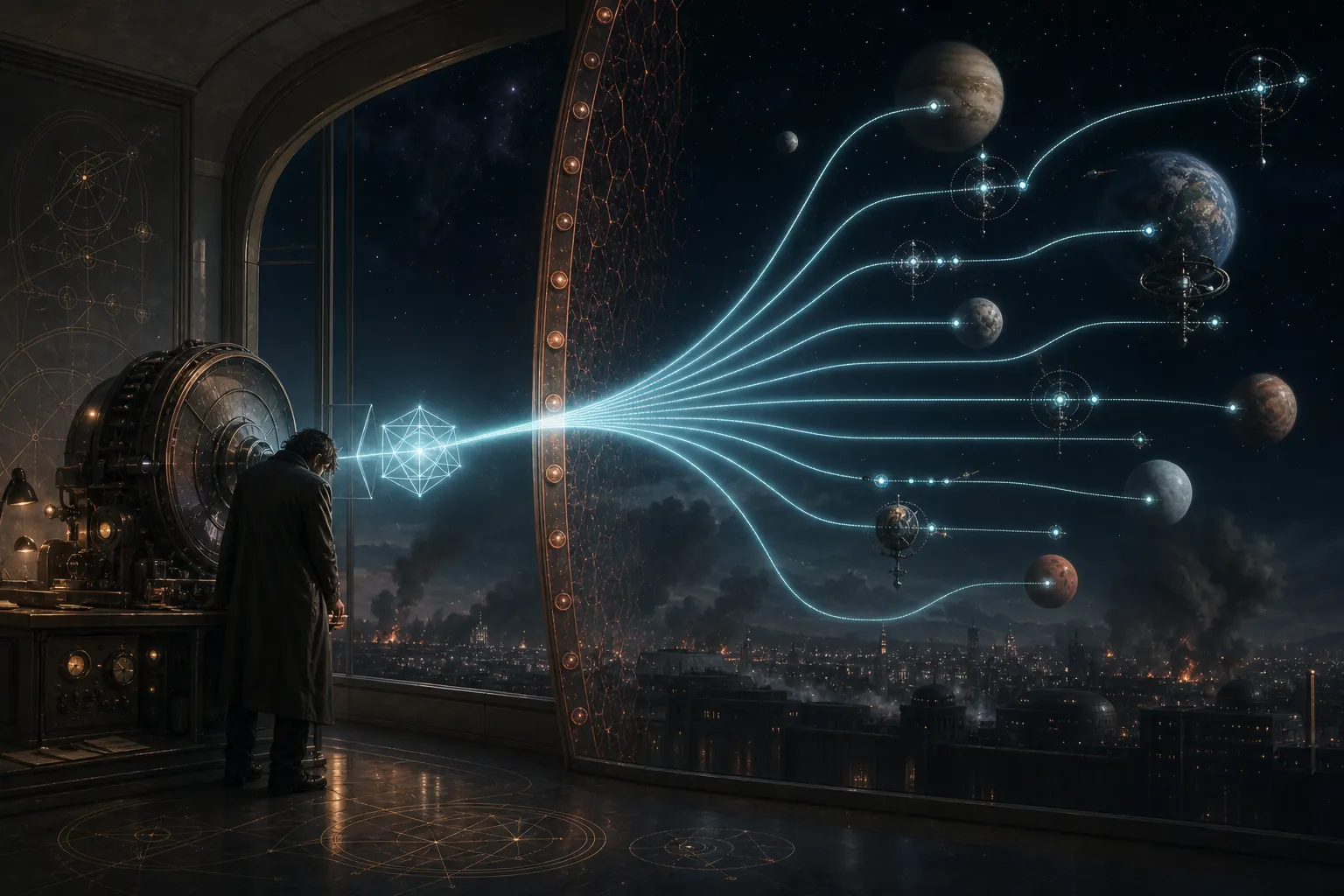
What to notice
- 01
Physicist, partner, and border-crosser
Shevek
Shevek wants to finish and share his General Temporal Theory, but discovers that crossing a wall does not mean leaving institutions of possession behind.
In the image: Shevek chooses distribution over the protected prestige offered by his hosts.
- 02
Plot trajectory
Shevek transmits the theory beyond Urras
From the Terran embassy, Shevek gives his completed work to every world that can receive it rather than allowing one state to monopolize its use.
In the image: The broadcast converts an intellectual result into a political act.
- 03
Primary concept
Commons and property regimes
The paired worlds show that abolishing legal ownership changes everyday life without automatically abolishing exclusion, status, gatekeeping, or the labor required to maintain shared systems.
In the image: Wide access removes one exclusion right, though stewardship and application remain unresolved.
- 04
Primary concept
Science as infrastructure
Shevek's theory depends on teachers, correspondence, publishing, time, equipment, and trust, making intellectual freedom a property of institutions rather than solitary genius alone.
In the image: Embassies, transmitters, receivers, translators, and future researchers carry the work beyond its author.
Optional detailThree supporting pressuresScarcity, unequal information, and ideology explain why formal rules never tell the whole story.
Ideas explained
Ideas to carry into the story
Idea 1
Critical resource dependence
A system becomes vulnerable when essential goods or services have few substitutes and narrow routes of supply.
In this story: Anarres's ecology and trade relationship with Urras make food, minerals, transport, and coordinated labor political facts.
Which Anarresti constraints come from the moon, and which come from choices about how to organize life there?
Read the plain-language concept articleIdea 2
Information asymmetry
Power grows when one party knows more about the options, stakes, or audience than another can independently verify.
In this story: Sabul, the Urrasti university, and state institutions each curate what Shevek can see while asking him to trust their account of exchange.
When does guidance become control over the map of possible choices?
Read the plain-language concept articleIdea 3
Ideological capture
A worldview becomes captured when evidence is admitted mainly for its usefulness to conclusions the institution already protects.
In this story: Each world uses the other's failures as reassurance that its own system requires no deeper correction.
Which facts are treated as criticism, and which are converted into proof of loyalty?
Read the plain-language concept article04 · Reading guide
Use the alternating chapters as a conversation
Chapter numbers are stable across the novel's core. The selected edition's foreword and page boundaries are not treated as story landmarks.
People and inherited voices
Shevek
Physicist, partner, and border-crosser
Shevek wants to finish and share his General Temporal Theory, but discovers that crossing a wall does not mean leaving institutions of possession behind.
Takver
Biologist and Shevek's partner
Takver connects intellectual freedom to care, shared work, family, and the ecological limits within which Anarresti ideals must be lived.
Bedap
Friend and institutional critic
Bedap gives Shevek language for the informal conformity and administrative caution that can harden without laws or police.
Sabul
Senior physicist and gatekeeper
Sabul mediates access to Urrasti physics and uses control of publication to keep Shevek's growing work inside an unequal professional bargain.
Worlds and collective action
Anarres
The austere anarchist moon
Anarres organizes survival through syndicates, voluntary labor, shared goods, and mutual obligation under severe ecological limits.
Urras
The abundant propertarian world
Urras offers Shevek beauty, resources, and scientific prestige while keeping class, gender, national rivalry, and political violence outside his protected university view.
Syndicate of Initiative
Network for unpropertied communication
The syndicate treats contact as collective work and creates a route across the wall that official Anarresti channels have been unwilling to open.
Reader lens · Chapters 1–2
List the walls before deciding which are physical
The port barrier is obvious. Also note linguistic taboos, work expectations, restricted records, childhood shame, and the protective walls around Shevek on Urras. Ask what each boundary protects and whom it prevents from acting.
Reader lens · Chapters 3–4
Compare prestige with access
Urras gives Shevek status and material support. Sabul gives him rare scientific papers. Track the price attached to each gift: credit, gratitude, isolation, silence, or control over where the resulting work can travel.
Reader lens · Chapters 5–6
Distinguish privacy, possession, and care
The book contrasts a socially isolated guest, commodified intimacy, and a partnership made without marriage law or ownership. Notice when a boundary enables mutual attention and when it protects unequal power.
Reader lens · Chapters 7–8
Put material abundance beside political voice
Urras can supply beauty and leisure while excluding most people from their benefits. Anarres distributes scarcity more equally while asking extraordinary sacrifice. Do not let either fact erase the other.
Reader lens · Chapters 9–10
Watch communication become collective labor
Individual insight does not open the wall by itself. Track the workers, dissidents, printers, messengers, syndicate members, and hosts who turn a private conviction into a channel that other people can use.
Reader lens · Chapters 11–13
Ask what the ending opens rather than what it solves
The theory circulates and a visitor approaches Anarres, but neither society is repaired. The ending's achievement is a reversible boundary: people and ideas may cross, return, answer, and change the next decision.
Progress-safe room
Safe through Chapter 6
Progress-safe room
Safe through Chapter 13
05 · Ending explained
Why returning is more radical than choosing the better world
Complete plot facts appear below. The ending does not crown a winning system; it changes who may participate in revising one.
The ending mechanism
Shevek makes two things unownable: the theory and the journey
After the Urrasti demonstration is attacked, Shevek cannot return to the protected university and cannot trust A-Io's government with a theory that may transform communication across worlds. The Terran embassy offers refuge. From there he transmits the work broadly, refusing to let the institution that financed his visit convert hospitality into exclusive possession.
That choice is not presented as innocence. Knowledge made available to everyone can still be weaponized, neglected, commercialized, or governed badly. Shevek controls only the initial distribution. His act matters because it changes who may answer and prevents one state from setting monopoly as the first condition of use.
He then returns to Anarres rather than escaping permanently into a richer society or accepting exile as proof of purity. Ketho, a Hainish visitor, travels with him. The same port that once exported Shevek as a dangerous exception must now decide whether it can receive an outsider. Communication becomes reciprocal and therefore harder for either world to narrate entirely on its own terms.
- The demonstration
- Shevek's protected encounter with Urras ends when state violence makes the cost of its property order impossible to keep offstage.
- The embassy
- A third political space gives him enough safety and communication infrastructure to refuse A-Io's claim on his work.
- The broadcast
- The theory is distributed beyond one owner, but responsibility for maintenance and use remains a future institutional problem.
- Ketho's arrival
- The return is not restoration of the old isolation; an outsider makes openness a shared risk Anarres must now negotiate.
Keep exploring
Follow the idea beyond this ending
The Idea Atlas connects this novel’s central question to the science, philosophy, and other stories that approach it differently.
Open the connected ideaContinue through the catalog
Find another world on the same axis
Questions the return leaves open
The novel compares living systems, not political slogans
Anarres and Urras are easiest to discuss as opposites. The alternating structure keeps showing that freedom depends on daily access, relationships, labor, and the practical ability to challenge whatever a society has made normal.
These lenses help hold affection and criticism together instead of asking which world wins.
Form and time
Why does the novel alternate past and present?
Every Urrasti experience raises a question that an Anarresti memory complicates. The structure delays a simple verdict and makes departure and return parts of one movement rather than opposite decisions.
Why this matters: Readers judge institutions through accumulated relationships and consequences, not a tour of political features.
Shevek and Takver
How can commitment avoid becoming possession?
Their partnership creates continuity, privacy, shared work, and care without relying on ownership as its moral language. It also demands sacrifice and can be strained by distance, labor, and ambition.
Why this matters: The relationship shows freedom as a durable practice between people, not the absence of every claim.
Invisible authority
How does power survive where formal rulers do not?
Sabul controls access to scientific conversation through reputation, archives, and professional permission. Labor administration and public opinion can similarly make refusal costly without issuing a legal command.
Why this matters: The novel asks readers to trace who can block action in practice, even when nobody owns the official right to do so.
Giving the theory
Does open access make knowledge free?
Shevek prevents one state from monopolizing the ansible theory by broadcasting it widely. Future communities must still interpret, maintain, govern, and possibly misuse what they receive.
Why this matters: Sharing removes one barrier to freedom while leaving collective responsibility as unfinished work.
Coordinates on a neighboring axis
Novel guide
Ancillary Justice
Ancillary Justice
Ann Leckie
A starship intelligence reduced to one vulnerable human body crosses an icy planet with a single purpose: reach the ruler who destroyed the rest of her.
Novel guide
Dawn
Dawn
Octavia E. Butler
Lilith wakes alone on a living alien ship and learns that her rescuers will return humanity to Earth only by changing what future humans can be.
Novel guide
Dune
Dune
Frank Herbert
Paul Atreides arrives on a desert world knowing his family has entered a trap—and discovers that surviving it may turn him into the future he fears.
Content notes
State violence, protest suppression, and mass death · Famine, scarcity, and dangerous labor · Attempted sexual assault · Family separation and social isolation · Illness, injury, and death · Political coercion and labor exploitation
Editorial record
Research and sources
The story analysis is original. Background sources support the scientific and philosophical explainers connected to this novel.
Last reviewed July 22, 2026